
Working Capital Loans with Variable Interest for Businesses
Payroll can come due before customer invoices are paid. A working capital loan can help cover operating expenses during that gap, giving a business funds for needs such as payroll, supplies, or labor while it waits for revenue. These loans may suit expenses expected to return value within 12 months or less.
It’s reasonable to focus on how much you can borrow, but repayment structure matters just as much to cash flow. Understanding how to get a working capital loan means looking beyond the application: repayment timing, variable interest, and whether interest applies to the full credit limit or only the amount drawn can all affect your costs. This guide explains how working capital loans work, what to prepare, and how to assess repayment and operating costs so you can decide whether this financing fits your business needs.
Table of Contents
What is a working capital loan?
A working capital loan provides funds for day-to-day business needs, such as payroll, supplies, or expenses due before customer payments arrive. It differs from real estate financing, which funds property, and equipment financing, which supports equipment purchases. Match the financing to the expense and the revenue expected to cover it.
Compare these options based on how you access and repay the funds:
Business line of credit: Draw funds as needed up to a set limit, then repay and borrow again. Interest generally applies to the amount drawn, not the full limit.
Short-term business loan: Receive a lump sum and repay it on a schedule; short-term loans have repayment terms of less than one year.
Merchant cash advance (MCA): Receives repayment from future business sales, so consider how deductions may interact with incoming revenue.
Invoice financing: Uses unpaid invoices to access funds before customers pay, linking financing to receivables.
SBA loan: SBA 7(a) financing can support working capital. For loans of $50,000 or less, rate caps are base rate plus 6.5%, according to the U.S. Small Business Administration.
Eligibility varies by lender and financing type. Lenders often look for a U.S. business history of at least 1-2 years. Online lenders may approve applicants with credit scores as low as 500, while some lenders may work with businesses with scores of 600 or lower. Business credit, revenue consistency, cash flow, and existing debt can also inform an application. There is no single revenue threshold across all working capital loans.
Small businesses can seek working capital loans from banks, credit unions, SBA lenders, and online lenders. Each reviews the application and business finances, so documentation and eligibility criteria vary.
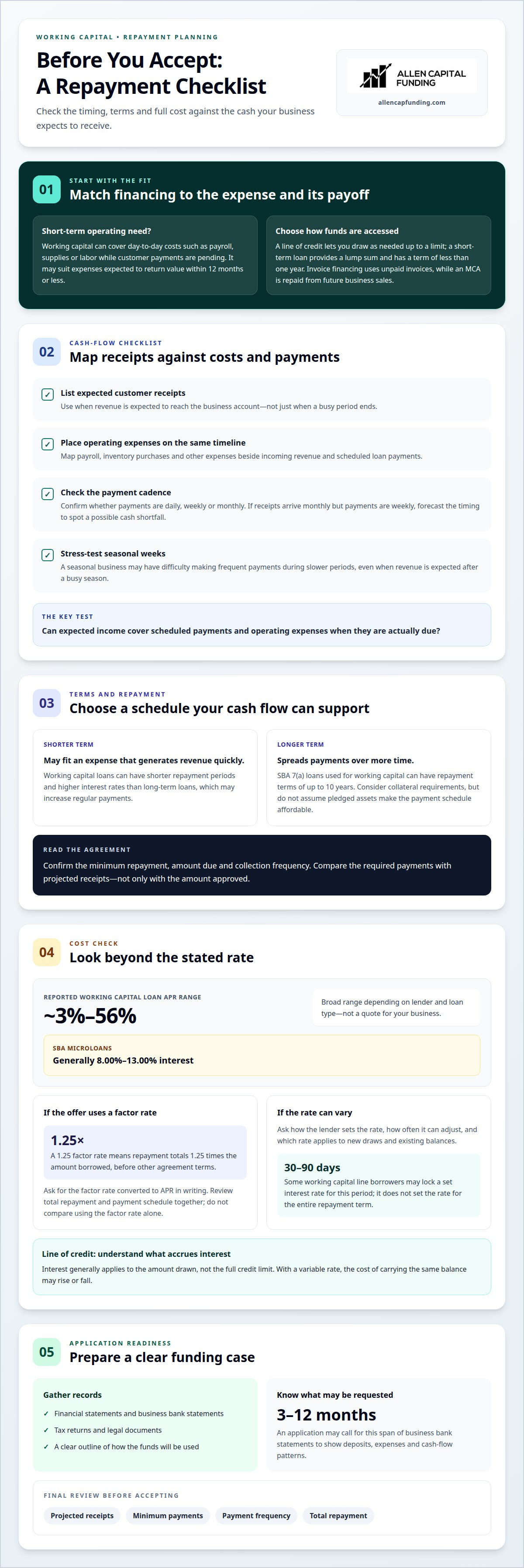
Prepare financial statements, business bank statements, tax returns, legal documents, and a clear outline of how the funds will be used. The application may call for three to 12 months of business bank statements, which help show deposits, expenses, and cash-flow patterns.
A sweep account can automatically use excess cash to pay down a line of credit, helping reduce interest costs. This can suit a business with fluctuating revenue: extra cash lowers the outstanding balance, while the line remains available for a later operating expense.
Repayment planning and cash flow scenarios
Choose repayment terms based on the cash your business expects to receive, not just the amount approved. A seasonal company collecting revenue after a busy period may struggle with frequent payments during slower weeks. Map expected customer receipts against payroll, inventory purchases, and scheduled payments before accepting financing. Working capital loans can have higher interest rates and shorter repayment periods than long-term loans, which may increase regular payments.
For SBA 7(a) loans used for working capital, repayment terms can extend up to 10 years. A shorter loan may suit an expense that generates revenue quickly, while a longer term spreads payments over more time. Consider collateral requirements alongside cash flow, and don’t assume that pledged assets make a payment schedule affordable.
Check the agreement for minimum repayment requirements and payment frequency. It should state how much is due, when payments are collected, and whether they are daily, weekly, or monthly. Match that schedule to when revenue reaches your business account. If receipts arrive monthly but payments are weekly, forecast the timing carefully to avoid a cash shortfall.
Factor rates need a different comparison method from interest rates. Ask for the factor rate converted to APR in writing, then review the total repayment amount and payment schedule together. For example, a 1.25 factor rate means the repayment total is 1.25 times the amount borrowed, before considering any other terms in the agreement. Don’t compare offers using the factor rate alone.
To apply, first define the expense and amount needed. Prepare your financial records and a clear outline of how you’ll use the funds, then submit the application. Before accepting, compare the proposed terms with projected receipts, including minimum payments, payment frequency, and total repayment. This makes the cash-flow impact clearer before you use the funds.
For a business weighing short-term funding against longer-range plans, working capital financing can be considered alongside the timing of operating expenses and incoming revenue.
Variable interest and interest-only-on-drawn-amounts
A business line of credit may charge interest only on the amount drawn, rather than the full credit limit. That matters if you want credit available for uncertain expenses but expect to use only part of it. With variable interest, the rate can change, so the cost of carrying the same balance may rise or fall during repayment.
Before accepting an offer, identify how the lender sets the variable rate and how often it can adjust. Ask which rate applies to new draws and existing balances, and whether the agreement includes a temporary fixed-rate option. Some working capital line borrowers may lock in a set interest rate for 30 to 90 days. A fixed period can help with short-term planning, but it doesn’t establish the rate for the entire repayment term.
Reported working capital loan rates range from about 3% to 56% APR, depending on lender and loan type. Treat this as a broad comparison range, not a quote for your business. For SBA microloans, interest rates are generally 8.00% to 13.00%. Loan amount, eligibility, repayment terms, and funding speed differ by program and lender.
Online lenders may fund a working capital loan in as little as one to two business days. A fast funding timeline doesn’t replace a careful review of the full borrowing cost. Compare APR, fees, required payments, and the repayment period. If an offer uses a factor rate instead of an interest rate, request its APR conversion in writing and review the total repayment amount before deciding.
Build a cash-flow forecast for both a lower-revenue period and a typical one. Estimate interest using the amount you expect to draw, then account for possible rate changes and scheduled principal payments. This helps show whether revenue can support repayment without using funds set aside for payroll or other operating costs.
Using working capital loans to cover operating expenses
Working capital loans can bridge the gap between paying business expenses and collecting revenue. For example, a company may need to meet payroll while waiting for customers to pay outstanding invoices. A line of credit can also help fund supplies and labor for a larger contract before the customer pays.
Start with a specific operating need, then connect the loan amount to expected cash inflows. Separate expenses that support near-term business activity from costs that won’t generate revenue soon. This makes it easier to estimate how repayment fits into cash flow and whether the borrowed funds have a clear path back into the business.
Payroll: Map payroll dates against expected customer receipts, so borrowing addresses a timing gap rather than an ongoing shortfall.
Inventory and supplies: Tie the amount requested to the purchase and the sales or contract revenue expected to follow.
Recurring expenses: List obligations by due date and compare them with incoming revenue before deciding how much capital to draw.
Qualification depends on the lender’s review of the business and its finances. A credit score may be one consideration, alongside revenue patterns, bank activity, existing obligations, and the purpose of the funds. Prepare a cash-flow forecast showing the expense, when it must be paid, and when related income is expected. This helps explain how the proposed loan amount supports operations and repayment.
Keep borrowed funds tied to the planned expense. Track each draw and payment in your cash-flow records, and update the forecast if customer receipts shift. If an expense recurs monthly, consider whether short-term financing is appropriate or whether repeated cash gaps point to a broader issue. Working capital financing is most useful when you can identify the need and expected source of repayment.
If you’re planning funding around operating expenses, explore working capital options that align with your business’s cash-flow needs.
Allen Capital Funding: SBA Loans
Allen Capital Funding helps businesses explore funding options for operating needs, planned growth, and cash-flow gaps. If you’re weighing an SBA loan against working capital or a credit line, the right fit depends on how you’ll use the funds and how repayment aligns with business revenue. SBA Loans may suit businesses seeking structured financing, while Working Capital and Credit Lines can address different operating needs. Allen Capital Funding provides guidance to help you weigh these options against your business priorities. Bring a clear outline of the expense, expected revenue, and repayment capacity to the discussion. Contact Allen Capital Funding to talk through your business financing needs.
Make your next funding decision with clarity
Connect financing to a defined business objective. Before moving forward, consider how the funds will support operations, what revenue or business outcome they’re intended to enable, and how the commitment fits your broader plans. This perspective can help keep borrowing decisions aligned with your priorities.
If you’re deciding how to get a working capital loan, Allen Capital Funding can help you consider funding options in context. The company offers Credit Lines, SBA Loans, Real Estate, and Working Capital financing for businesses. The right conversation starts with your goals, intended use of funds, and business outlook, without pressure to choose a particular product.
Contact Allen Capital Funding today to discuss your business financing needs and take a considered next step toward your plans.
Frequently Asked Questions
What is a working capital loan and what can it be used for?
A working capital loan provides business financing for short-term operational needs rather than property or equipment purchases. A business might use one to cover utilities, rent, or bills due before customers pay. If you’re learning how to get a working capital loan, start by identifying a specific expense and a realistic source of repayment, rather than borrowing to cover an ongoing gap without a repayment plan.
What are the eligibility requirements for a working capital loan in the United States?
Eligibility generally depends on operating history, financial records, cash flow, and the business’s ability to repay. A U.S. business applying for an SBA 7(a) loan applies through a local lender, according to the U.S. Small Business Administration. A practical part of how to get a working capital loan is showing how recurring revenue and available cash can support payments under the proposed financing terms.
What credit score, revenue, and time in business do lenders require?
There is no single credit score or revenue threshold for every working capital loan. Some online lenders may consider applicants with credit scores as low as 500, and some lenders may work with businesses scoring 600 or lower. Lenders often look for at least 1-2 years of business history. Revenue consistency and cash available after expenses help show whether repayments fit the business.
What are current working capital loan interest rates, fees, and repayment terms?
In November 2026, reported working capital loan rates range from about 3% to 56% APR, depending on lender and loan type. Fees and repayment terms also affect total borrowing costs, so assess them alongside the rate. For an offer using a factor rate, request its APR conversion in writing. Then review the total repayment amount and payment schedule before accepting.
What types of working capital financing are available, and how do they compare?
Common options include revolving credit lines, term loans, invoice financing, merchant cash advances, and SBA loans. A line can be reused as it’s repaid, while a term loan provides a lump sum with scheduled payments. Invoice financing is tied to unpaid receivables; a merchant cash advance is repaid from future sales. SBA financing follows its program terms and lender underwriting.
How long does working capital loan approval and funding take?
Some online lenders may fund a working capital loan in one to two business days, while other lenders may take a few days. Traditional bank decisions can take weeks to months, and receiving funds from an SBA 7(a) loan can take up to 90 days. Application completeness, lender review, and financing type influence timing, so plan around the slowest likely funding date.



Comments