
Working Capital Cycle: How Inventory Turns Into Cash
Profit can rise while cash remains tied up in inventory and unpaid invoices. The working capital cycle measures how long it takes a business to convert its investment in inventory and sales into cash, after accounting for the time it has to pay suppliers. The working capital cycle, explained by its core formula, is inventory days plus receivable days minus payable days.
That timing matters because cash committed to inventory or waiting on customer payments isn’t available for other business needs. A shorter cycle can free up cash sooner, though the right target depends on how the business buys, sells, and collects.
This guide explains how to calculate the cycle using inventory, receivables, and payables days, and what the result can reveal about cash flow. It also shows why reducing the time inventory sits or invoices go unpaid can help a business manage working capital, and how supplier payment timing affects the calculation.
Table of Contents
What is a Working Capital Cycle?
The working capital cycle tracks how long cash stays tied up in day-to-day operations before returning to the business. To understand the effect on cash flow, look at changes in inventory, accounts receivable, and accounts payable together.
Cycle Versus Cash Conversion Cycle
The working capital cycle describes the time needed to convert net working capital, current assets minus current liabilities, into cash. The cash conversion cycle focuses on the operating days between paying suppliers and collecting sales proceeds. Businesses often use the terms interchangeably, but the second emphasizes transaction timing. Measuring both helps connect balance-sheet changes with cash flow.
Changes in net working capital can absorb or release cash even when revenue stays steady. Buying more inventory, for example, uses cash before those goods generate sales, while growing accounts receivable means more revenue remains uncollected. An increase in accounts payable can preserve cash temporarily because supplier bills remain unpaid. Together, these movements affect liquidity, not just reported profit.
A common mistake is assuming higher sales mean cash flow is improving. If customers take longer to pay while inventory builds, cash can become tight despite rising revenue. Another mistake is delaying supplier payments without considering the business relationship or upcoming obligations. Negative working capital can signal financial distress if the business lacks enough cash to meet current liabilities.
Financing Cash-Flow Gaps
Financing a cash-flow gap means arranging funds to cover operating costs while cash remains tied up in inventory or unpaid invoices. The need becomes clearer when a business compares supplier due dates with expected customer collections. A credit line may help bridge a timing gap, but it doesn’t shorten the cycle itself. Forecasting these dates helps distinguish a temporary timing need from a deeper liquidity problem.
Inventory, receivables, and payables days
Three timing measures show how operations move from investment to cash: inventory days, receivable days, and payable days. Compare each measure with the accounts and activity that drive it.
Inventory Days and DIO
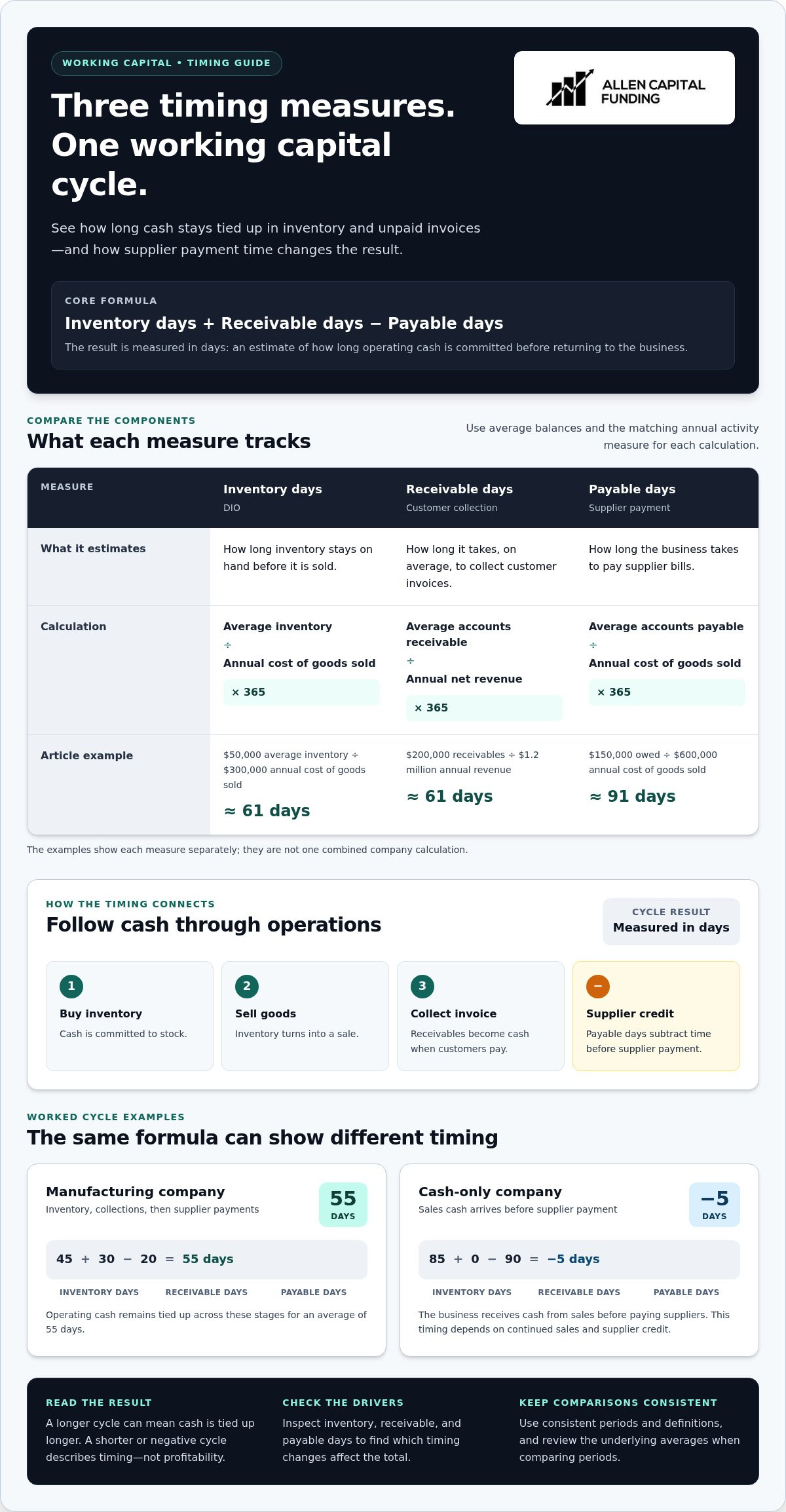
Days Inventory Outstanding (DIO) estimates how long inventory stays on hand before it’s sold. Calculate it by dividing average inventory by annual cost of goods sold, then multiplying by 365. For example, $50,000 in average inventory and $300,000 in annual cost of goods sold produce about 61 inventory days. That result helps reveal how long cash remains invested in stock.
Receivables and Receivable Days
Accounts receivable records customer invoices that haven’t been collected, while receivable days estimate the average collection time. Divide average accounts receivable by annual net revenue and multiply by 365. With $200,000 in receivables and $1.2 million in annual revenue, collection takes roughly 61 days. Compare that measure with actual payment patterns to see whether sales are converting into cash promptly.
Payables and Payable Days
Accounts payable tracks amounts owed to suppliers, and payable days estimate the time a business takes to pay them. Divide average accounts payable by annual cost of goods sold, then multiply by 365. A business owing $150,000 with $600,000 in annual cost of goods sold takes about 91 days to pay. This measure shows how supplier credit affects cash timing.
How Inventory, Receivables, and Payables Connect
These measures follow cash through a connected sequence: a business buys inventory, sells goods, records receivables when customers owe payment, and collects cash. Supplier credit can delay paying for inventory, while slow stock turnover or late collections can extend the time before cash returns. Comparing all three measures helps pinpoint where operating cash is tied up. For businesses also weighing property investment, explore real estate options separately from day-to-day working capital needs.
Working capital cycle formula
The working capital cycle formula adds the time needed to sell inventory and collect customer payments, then subtracts supplier payment time. In symbols: working capital cycle = inventory days + receivable days − payable days. The result, measured in days, estimates how long operating cash is committed before returning to the business.
Use consistent periods and definitions for all three components. Inventory days reflect how long goods remain in stock; receivable days track the wait to collect sales; payable days measure the time before paying suppliers. For a manufacturing company with 45 inventory days, 30 receivable days, and 20 payable days, the calculation is 45 + 30 − 20, or 55 days.
That 55-day result means the business’s operating cash remains tied up across those stages for that period, on average. It isn’t a forecast of the exact date each sale becomes cash. Demand, product mix, customer collection patterns, and supplier payment terms can all shift the component figures. Review the underlying averages when comparing periods, so a change in the total points to a real timing difference.
A negative result is possible. Consider a cash-only company with 85 inventory days, zero receivable days, and 90 payable days. Its cycle is 85 + 0 − 90, or negative five days. The business receives cash from sales before paying suppliers. That timing can support liquidity, but it depends on continued sales and supplier credit.
Use the formula as a diagnostic, not a stand-alone measure of financial health. A longer cycle can indicate that cash is tied up longer, while a shorter or negative cycle describes timing, not profitability. Compare the result with prior periods and inspect each component. If inventory days rise as demand slows, for example, the total may reveal pressure that a revenue figure alone would miss.
Benefits of a shorter cycle
A shorter working capital cycle can return cash to the business sooner. That cash can support operating costs, replenish current assets, or meet liabilities without waiting as long for customer collections. The key measure is the time between investing in operations and recovering cash. A shorter period can improve liquidity, but it doesn’t automatically increase profit or revenue.
Start with inventory. Review slow-moving items and adjust purchasing to match customer demand. A used car dealership, for example, could reduce the time needed to prepare photographs and listings. The example considers cutting that process by four days from its 14-day duration. Faster listing may help convert inventory into sales sooner, while buying too little stock can leave customer demand unmet.
Next, focus on receivables and supplier timing. Clear invoices, accurate billing, and prompt follow-up can help customers pay without avoidable delays. Review payment terms with suppliers as well. Businesses may use net 30, net 60, or net 90 terms; negotiating 60 days instead of 30 can give sales more time to convert into cash before bills fall due. Manage terms responsibly, since payment delays can affect supplier relationships.
Shorter isn’t always better if the changes weaken operations. Cutting inventory too far can lead to missed sales, while paying suppliers later may strain reliable supply. Compare each component before changing policy, then monitor whether the cycle improves without harming service or stock availability. A business with long collection periods may need a different focus from one holding excess inventory. To discuss cash-flow needs and potential next steps, connect about your business’s cash flow.
Allen Capital Funding: Credit Lines
Allen Capital Funding offers credit lines for businesses managing ongoing funding needs, including cash-flow timing gaps. A credit line may be worth discussing when customer payments arrive after expenses fall due, or when working capital must support regular operations. It can provide access to funds for eligible business needs, but it doesn’t replace reviewing inventory, collections, and supplier terms.
Before considering financing, map expected cash inflows and outflows, identify when a shortfall occurs, and estimate how long it lasts. This helps clarify whether the need is temporary or reflects a cycle that requires operational changes. Allen Capital Funding also offers working capital and SBA loans for different business financing needs.
Contact Allen Capital Funding to discuss your business’s funding needs.
Turn Cash-Flow Insight Into Your Next Move
With the working capital cycle explained, make its patterns part of your planning. Review cash forecasts alongside operating decisions, then consider whether a funding need is temporary or connected to a broader growth plan. This distinction can help you choose a practical direction instead of reacting to each cash pinch in isolation.
Allen Capital Funding offers Credit Lines, SBA Loans, and Real Estate solutions for businesses assessing their financing needs. Start the conversation with your goals, current cash-flow pressures, and the plans you want to move forward. Financing is one part of the decision; disciplined forecasting and operational choices remain central to managing cash.
Contact Allen Capital Funding to discuss a financing path for your business. A clearer plan can help you move ahead with greater confidence.
Frequently Asked Questions
What is the working capital cycle?
The working capital cycle shows how long business resources remain committed to operations before cash becomes available again. It connects purchasing, production or service delivery, customer billing, and collection. Having the working capital cycle explained in relation to a business’s actual operations helps managers identify where cash waits before returning. For a service firm, the sequence may begin with delivering work rather than buying inventory.
How is the working capital cycle calculated?
Calculate it by adding inventory days and receivable days, then subtracting payable days. For example, inventory sold in 85 days, customer payments collected in 20 days, and supplier bills paid in 90 days produce a 15-day cycle: 85 + 20 − 90. Use figures from the same measurement period. The working capital cycle explained with consistent inputs gives a more meaningful comparison between reporting periods.
What are the steps in a typical working capital cycle?
A typical cycle begins when a business buys materials or prepares to deliver a service. It then holds or uses those resources, completes a sale, bills the customer if payment is due later, and collects the receivable. The business also pays suppliers according to agreed terms. A service firm that doesn’t hold stock may move directly from service delivery to invoicing and collection.
What do inventory days, receivable days, and payable days mean?
Inventory days estimate how long goods remain in stock before sale. Receivable days indicate the average wait between invoicing customers and collecting payment. Payable days estimate how long the business takes to pay suppliers. A company reviewing these measures can investigate a rise in receivable days as a possible sign of slower collections, or rising inventory days as a sign that stock is moving more slowly than planned.
How does the cash conversion cycle differ from the operating cycle?
The operating cycle generally measures the time from acquiring inventory to collecting customer payments, combining inventory and receivable days. The cash conversion cycle adjusts for supplier payment timing by subtracting payable days. A business with extended supplier terms can have a shorter cash conversion cycle than operating cycle because it pays suppliers later. This distinction separates sales and collection timing from cash-funding timing.
What is a good working capital cycle length by industry?
There isn’t one ideal cycle length for every industry. A manufacturer may carry raw materials, work in progress, and finished goods, while a service firm may have little or no inventory. Retailers with quick customer payments and longer supplier terms operate differently from businesses that invoice customers and wait for collection. Compare a company’s cycle with its own history, operating model, and capacity to manage cash needs.



Comments