
What Lenders Look for in a Business Plan for Loan Readiness
A business plan may present a compelling growth idea, but lenders need to understand how the loan will support the business and be repaid. Knowing what lenders look for in a business plan starts with clear financial records, realistic projections, focused market research, and a specific explanation of how you’ll use the funds. Connect each element to the business’s ability to generate revenue and manage repayment.
It’s reasonable to expect lenders to look closely at the numbers. They also want a clear picture of your customers, competitors, business strengths, and the purpose of the loan. This article explains how lenders assess historical financial statements, market research, competitive analysis, and small business loan requests. You’ll see what makes a plan more informative and how to present a practical case for funding without relying on broad claims or unsupported projections.
Table of Contents
1. What Do Lenders Want from a Business Plan?
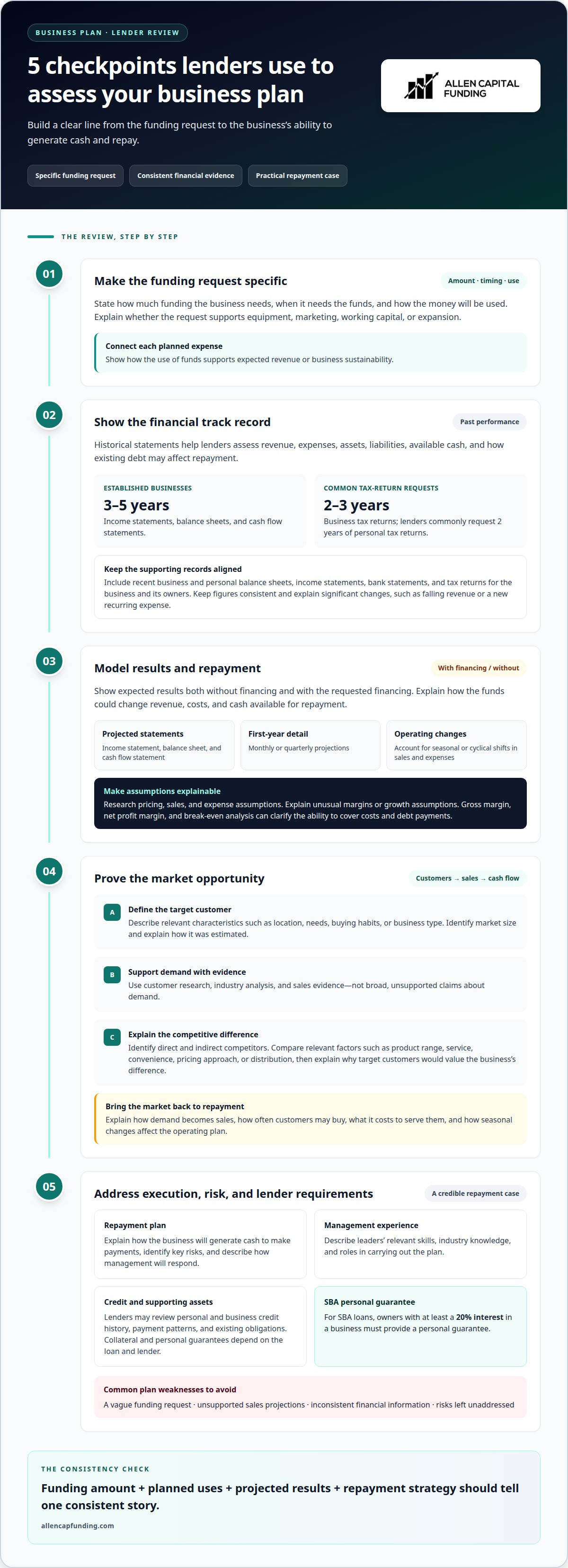
A business plan can both guide your strategy and support a loan application. Explain the company’s history, customers, revenue model, and growth priorities. In the executive summary, state the amount requested, when you need the funds, and how you’ll use them. Whether the money is for equipment, marketing, working capital, or expansion, connect each planned expense to expected revenue or business sustainability.
Lenders also need a practical case for repayment. Explain how the business will generate cash to make payments, identify key risks, and describe how management will respond. The plan helps lenders assess your request alongside financial records and the business’s repayment capacity. To show what lenders look for in a business plan, make sure the loan amount, planned uses, projected results, and repayment strategy tell a consistent story.
Banks, SBA lenders, and online lenders may differ in the documents and level of detail they request. Requirements depend on the lender and loan program, so tailor your application rather than assuming one plan suits every lender. For an SBA loan, explain exactly how you’ll use the funds and how the project supports the business.
Collateral and personal guarantees depend on the loan and lender. Business assets, such as equipment or real property, may support a loan; lenders may also consider personal assets. For SBA loans, the U.S. Small Business Administration requires each owner with at least a 20% interest in a business to provide a personal guarantee. Lenders may review both personal and business credit history to assess financial responsibility; payment patterns and existing obligations help provide context.
Management experience matters when it relates to the company’s work and growth plan. Describe each key leader’s relevant skills, industry knowledge, and role in carrying out the plan. Common application problems include a vague funding request, unsupported sales projections, inconsistent financial information, and unaddressed risks. If the plan projects expansion, explain how the funds will support it and how the expected revenue will contribute to repayment.
2. Historical financial statements
Historical statements show how the business performed before seeking financing. Established businesses should include income statements, balance sheets, and cash flow statements from the past three to five years. These documents show revenue, expenses, assets, liabilities, and changes in available cash. Lenders can compare periods to assess whether income is steady, costs are controlled, and existing debt affects repayment capacity.
What documents should accompany a business plan when applying for a business loan? Include recent business and personal balance sheets, income statements, bank statements, and tax returns for the business and its owners. Business tax returns commonly cover two to three years, while lenders commonly request two years of personal tax returns. Keep figures consistent across statements, returns, and projections. Explain significant changes, such as falling revenue or a new recurring expense.
Build projections that demonstrate financial viability, not just growth. Show expected results both without financing and with the requested financing, then explain how the funds could change revenue, costs, and cash available for repayment. Include projected income statements, balance sheets, and cash flow statements. Provide monthly or quarterly detail for the first year, and account for seasonal or cyclical shifts that could affect sales or expenses.
Connect the requested amount to the loan’s purpose and the financial model. For example, if financing will support equipment, show the related costs and explain how the purchase affects operating capacity and cash flow. Use researched assumptions for pricing, sales, and expenses. Lenders compare projections with market norms, so explain unusual margins or growth assumptions rather than relying on optimistic estimates. Gross margin, net profit margin, and break-even analysis can clarify the business’s ability to cover costs and debt payments. A financial check-up can help organize these figures and clarify the repayment picture before an application.
3. Market research and competitive analysis
Market research shows whom the business serves and whether demand can support revenue. Define target customers using relevant characteristics, such as location, needs, buying habits, or business type. For example, a neighborhood bakery might focus on nearby residents seeking custom celebration cakes instead of claiming to serve every local customer. Identify the market’s size and explain how you estimated it. Use customer research, industry analysis, and sales evidence to support the opportunity, not broad claims about demand.
Competitive analysis should identify direct and indirect competitors and explain how customers choose among them. Compare relevant factors, such as product range, service, convenience, pricing approach, or distribution. Then state the business’s value proposition: what it does differently and why target customers would care. A bakery might stand out through custom orders and local delivery, but should explain how those choices attract customers and support revenue. Connect the difference to the company’s mission and operating plan.
Show lenders how the market connects to cash flow and the need for capital. Explain how customer demand becomes sales, how often customers may buy, and what it costs to serve them. A seasonal business, for example, should describe how demand changes during its sales cycle and how it plans for slower periods. This links market conditions to realistic operating assumptions instead of treating an attractive market estimate as proof of repayment capacity.
Include the competitive and regulatory conditions relevant to the business’s location and industry. Identify rules that affect operations, costs, product delivery, or customer access, and explain how the business plans to adapt if conditions change. Avoid unsupported claims that the company faces no barriers. Tie each market risk to a response, such as adjusting suppliers or sales channels. Tailor the research to the loan application and show how the proposed use of funds supports the business’s market position.
4. What business plan sections are required for an SBA loan application?
An SBA loan application needs a plan that explains the business, its market, leadership, funding purpose, and ability to repay. The exact package depends on the loan program and lender, so treat these as core sections to organize rather than a universal SBA template. Start with an executive summary identifying the company, its goals, the requested financing, and its intended use. Keep it consistent with the detailed sections that follow.
Use the company description to explain its products or services, legal structure, target customers, and value proposition. Describe how the business serves customers, delivers its offerings, and earns revenue. In the management section, connect leaders’ skills and experience to the company’s operations and growth strategy. Market research should define the target market and competitors, explain the business’s differentiation, and provide evidence for the opportunity and sales assumptions.
The funding request should state the amount sought and connect each planned use to the project. For an expansion, explain how funds will support added capacity, customer acquisition, or working capital, as applicable. Include financial statements and projections showing revenue, expenses, assets, liabilities, and cash flow. Present results with and without financing, and explain how projected cash supports repayment. The U.S. Small Business Administration says calculating startup costs can help a business secure loans, so include a clear breakdown when launching or expanding.
Add a risk discussion that identifies obstacles and practical responses, such as seasonal demand or supplier changes. A break-even analysis can show the sales level needed to cover costs, but it is an estimate, not a guarantee of performance. The U.S. Small Business Administration advises adding about 10% to a break-even analysis for unpredictable miscellaneous expenses. Align assumptions across the market analysis and financial forecast, then tailor supporting documents to the lender’s application requirements. For a commercial property project, explore real estate financing options as part of planning the funding request.
Allen Capital Funding
Allen Capital Funding helps small businesses explore funding options suited to their plans and financial needs. If your business plan is taking shape but you’re unsure which financing approach fits its purpose, the team can guide you through options such as SBA Loans, Credit Lines, Working Capital, and Real Estate financing.
Discuss your funding request when weighing how to finance an expansion, manage working capital needs, or pursue a property project. A clear account of your intended use, projected cash flow, and repayment capacity can help frame the discussion. Allen Capital Funding provides tailored funding options and guidance to help business owners consider their next financing step.
Contact Allen Capital Funding for guidance on your business’s funding needs.
Turn Your Plan Into a Clear Next Step
A financing decision can shape more than the next application. It can influence hiring, purchasing, expansion, and the pace of future growth. Use your business plan as a working decision-making tool, not just a document for lenders. Revisit it as customer demand, operating costs, or business priorities change.
Knowing what lenders look for in a business plan can help you prepare for a focused funding discussion. Consider which business milestone the financing would support and how it fits your broader direction. This perspective can help you explain your needs clearly and choose your next step deliberately.
Allen Capital Funding can help you explore funding options in relation to your business goals. Contact Allen Capital Funding to discuss your financing needs and where you want to take the business. A clear plan gives you a useful starting point for that conversation, and each informed step can bring your next growth decision into sharper focus.
Frequently Asked Questions
What Do Lenders Want from a Business Plan?
Lenders want a credible explanation of how the business operates, manages risk, and supports repayment. They also assess the people responsible for carrying out the plan, the company’s financial responsibility, and conditions affecting its industry. Show how daily operations connect to business goals. A plan is more useful when its assumptions, leadership roles, and funding purpose work together rather than reading as separate claims.
What financial projections do lenders expect in a business plan?
Lenders expect projections to be internally consistent and grounded in the business’s operating assumptions. Show how expected sales relate to pricing, customer demand, staffing, and expenses. If a forecast assumes more orders, for example, account for the capacity and costs needed to fulfill them. Make the assumptions behind your projections clear so lenders can see what may change if actual performance differs.
What debt service coverage ratio do business lenders require?
Lenders assess whether operating cash flow can cover scheduled debt payments, including the proposed loan and existing obligations. They consider recurring cash available, payment timing, and the reliability of projected income. Use consistent financial information and explain significant changes in debt or earnings. A ratio alone does not show the full repayment picture if cash flow is volatile or obligations are left out.
What cash flow information do lenders look for in a business plan?
Lenders look at when cash enters and leaves the business, not just whether projected sales appear profitable. Explain the timing of customer payments, supplier bills, payroll, inventory purchases, and debt payments. A company that pays suppliers before collecting invoices, for example, may face a temporary cash gap despite steady sales. Show how operating cycles, seasonal changes, and available cash affect the ability to meet obligations.
What industry, market, and competition analysis do lenders expect?
Lenders expect research that connects customer demand to the business’s ability to earn revenue. Explain how customers find and choose the business, what alternatives they have, and what could change demand. Include relevant industry conditions and rules affecting operations. A change in supplier availability, for instance, may affect delivery capacity or costs. Explain how management would respond and support key assumptions with relevant market evidence.
What common business plan mistakes cause lenders to reject loan applications?
Weak plans often contain conflicting figures, unsupported growth assumptions, or a gap between the funding request and the proposed project. Unexplained changes in revenue or debt can also make an application difficult to assess. Review the plan and supporting documents together for consistency. Address risks directly, and make sure every major claim is supported by the business’s records or operating plan.



Comments