
What Is a Good DSCR for a Commercial Loan? 2026 Guide
Updated: Oct 21
A 1.25x DSCR can be a useful target, but it isn’t a universal pass mark. If you’re asking what is a good DSCR for a commercial loan, the answer depends on the lender, loan program, property, and strength of its cash flow. Common commercial lending benchmarks fall in the 1.20x to 1.35x range, with 1.25x often used as a reference point.
It’s reasonable to want to know whether your cash flow can support the debt you’re seeking, especially when lenders may calculate the numbers differently. DSCR compares net operating income with annual debt service. A ratio above 1.0x means income exceeds the debt payments counted in the calculation, but lenders may use historical financials and apply their own requirements. The ratio alone doesn’t determine approval.
This guide explains how DSCR is calculated, what lenders may consider strong, and why thresholds vary by financing option and risk. You’ll also learn how the ratio can affect potential loan size and what to review before pursuing financing. Allen Capital Funding helps business owners assess commercial real estate financing alongside their broader funding needs.
Table of Contents
What Is DSCR for a Commercial Loan, and Why Does It Matter?
Debt service coverage ratio (DSCR) compares income available for debt payments with the scheduled debt service due over the same period. Lenders use it to assess whether a property or business generates enough qualifying income to meet loan obligations, and how much room remains if income falls or expenses rise.
DSCR is a useful starting point when you’re asking, “what is a good DSCR for a commercial loan?” It offers a snapshot of repayment capacity, not a promise of financing. There is no single industry-wide figure that guarantees approval. Requirements vary, and the calculation may depend on the financing structure and the financial records under review.
What does a debt service coverage ratio measure?
At its core, DSCR is qualifying income divided by annual debt service. For commercial real estate, qualifying income often centers on net operating income, or NOI. For a business loan, a lender may assess cash flow using business financial statements and other records. Annual debt service generally refers to the scheduled payments included in the lender’s analysis, but the exact items can differ.
A DSCR of 1.0x means qualifying income equals the debt service counted in the calculation. A ratio above 1.0x indicates income exceeds those payments, creating a cushion. For example, a business with a DSCR of 1.10x has more income relative to debt service than it needs to cover the obligations included in that calculation. That cushion is not necessarily available cash: other expenses, obligations, or changes in performance can affect the business’s finances.
Definitions matter. A borrower’s calculation might use adjusted or projected income, while a lender may rely on historical statements or tax returns and apply its own rules to income and expenses. The resulting ratios can differ, so use your estimate as a planning tool rather than assuming it will match underwriting.
Why does DSCR matter in commercial loan underwriting?
Coverage helps a lender assess whether a property or business can repay debt from its income. A stronger ratio can indicate more capacity to absorb a shortfall or unexpected cost, while a thinner margin may raise questions about repayment risk. It can also influence how much annual debt service the lender believes the cash flow can support.
DSCR is one part of a broader review. Lenders may also consider income consistency, operating expenses, existing obligations, credit history, collateral, and the purpose and structure of the financing. A healthy ratio can support an application, but it doesn’t erase other concerns or automatically secure approval. A ratio below a lender’s preferred level also needs to be considered in the context of the property, business, and proposed financing.
Understanding the measure gives you a clearer way to discuss cash flow and financing capacity. It also helps you spot where lender calculations may differ from your own before comparing loan options.
How to Calculate Commercial Loan DSCR: Formula and Example
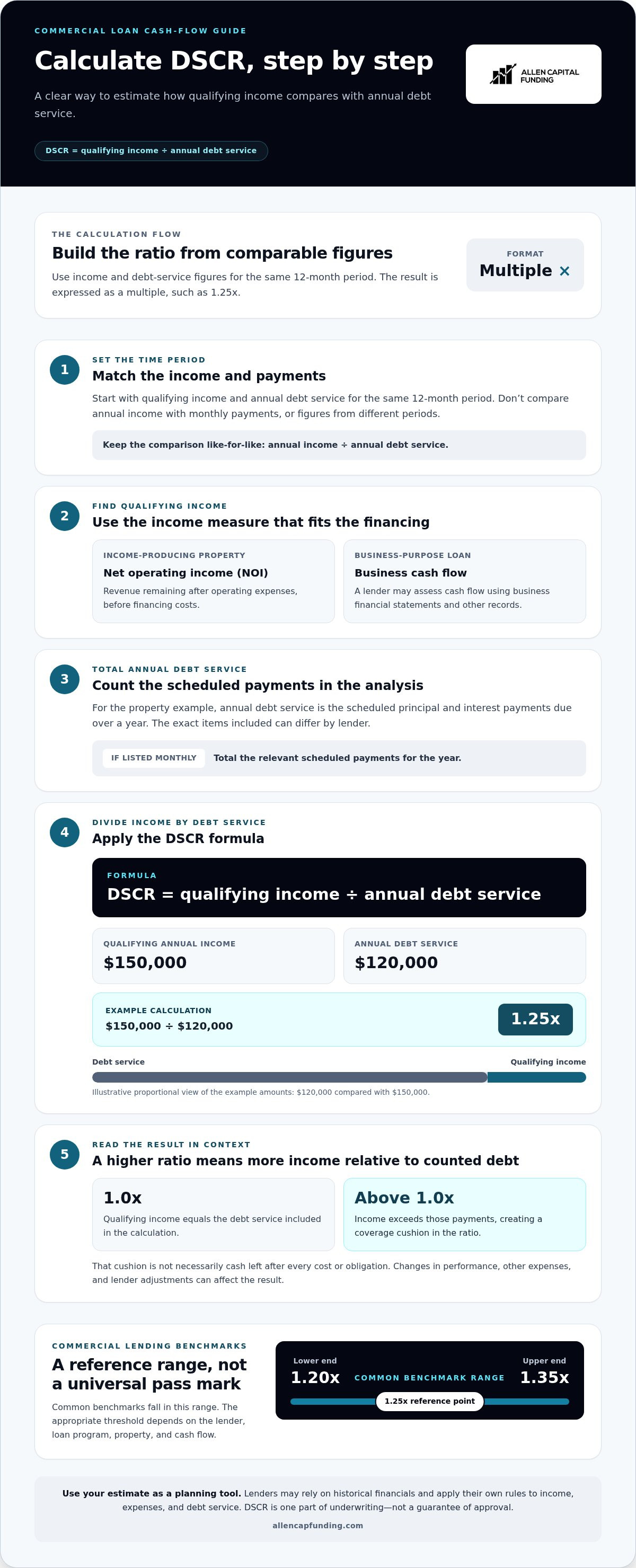
Start with two figures for the same 12-month period: qualifying income and annual debt service. For income-producing commercial property, the calculation commonly uses net operating income (NOI). The result is expressed as a multiple, such as 1.25x, rather than as a percentage.
DSCR = qualifying net operating income ÷ annual debt service
The formula is straightforward, but the inputs require care. If you’re using DSCR to explore what is a good DSCR for a commercial loan, make sure your estimate reflects the relevant property or business, the period being analyzed, and the lender’s definition of qualifying income and debt service.
Which income and debt payment figures go into the formula?
For an income-producing property, NOI is revenue remaining after operating expenses are deducted, before financing costs. Annual debt service is the scheduled principal and interest payments due over a year. Keep the periods consistent: don’t divide annual NOI by monthly payments or compare income from one period with debt payments from another.
Lender methods can differ. A lender may adjust income or expenses, or define qualifying cash flow differently. Business-purpose loans may use cash-flow measures from business financial records rather than property NOI. Use figures you can support with records, and treat your own calculation as an estimate until the lender’s method is clear.
How does a simple DSCR calculation work?
Consider this illustrative example, not a lender requirement or a prediction of any borrower’s results:
Qualifying annual income: $150,000
Annual debt service: $120,000
Calculation: $150,000 ÷ $120,000 = 1.25x
A 1.25x result means the calculation shows $1.25 of qualifying income for every $1 of annual debt service. The difference is a coverage cushion in the ratio, not necessarily cash left over after every business cost or obligation has been paid. If either input changes, the result changes too.
A calculation helps organize the numbers, but it doesn’t determine how a financing request will be assessed. Allen Capital Funding helps business owners consider commercial real estate financing alongside their broader funding needs. Reviewing commercial real estate financing guidance alongside your cash-flow estimate can help frame the financing discussion.
What Is a Good DSCR for a Commercial Loan? Understand the Benchmark
If you’re asking what is a good DSCR for a commercial loan, approximately 1.20x to 1.25x is often cited as a commercial real estate reference range. It’s a useful starting point, not a universal rule. Common commercial lending requirements can fall within a broader range of 1.20x to 1.35x, with 1.25x often used as a benchmark.
That range doesn’t tell you what a specific lender will require. The threshold can shift with the property’s income and risk, the loan structure, and the lender’s underwriting approach. A ratio above a common reference point may support a financing request, but it doesn’t guarantee approval. Lenders consider other aspects of the transaction and borrower, too.
Is 1.25 DSCR good for a commercial loan?
A 1.25x DSCR means qualifying income is 25% greater than the annual debt service included in the calculation. That can indicate a useful coverage cushion. But 1.25x is a reference, not a guaranteed minimum across all commercial loans or a promise of approval. The same ratio may be viewed differently depending on the property, financing terms, and lender’s income calculation.
For a quick conceptual guide, compare the ratio with debt service this way:
Below 1.0x: Qualifying income is less than the debt service counted, indicating a coverage shortfall under that calculation.
Near 1.0x: Income is close to the amount needed for scheduled debt service, leaving little cushion in the ratio.
Above 1.0x: Income exceeds debt service. A higher ratio indicates more coverage, though it doesn’t settle the lender’s full assessment.
These descriptions explain the relationship between income and payments. They aren’t lender approval categories, and an individual lender’s criteria may differ.
Why do commercial loan DSCR requirements vary?
Property cash flow is one factor. Occupancy, income stability, operating expenses, and asset type can shape a lender’s view of how dependable that cash flow is. A property with volatile income may be assessed differently from one with a more consistent operating history. Leverage and the proposed loan structure also matter because they affect scheduled debt service and the coverage a lender expects.
Underwriting methods vary as well. Lenders may define qualifying income, expenses, and debt service differently, so two analyses of the same property can produce different ratios. Program-specific criteria make a universal cutoff even less reliable. Freddie Mac conventional fixed-rate loans require a 1.25x minimum, while HUD market-rate multifamily programs use a 1.15x minimum. Those thresholds apply to the named programs, not to every commercial loan.
Property-level DSCR and business cash-flow analysis aren’t interchangeable. A commercial real estate review generally centers on the property’s income and expenses. An operating-business financing assessment may rely on business cash flow and financial records. Identify which income and debt payments are being evaluated before treating any ratio as a meaningful benchmark.
How to Assess and Strengthen Your DSCR Before Applying
A useful DSCR estimate starts with reliable records, not an optimistic forecast. Before exploring financing, build a clear picture of the income available for debt payments, the obligations already in place, and the payments a proposed loan could add. This helps you identify questions early and compare your estimate with a lender’s underwriting calculation.
How can you estimate DSCR before speaking with a lender?
Gather current income statements and, for commercial property, operating records that show revenue and expenses. Add schedules for existing debt and a supportable estimate of the proposed loan’s annual payments. Keep the time periods consistent, and record which income or expense adjustments you included so you can explain your assumptions.
Choose the relevant income measure. For an income-producing property, organize the records needed to assess net operating income. For a business-purpose loan, use business financial information that reflects the cash flow being evaluated.
Account for debt obligations. List scheduled payments included in the calculation, including existing debt where relevant, and estimate the proposed debt service using the structure under consideration.
Calculate and document the estimate. Divide qualifying income by annual debt service. Keep a separate note of projections, one-time items, and adjustments rather than presenting them as established results.
Review the assumptions. Compare your estimate with the lender’s defined income and debt-service measures. A different method can produce a different ratio.
Look beyond the final figure. Uneven occupancy, seasonal revenue, customer concentration, or inconsistent business income may make cash flow less dependable than a single annual total suggests. Existing obligations also matter: debt payments can reduce the income available to support additional borrowing.
What can improve coverage without overstating the numbers?
Focus on changes that are sustainable and supported by records. Review recurring operating costs for efficiency opportunities while protecting the property or business’s ability to maintain operations and generate income. If you expect revenue to rise, distinguish documented performance from projections and use realistic assumptions. Don’t count hoped-for growth as proven cash flow.
You can also revisit the borrowing need. A smaller request may reduce proposed debt service, while a different repayment structure can change how payments fit the cash-flow picture. Consider the trade-offs alongside the business purpose, collateral, and broader funding plan. The goal is not to manipulate the ratio. It’s to understand what the cash flow can reasonably support and prepare a financing request that reflects it.
There’s no single adjustment that ensures a stronger DSCR or loan approval. A practical review clarifies where the estimate is sensitive: income, expenses, existing debt, or the proposed borrowing amount. That context can make a financing discussion more productive than relying on one ratio alone.
For commercial real estate financing, review your funding needs with Allen Capital Funding and consider your DSCR alongside your broader business funding needs.
How to Use DSCR When Comparing Commercial Financing Options
DSCR helps answer one important question: how much income is available to cover debt payments? It doesn’t tell you whether a financing option fits your business overall. Compare coverage alongside the loan’s purpose, repayment structure, collateral, and effect on cash flow. That broader view is more useful than choosing an option based on a single ratio or asking only what is a good DSCR for a commercial loan.
How does DSCR fit alongside other loan evaluation measures?
Each measure offers a different perspective. DSCR focuses on income relative to debt service. Loan-to-value (LTV) compares the loan amount with the value of the collateral, while debt yield relates a property’s income to its loan balance. These measures aren’t interchangeable, and a lender may consider them together. A commercial real estate loan may focus on property-level cash flow, while financing for operating expenses or equipment may involve a broader review of business finances.
Compare financing options on consistent terms. A different repayment schedule can change annual debt service and therefore the DSCR, even if the underlying income stays the same. Consider how payments align with the timing and reliability of your cash flow, what collateral is involved, and whether the funding serves the intended purpose. A ratio by itself can’t show the full effect on your business.
If you’re evaluating property financing, Allen Capital Funding’s commercial real estate loans guide can help you explore the property-financing context. Use it alongside your own assessment of cash flow and financing needs.
What should you prepare for a commercial funding conversation?
Bring a concise picture of what you’re financing and how repayment fits the business. Organize relevant financial records and be ready to explain how you arrived at income and debt-service estimates. Separate historical results from projections, and note the assumptions behind forecast revenue, expenses, or proposed payments. Clear documentation helps keep the conversation grounded in the available financial picture.
Purpose: Describe what the funding will support, such as a property purchase, equipment, or working capital.
Funding need: Summarize the amount you’re seeking and how you estimated it.
Cash flow: Gather relevant income, expense, and existing debt records, using consistent time periods.
Assumptions: Identify projected figures and explain what supports them.
A DSCR estimate can guide the discussion, but it shouldn’t be the whole funding strategy. Allen Capital Funding helps business owners explore commercial real estate financing and other debt-based funding options with tailored guidance. Organize your financial picture, then schedule an online consultation with Allen Capital Funding to discuss capital options in the context of your business’s purpose, obligations, and cash-flow needs.
Turn Your DSCR Estimate Into a Financing Plan
A ratio is most useful when it helps you make a decision. Use your estimate to identify the assumptions that matter, then consider how the financing would support your business goals and fit its cash-flow needs. That perspective is more useful than treating “what is a good DSCR for a commercial loan” as a question with one number that applies to every situation.
Allen Capital Funding offers commercial real estate financing and provides guidance on tailored capital options. A funding conversation can connect your financing purpose with the broader needs of your business, so your next step reflects more than a single metric.
Explore tailored commercial funding options and take a clear, informed step toward your next opportunity. With a thoughtful plan, you can approach financing decisions with greater confidence.
Frequently Asked Questions
Is a 1.25 DSCR good for a commercial loan?
Often, 1.25x is considered a useful commercial real estate benchmark, but whether it’s good for your application depends on the lender and financing details. It means qualifying income is 25% higher than the debt service counted in the calculation. If you’re asking what is a good DSCR for a commercial loan, treat 1.25x as a reference, not a universal cutoff. The lender’s underwriting method and broader review still matter.
How do you calculate DSCR for a commercial loan?
Divide the qualifying income for the period by the debt service for that same period. For example, if a property has $180,000 in qualifying annual income and $150,000 in annual debt service, the estimated DSCR is 1.20x. Use figures supported by financial or operating records, and keep the time periods aligned. A lender may adjust the income or payment figures, so your preliminary result may differ from its underwriting calculation.
Can you get a commercial loan with a DSCR below 1.0?
It may be possible in some circumstances, but a DSCR below 1.0 indicates that the qualifying income in the calculation doesn’t fully cover the debt service being evaluated. That can make repayment capacity harder to support. A lender may consider other financial strengths or transaction details, but there’s no general rule that guarantees an exception. Review the cash-flow shortfall and proposed financing structure as part of the full funding picture.
What happens if a commercial property's DSCR is too low?
A low property DSCR may lead a lender to view the requested debt as greater than the property’s supported repayment capacity. Depending on its underwriting, the lender could reduce the amount of debt service or loan proceeds considered supportable, request additional information, or decline the request. Check whether the estimate reflects current occupancy, operating costs, and documented income. Correcting an error in the records can change the analysis, but stronger figures should be supported.
Is DSCR calculated differently for a business loan and a commercial real estate loan?
Yes. A commercial real estate calculation commonly assesses income generated by the property after operating expenses, while a business loan analysis may use cash-flow measures drawn from business financial records. The specific income included, adjustments made, and obligations counted can vary by lender and financing structure. Keep the two assessments distinct, especially if a business owns or operates the property, and identify which records support each calculation.
Does DSCR include principal, interest, taxes, and insurance?
Not always in the same way. Annual debt service commonly refers to scheduled principal and interest payments, while property taxes and insurance may be treated as operating expenses that reduce net operating income. A lender’s method can vary, including how it classifies costs and adjusts the income figure. Don’t assume taxes and insurance are added to debt service or excluded from the analysis; understand how the specific calculation treats them.
Can a lender approve a commercial loan with a strong DSCR?
Yes, a strong DSCR can support an application by showing more qualifying income relative to the debt service evaluated. It doesn’t guarantee approval. A lender may also assess credit, collateral, financial history, the requested loan amount, and the purpose and structure of the financing. If the ratio looks strong, make sure the underlying figures are well documented and consider how the proposed payments fit alongside existing business obligations.



Comments