
What Can an SBA 504 Loan Be Used For? Eligible Costs and Uses
Fixed assets qualify; everyday operating needs don’t. Understanding what an SBA 504 loan can be used for starts with that distinction: eligible projects generally include buying, building, or improving commercial real estate and purchasing long-term machinery or equipment. According to the U.S. Small Business Administration, qualifying energy-saving projects can include facilities that achieve a 10 percent decrease in energy consumption.
It’s easy to assume a business loan can cover any expense that helps a company grow. The 504 program is more specific: it’s designed for major fixed assets, so working capital, inventory, and routine operating expenses aren’t eligible uses.
This guide explains which property, equipment, and related project costs may qualify, how a private lender and a Certified Development Company share the financing, and which uses are excluded. You’ll also see where occupancy requirements and eligible debt refinancing matter, so you can assess whether a 504 project fits your plans.
Table of Contents
Eligible uses of SBA 504 loan funds
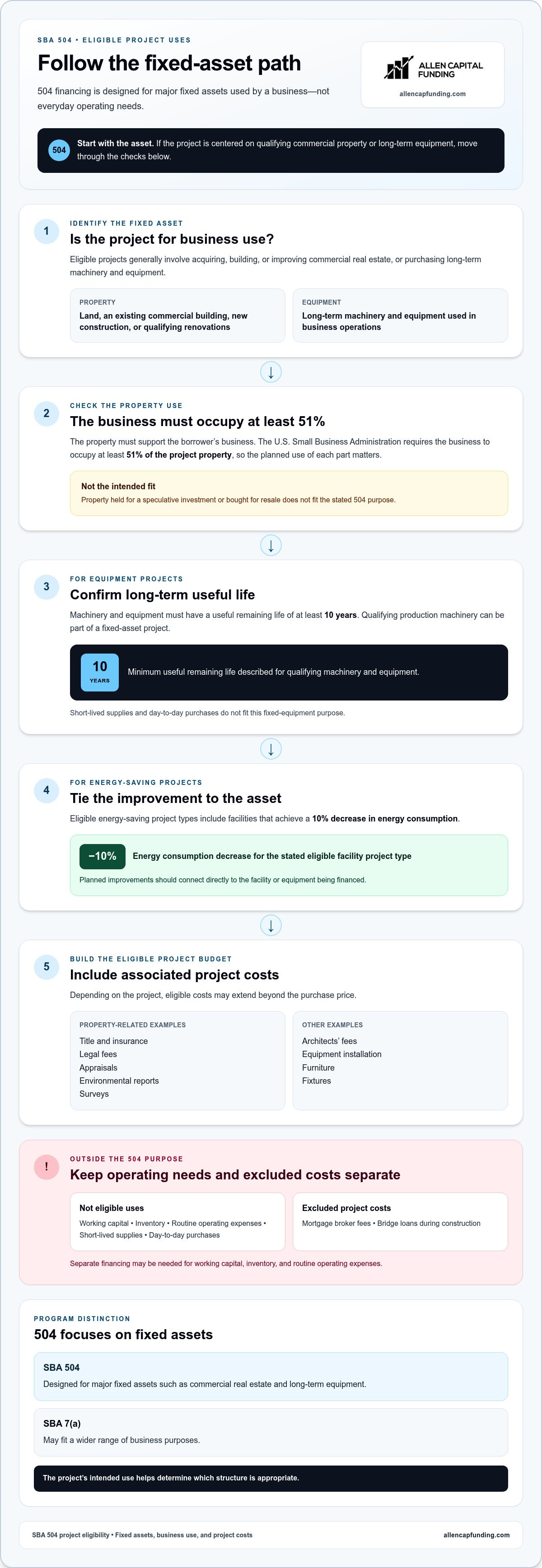
Understanding what an SBA 504 loan can be used for starts with the asset: the program finances major fixed assets for business use. Eligible projects can include buying land or an existing commercial building, constructing a facility, or renovating property. A business might use the financing to acquire a building and improve it for its operations.
The property must support the borrower’s business, not a speculative investment. SBA 504 funds can finance owner-occupied commercial real estate, and the U.S. Small Business Administration requires the business to occupy at least 51% of the project property. That makes the planned use of each part of a building relevant to project eligibility.
Equipment is another core use. According to the U.S. Small Business Administration, an SBA 504 loan can finance long-term machinery and equipment with a useful remaining life of at least 10 years. A manufacturer could, for example, finance qualifying production machinery as part of a fixed-asset project. Short-lived supplies and day-to-day purchases don’t fit this purpose.
Energy-saving improvements may qualify when they meet the program’s project criteria. According to the U.S. Small Business Administration, eligible energy-saving project types include facilities that achieve a 10 percent decrease in energy consumption. The planned improvements should connect directly to the facility or equipment being financed.
Real estate: Purchase land or an existing business property, or fund construction and qualifying renovations.
Fixed equipment: Finance qualifying long-term machinery and equipment used in business operations.
Associated project costs: Eligible costs may include title and insurance, legal fees, appraisals, environmental reports, architects’ fees, surveys, equipment installation, furniture, and fixtures.
What’s the difference between an SBA 504 loan and an SBA 7(a) loan? The 504 loan program focuses on major fixed assets such as commercial real estate and long-term equipment, while the 7(a) program may fit a wider range of business purposes. The project’s intended use helps determine which structure is appropriate.
Eligible project costs may go beyond the purchase price. Depending on the project, these can include title and insurance, appraisals, legal fees, surveys, and equipment installation. Mortgage broker fees and bridge loans during construction are excluded, so keep them separate from the eligible project budget.
To apply, the borrower works with a Certified Development Company and a private lender to present the project and its financing needs. Prepare a clear project scope and supporting financial records. Application guidance recommends gathering three years of business and personal tax returns. The lender and CDC assess the project, borrower, property use, and costs as part of the financing process.
Financing structure shared by a lender, CDC, and borrower
An SBA 504 project typically brings together three financing partners: a private lender, a Certified Development Company (CDC), and the borrower. In the common structure, the lender funds 50% of project costs, the CDC provides up to 40% through an SBA-backed debenture, and the borrower contributes at least 10% as equity. These shares establish the starting point for planning the project budget.
The lender generally provides the first mortgage, while the CDC arranges the SBA-backed portion. The CDC is a nonprofit corporation approved and regulated by the SBA, and 504 financing is available through CDCs. The borrower’s equity completes the financing structure. Each participant has a distinct role, so the project amount and planned use need to align across the financing package.
Consider a $2 million owner-occupied warehouse project. A typical illustration assigns about $1 million to the bank, $800,000 to the CDC/SBA portion, and $200,000 to the borrower’s down payment. Those figures show how the 50/40/10 structure can work in a straightforward example. They’re an illustration, not a fixed allocation for every project.
The borrower contribution can rise for certain projects. A new business that has operated for less than two years, or a borrower financing a special purpose property, generally must contribute 15% equity. A special purpose property has one use, or limited uses, and would require a large capital investment to convert. That higher contribution affects the borrower’s cash plan and the project’s financing mix.
Private lender: Typically finances 50% of the project and provides the first mortgage.
CDC: Provides up to 40% through the SBA-backed debenture in a typical structure.
Borrower: Contributes at least 10% equity, with a higher contribution generally required for the specified new-business or special-purpose cases.
The project’s eligible costs, asset type, and required borrower equity shape the financing plan. Reviewing these elements together helps clarify how much each financing partner needs to cover before closing.
As the project moves toward closing, the lender and CDC coordinate their parts of the financing, while the borrower provides the required equity. A clear budget that separates project costs from the borrower contribution helps each partner assess its share. For a project involving commercial property or equipment, a project financing review can help organize the funding picture and clarify the next planning steps.
Repayment terms
SBA 504 repayment terms depend on the asset financed. The available maturities are 10, 20, or 25 years. Equipment financing may use a 10-year term, while commercial real estate can use a 20- or 25-year term. Matching the repayment period to the asset helps align scheduled payments with the project’s useful life.
The CDC/SBA portion provides fixed-rate financing for the borrower. Its debenture rate moves monthly with 10-year U.S. Treasury yields, and the rate is pegged to an increment above the current market rate for 10-year Treasury issues. That monthly movement affects the CDC/SBA debenture rate; it doesn’t mean the borrower’s fixed rate changes monthly after financing is set.
Compare terms by looking beyond the interest rate. A longer maturity spreads repayment over more time, while a shorter term pays the balance down sooner. The project’s asset type determines which available term applies. For a business financing equipment, a 10-year repayment period may be relevant; a real estate project may use a longer maturity.
Prepayment rules also affect planning. SBA 504 loans with 20- or 25-year terms have prepayment penalties if paid off during the first 10 years. A 10-year-term loan can be repaid without a penalty after five years. A business considering an early sale, refinance, or major payoff should include those timelines in its cash-flow planning.
The borrower’s down payment shapes the amount that must be financed, but it doesn’t determine the repayment term by itself. In a typical project, the borrower contributes 10% equity, while a new business operating for less than two years or a special-purpose property generally requires 15%. The asset being financed remains central to the maturity selection.
For equipment: Consider how the 10-year term fits the equipment’s useful life and the business’s expected cash flow.
For real estate: Compare the available 20- and 25-year terms with the property project’s operating horizon.
For early payoff planning: Account for the applicable prepayment rules before assuming the balance can be cleared without added cost.
Before accepting a proposed structure, compare the payment schedule with the project’s revenue and operating needs. If financing property and equipment together, understand which assets determine the applicable maturity. The CDC/SBA rate, private lender financing, equity contribution, and repayment horizon all affect the overall commitment. Reviewing them together makes the loan amount and long-term obligations easier to assess before closing.
Owner-occupancy requirements
Owner occupancy helps distinguish an SBA 504 project from a property investment. According to the U.S. Small Business Administration, SBA 504 financing requires at least 51% of the project property to be owner-occupied. The borrower’s business must use the property for its operations, rather than acquire it mainly to rent to others.
The program serves for-profit, owner-occupied businesses in the United States or its territories. If a business plans to occupy part of a building and lease the rest, the occupied share matters. The planned business use is important: property intended primarily to generate rental income does not meet the owner-occupancy purpose.
New construction has a separate occupancy schedule. The owner-user must occupy at least 60% of a newly constructed building at the start, then reach 80% occupancy within 10 years. That timetable affects the project plan, especially when a business expects to expand into unused space gradually. Forecast how the company will use the building as operations grow.
Equity requirements can also change with the borrower or property type. A typical project requires a 10% borrower contribution. A business operating for less than two years or a borrower financing a special purpose property generally must contribute 15%. For a new business financing a special purpose property, the equity requirement is 20%.
A special-purpose property is designed for one use, or a limited range of uses, and cannot be converted without a large capital investment. If you are financing a facility built for a specific operation, factor its classification into the equity plan. The property’s design and potential for conversion shape this assessment.
Equipment projects have their own asset test. According to the U.S. Small Business Administration, eligible machinery and equipment must have a useful remaining life of at least 10 years. A borrower should connect the equipment’s expected service life to the project plan, rather than assume every business purchase qualifies.
Existing property: Plan business occupancy for at least 51% of the project property.
New construction: Meet the 60% occupancy requirement at the start and the 80% threshold within 10 years.
Equity planning: Account for the typical 10% contribution, the 15% requirement for specified new-business or special-purpose cases, and the 20% requirement for a new business financing a special purpose property.
Equipment: Confirm that financed machinery has at least 10 years of useful remaining life.
Working capital does not replace the equity contribution or change occupancy rules. Separate the property and equipment project from routine business needs, then map out how the borrower will use the site and meet the required contribution. This makes the intended use, occupancy schedule, and financing structure easier to assess together.
Ineligible working capital, inventory, and operating expenses
SBA 504 loans finance major fixed assets, not the everyday costs of running a business. Working capital and inventory are ineligible uses. That means a borrower can’t use the loan to cover payroll, replenish products for resale, or pay routine bills. Those costs may support growth, but they don’t become eligible project assets simply because the business needs them.
Separate project costs from operating needs when preparing the budget. A facility renovation or qualifying machinery purchase may fit the program, but wages for staff operating that machinery do not. Equipment installation may also qualify as a project cost, while routine supplies used afterward are operating expenses. Clear categories help keep recurring expenses separate from fixed-asset costs.
The financing structure doesn’t change these restrictions. Even when a CDC provides up to 40% of typical project costs, that portion must support eligible uses. For example, a project combining building renovations and machinery upgrades can be assessed as a fixed-asset project. The borrower still needs another funding plan for inventory or working capital.
Other exclusions also affect project budgets. SBA 504 proceeds can’t pay mortgage broker fees, bridge loans during construction, or existing business debt as a general use. Debt consolidation and refinancing are allowed only under the specific conditions in 13 CFR 120.882, paragraphs (e) and (g). Separate eligible project expenses from debt obligations before calculating the financing request.
Working capital: Don’t include payroll, rent, utilities, or other routine operating needs.
Inventory: Don’t use proceeds to purchase goods intended for sale or ongoing production supplies.
Fixed assets: Identify eligible real estate improvements and long-term machinery separately from operating expenses.
Debt and fees: Exclude mortgage broker fees and construction bridge loans; treat debt refinancing under the applicable regulatory conditions.
Consider a $1 million project to renovate a building and upgrade heavy machinery. Those fixed-asset costs can be evaluated as the project purpose, while inventory and payroll remain outside that budget. The U.S. Small Business Administration’s 504 loan program focuses on business assets, not general capital for every expense. A precise project description helps show how each requested cost supports the eligible property or equipment.
If the main need is cash for inventory, payroll, or recurring bills, SBA 504 financing isn’t designed for that purpose. Explore working capital options to address operating needs separately from a fixed-asset project.
Allen Capital Funding: Credit Lines
Allen Capital Funding helps business owners explore financing options that align with the purpose of their project. If an SBA 504 loan fits a long-term property or equipment investment, its fixed-asset focus can support that plan. For cash flow, inventory, or other operating needs that 504 financing excludes, a credit line or working capital may be more relevant.
Allen Capital Funding also offers SBA Loans and Real Estate solutions for businesses planning eligible growth projects. The right direction depends on whether the need is a major fixed asset or ongoing business capital. Separating those goals helps frame a more useful financing conversation.
Contact Allen Capital Funding to discuss your business financing needs, or visit allencapfunding.com.
Shape Your Next Financing Decision
Your next decision is not only whether the project fits a financing structure. Consider how the commitment aligns with your broader business plan, cash flow needs, and timing for future growth. This perspective can help you decide whether to pursue a fixed-asset project now or coordinate it with other financing needs.
As you assess what an SBA 504 loan can be used for, keep the project purpose connected to your broader financing plan. Allen Capital Funding offers SBA Loans and Real Estate solutions for business growth, alongside Credit Lines for other business needs. A clear view of your goals can help frame which direction best supports your plans.
Use that plan to start a focused conversation about your options and a practical next step. Contact Allen Capital Funding to discuss your options. A thoughtful financing decision can help you move toward your next stage with greater clarity.
Frequently Asked Questions
What is the 504 loan program?
The SBA 504 loan program provides long-term, fixed-rate financing for major business assets. It’s intended to support business growth and job creation through projects such as acquiring commercial property or permanent equipment. A business planning a facility expansion, for example, may consider 504 financing for the property or eligible equipment, rather than for routine bills or inventory purchases.
Do I have to create jobs to qualify for an SBA 504 loan?
Not every project must create jobs specifically; an SBA 504 project must meet job creation goals or public policy objectives. A project that doesn’t add positions may still align with a public policy objective, such as an energy-focused project. The relevant project goal shapes how the financing supports economic development, so describe the expected business impact clearly when presenting a project.
Are SBA 504 loans only for real estate?
No. SBA 504 financing can also support qualifying long-term machinery and equipment, so a business expanding production may finance equipment rather than property. The program also includes certain marine facilities, such as fishing vessels and commercial boats. The key distinction is the asset’s role in the business project: ongoing supplies or short-term operating needs aren’t the same as permanent equipment.
Can SBA 504 loans be used for working capital?
No. SBA 504 funds can’t be used for working capital or inventory. For example, a retailer can’t use a 504 loan to restock products for sale, and a business can’t use it to cover payroll or routine bills. Keep those expenses separate from a fixed-asset project budget so the financing request reflects eligible project purposes.
How does an SBA 504 loan work?
An SBA 504 project combines a private lender, a Certified Development Company (CDC), and the borrower. The lender provides the first mortgage, while the CDC arranges the SBA-backed debenture. The borrower makes payments directly to the lender. For a business, this means coordinating project costs and financing documents with both funding partners as the transaction moves toward closing.
What Is an SBA 504 Loan and How Can It Help My Small Business?
An SBA 504 loan is long-term financing for major fixed assets, which can help a small business invest in a property or equipment project. For example, a company planning to expand its production capacity could explore financing for a facility or qualifying machinery. It’s less suited to a business whose immediate need is cash for payroll, inventory, or everyday expenses.
What can SBA 504 loan funds be used for?
Funds may support eligible commercial property, construction or renovation, and qualifying long-term equipment. Certain marine facilities, including commercial boats and fishing vessels, may also qualify. Eligible project-related costs can include items such as appraisals, surveys, legal fees, and equipment installation. To understand what an SBA 504 loan can be used for in a specific project, separate asset costs from ongoing operating expenses.
Can an SBA 504 loan be used to buy or construct commercial real estate?
Yes. SBA 504 financing can support the purchase or construction of commercial real estate for the borrower’s business use. For example, a business acquiring a facility for its own operations can explore whether the property project fits the program. The planned occupancy matters, as does the project’s purpose; buying a building mainly to hold it for resale or speculation isn’t an eligible use.



Comments