
Small business loan options for minority-owned businesses
Minority ownership can open doors to targeted funding and business resources, but there isn’t one universal loan qualification for every applicant. Eligibility for business loans for minority-owned businesses depends on the lender and program, alongside the business’s financial profile. For MBE certification, a business must be 51% owned and operated by a minority group. Funding paths can include SBA-backed loans and state programs, while other support may focus on contracting, advising, or business development.
It’s reasonable to want clear answers before choosing where to apply. This guide explains common eligibility factors, how financing options differ, and which resources may support minority- and women-owned businesses beyond borrowing. You’ll also learn how to match funding to a goal, from covering operating needs to financing equipment or real estate, so you can take the next step with a clearer plan.
Table of Contents
1. Who Qualifies for Minority Small Business Loans?
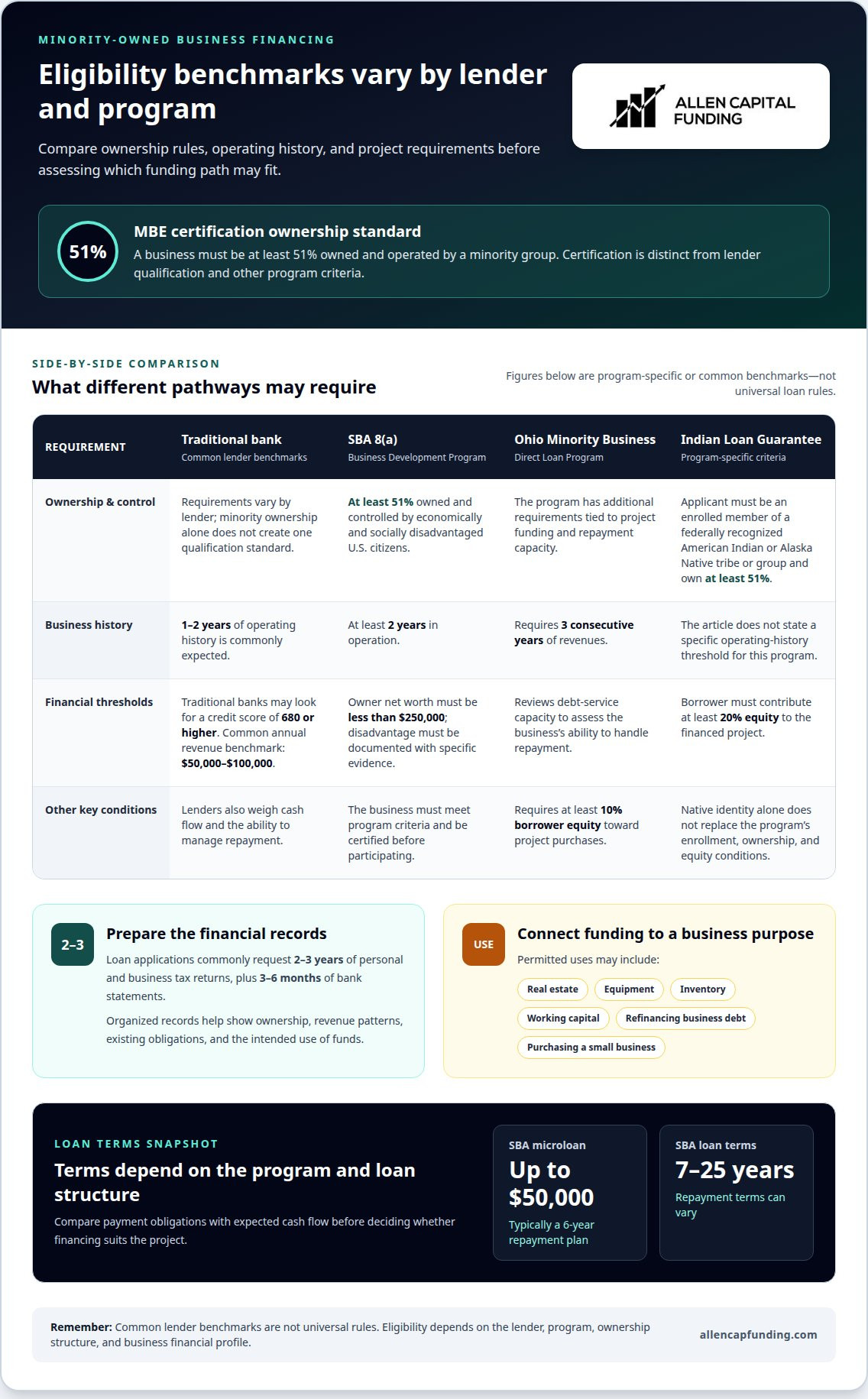
Eligibility for business loans for minority-owned businesses depends on the lender and program. Traditional banks may look for a credit score of 680 or higher. Many lenders expect 1–2 years of operating history and $50,000–$100,000 in annual revenue. These are common benchmarks, not universal rules. Lenders also weigh cash flow and the business’s ability to handle repayment.
Applicants commonly prepare 2–3 years of personal and business tax returns, plus 3–6 months of bank statements. Organized financial records help lenders assess revenue patterns, existing obligations, and whether the requested capital fits the business’s plans.
Permitted uses may include real estate, equipment, inventory, working capital, refinancing business debt, or purchasing a small business. When seeking business loans for minority-owned businesses, connect the requested funds to an eligible business purpose.
SBA microloans offer qualifying businesses up to $50,000, typically with a 6-year repayment plan. SBA loan repayment terms can range from 7 to 25 years. Rates and repayment schedules depend on the program and loan structure. Compare the payment obligations with expected cash flow before deciding whether a loan suits the project.
Minority ownership alone doesn’t establish one qualification standard. MBE certification requires a business to be 51% owned and operated by a minority group. The SBA 8(a) Business Development Program has separate criteria, including at least 51% ownership and control by economically and socially disadvantaged U.S. citizens, at least two years in operation, and documented disadvantage.
State programs can set additional requirements. The Ohio Minority Business Direct Loan Program requires three consecutive years of revenues and at least 10% borrower equity toward project purchases. It also reviews debt-service capacity. These criteria illustrate how program eligibility can combine ownership, business history, project funding, and repayment ability.
2. Eligibility for minority- and women-owned businesses
Eligibility depends on the funding source, ownership structure, and program purpose. A minority-owned business may need to show that a qualifying owner holds a required share and actively controls operations. MBE certification requires 51% minority ownership and operation. Women-owned businesses should review each lender or program’s ownership criteria, since requirements vary.
For the SBA 8(a) Business Development Program, a business must be at least 51% owned and controlled by economically and socially disadvantaged U.S. citizens. The owner’s net worth must be less than $250,000, and applicants must document disadvantage with specific evidence. Businesses must also meet program criteria and be certified before participating.
Some programs have narrower definitions. The Indian Loan Guarantee Program requires applicants to be enrolled members of a federally recognized American Indian or Alaska Native tribe or group. They must own at least 51% of the business and contribute at least 20% equity to the financed project. A “native” identity alone does not replace these program conditions.
Grant eligibility also varies. Many minority business grant programs require at least 51% minority ownership, while other sources may focus on location, industry, or project purpose. They apply through an eligible nonprofit or another entity, not directly.
To apply for a loan, identify the program first, then prepare ownership records and financial documents. Business loan applications commonly request 2–3 years of personal and business tax returns and 3–6 months of bank statements. Requirements differ, so organize records that show ownership, revenue, and the intended use of funds.
Watch for pressure to accept unclear terms, promises of guaranteed approval, or requests for sensitive account credentials. Before sharing information, review the repayment schedule, fees, and lender identity. A guarantee is no substitute for understanding the obligation: missed payments can strain cash flow and affect your ability to borrow later.
3. What Other Resources Are Available To Minority Small Business Owners?
Funding is only one part of business development. The Minority Business Development Agency helps facilitate over $1.8 trillion in revenue from minority-owned businesses. Its role makes it a useful resource for owners seeking business guidance, connections, and support beyond a loan program. Consider whether your immediate priority is capital, market access, or advice before choosing a resource.
Federal contracting can create another path to growth. According to the U.S. Small Business Administration, the federal government uses special programs to help small businesses win at least 23% of all federal contracting dollars annually. Eligible firms in the SBA 8(a) Business Development Program can compete for set-aside and sole-source contracts. That opportunity may suit a disadvantaged business ready to pursue government work, rather than borrow to cover an unrelated need.
The SBA 8(a) program also offers counseling, training, and management and technical guidance. Participation lasts nine years for eligible firms. Through the SBA Mentor-Protégé Program, participants can form joint ventures with established businesses. These resources can help owners build capacity for contracts and strengthen operations alongside funding plans.
For practical advising, Small Business Development Centers provide training and business guidance. The United States has nearly 100 SBDCs. An owner can use counseling to clarify a business plan, understand financing choices, or prepare for growth. Ask focused questions about cash flow, revenue projections, and the interest or repayment obligations attached to borrowing.
Match the resource to the next business step. A company pursuing federal contracts may benefit from 8(a) guidance; a business refining its plan may start with SBDC advising. For a project involving property, assess whether real estate financing fits the use and repayment plan. Grants, contracts, counseling, and loans serve different purposes, so a clear goal helps owners direct their time and funding efforts.
4. Small business loans for women- and minority-owned businesses
Women and minority entrepreneurs can compare financing by channel, not identity alone. SBA loans go through approved lenders; the SBA doesn’t issue them directly and partially guarantees them. Banks apply their own underwriting criteria, while CDFIs and online lenders set their own eligibility and repayment terms. Compare permitted uses, total repayment, and application requirements side by side. The right fit depends on cash flow and project needs, not simply a lender’s marketing to minority business owners.
State programs may offer targeted options. That can help owners connect funding to a specific purchase or operating need. Grants are another potential source, but each program sets its own eligibility rules and approved uses. Treat grants as a separate funding path, not a substitute for comparing loan terms.
Federal programs may also serve entrepreneurs in underserved communities. Participating lenders pledge at least 60% of their funding to underserved owners. This may make the program relevant to businesses seeking access to capital, while its loan structure still requires applicants to assess repayment obligations and qualification criteria.
Use a clear decision process. First, define whether you need funding for property, working capital, or another business purpose. Next, compare SBA, bank, CDFI, and online offers against that purpose. Then review repayment schedules and any guarantee requirements before accepting financing. Economically disadvantaged status may matter for specific federal programs, but it doesn’t automatically determine eligibility for every loan or grant. A focused comparison helps women- and minority-owned businesses pursue support that fits their goals.
Allen Capital Funding: SBA Loans
Allen Capital Funding helps small businesses assess funding options when a planned purchase or growth need calls for outside capital. If an SBA loan may fit your business purpose, its team can provide guidance on that route and other relevant financing choices.
For recurring cash-flow needs, consider a credit line; working capital financing can address day-to-day business requirements. Real estate financing may better suit a property purchase. Start by clearly describing your goal, how you’ll use the funds, and how repayment could fit your business finances.
When you’re ready to discuss business financing, contact Allen Capital Funding.
Make Your Next Financing Decision With a Clear Plan
Capital works best when it supports a defined business goal. Before choosing among business loans for minority-owned businesses, decide what the funding needs to accomplish and how repayment fits your plans. This focus helps you evaluate financing as part of a broader growth strategy, rather than treating it as an end in itself.
Allen Capital Funding offers SBA Loans, Credit Lines, and Real Estate financing. The team guides small businesses through funding options, including for owners weighing financing against their operating needs. A conversation can help clarify your funding purpose and identify an appropriate next step for your business.
Contact Allen Capital Funding to discuss your business financing needs. With a clear goal and a considered plan, you can move toward your next stage of growth with greater confidence.
Frequently Asked Questions
What Other Resources Are Available To Minority Small Business Owners?
Beyond lending, owners can explore business development support and competitive funding programs. The federal SBIR and STTR programs, known as America’s Seed Fund, provide over $4 billion each year in early-stage capital through competitive awards. These programs may suit businesses developing innovative products or technologies. Contracting support and business advising can also help owners build capabilities without treating a loan as the only growth tool.
Who Qualifies for Minority Small Business Loans?
Qualification depends on the lender and specific program, not minority ownership alone. Lenders assess business finances and repayment capacity, while targeted programs may also require qualifying ownership, control, or documentation of disadvantage. Start by identifying the exact program and distinguishing its ownership rules from its financial underwriting criteria. This helps applicants avoid assuming one certification automatically qualifies them for every funding source.
Can I get an SBA loan if I’m a startup?
A startup may pursue SBA financing, but eligibility depends on the loan program and lender’s assessment of the business. The SBA works with approved lenders rather than issuing loans directly, so applicants present their business plan, projected cash flow, funding purpose, and available financial records through the lender’s process. Some business development programs have additional eligibility requirements, so applicants should check the criteria for the specific program.
What credit score do I need for an SBA loan?
There isn’t one credit score threshold that applies to every SBA loan. The lender reviews the application, and traditional banks may look for a score of 680 or higher. Credit history is only one part of underwriting; lenders also consider the business’s financial picture and ability to repay. Before applying, review your credit reports for errors and prepare a clear explanation for any past issues.
Where Can I Get a Minority Business Loan?
You can apply through SBA-approved lenders, including banks and credit unions, because the SBA partners with lenders rather than making loans directly. State programs may provide another route, while community and online lenders offer additional options. Start by matching the lender’s financing purpose to your project, such as buying equipment or covering operating needs, then review the application process and repayment terms.
What business loan programs are available to minority-owned businesses in the U.S.?
Options include SBA 7(a), 504, microloans, and Community Advantage loans, along with state programs and the Indian Loan Guarantee Program for eligible applicants. SBA 504 financing is designed for real estate or large equipment purchases and provides long-term, fixed-rate financing. The right program depends on the planned use of funds, business profile, and any ownership or participation criteria the program sets.



Comments