
Short-term working capital financing and repayment options
A short-term loan can bridge a cash-flow gap, but the repayment schedule matters as much as the amount. Short-term working capital financing helps cover everyday operating costs, such as payroll, rent, supplies, or labor, while a business waits for revenue to arrive. Repayment periods commonly range from 3 to 18 months, with payments scheduled weekly or monthly.
When considering short-term working capital financing, focus on how the funds are provided and whether repayment fits your cash flow. A term loan delivers a lump sum to repay on a set schedule; a credit line provides revolving access to funds for changing needs.
This guide explains what working capital financing can cover, how repayment structures differ, and when financing may help a seasonal business manage slower periods. Compare term loans, credit lines, invoice financing, and other short-term options to see which structure fits your revenue patterns and operating needs.
Table of Contents
What is a Working Capital Loan?
A working capital loan funds everyday business expenses rather than long-term investments. It is most useful when the amount and repayment schedule match a specific cash-flow need.
Loan Definition and Purpose
Working capital is a business’s current assets minus its liabilities, and a working capital loan helps cover operating costs when cash is temporarily short. Business owners may use the funds for payroll, rent, supplies, or labor for a contract while waiting for customers to pay. Payment delays can last 30, 60, or 90 days, creating a gap between expenses and incoming revenue.
Estimate the need by forecasting near-term operating costs, subtracting available cash, and accounting for receivables and when they are expected to arrive. The amount borrowed should address the projected shortfall, not an unrelated long-term investment.
Predictable Loan Payments
Predictable payments are scheduled amounts you can include in a cash-flow budget. Map expected revenue and essential expenses for each payment period, then compare the remaining cash with the loan payment. This shows whether repayment fits your revenue timing, including slower collection periods.
Before borrowing, gather recent business bank statements and review business and personal credit. Qualification commonly depends on time in business, revenue consistency, and credit. Many lenders require 6-12 months of operating history; some may consider 3 months when sales are strong and consistent.
Repayment Timelines and Terms
Short-term loans typically have defined repayment periods of 3 to 18 months and are generally repaid within 18 months. Payments may be weekly or monthly, depending on the financing structure. Choose a schedule that aligns with predictable revenue, so due dates do not compete with payroll or other essential costs.
Approval and funding speed varies by lender and application. Alternative lenders can approve and fund working capital loans in as little as 24 hours, while direct short-term resources like quickcashdirect.com cater to rapid-access cash advances for urgent liquidity gaps. Complete financial records and a clear view of revenue can help a business present its borrowing needs.
Rates, Fees, and Tax Deductibility
There is no single typical interest rate or fee for every working capital loan. Pricing depends on factors such as credit, revenue consistency, repayment structure, and term. Compare the total repayment obligation and payment frequency, not just the advertised rate, to understand the effect on cash flow.
Whether loan interest and fees are tax-deductible in the United States depends on the business’s tax circumstances and how the costs are treated. Keep records of financing costs and have a tax professional determine their treatment for your business.
Daily, weekly, and monthly repayment schedules
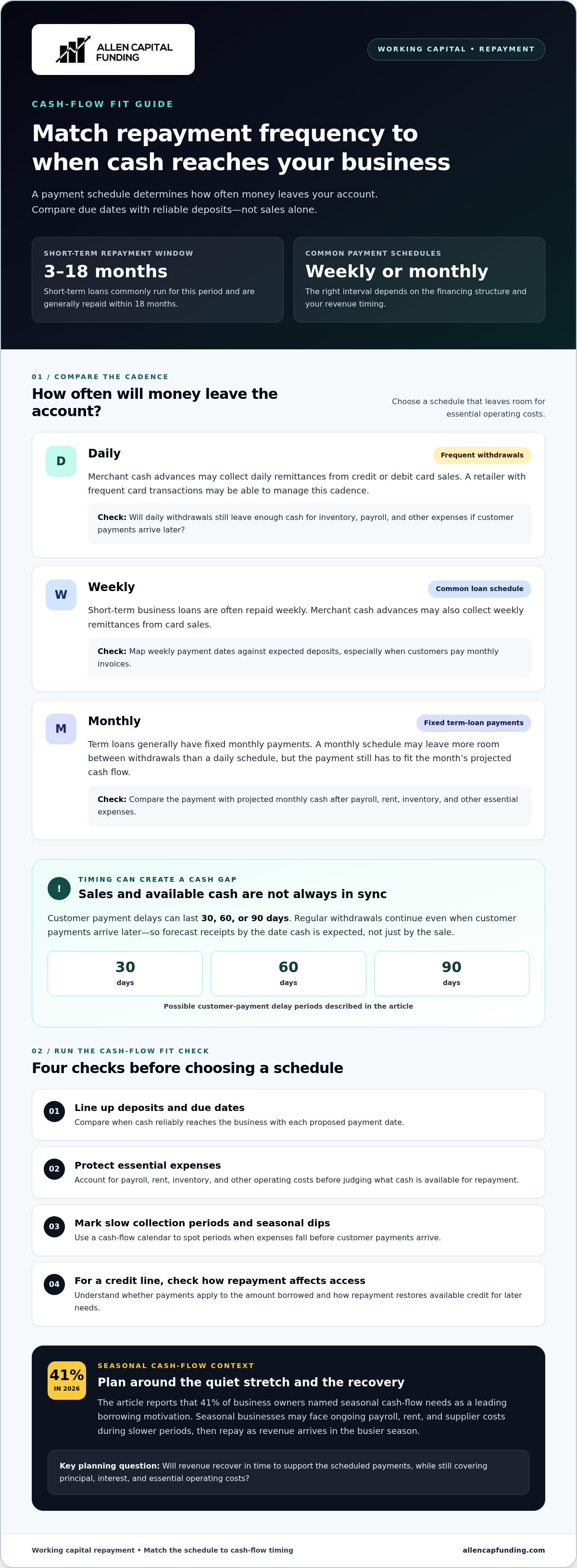
Repayment frequency determines how often money leaves your business account. Match the schedule to your revenue timing so payments don’t crowd out inventory purchases, payroll, or other expenses.
Repayment Frequency
Repayment frequency is the interval between required payments, commonly daily, weekly, or monthly. Short-term business loans are often repaid weekly or monthly, while term loans generally have fixed monthly payments. Merchant cash advances may collect daily or weekly remittances from credit or debit card sales.
Each structure affects cash flow differently. A retailer with frequent card transactions may manage daily remittances, while a contractor paid after completing projects may prefer less frequent payments. Review payment dates and how money is collected before accepting a financing structure. Regular withdrawals continue even when customer payments arrive later.
For a line of credit, understand whether required payments apply to the amount borrowed and how repayment restores available credit. Revolving access can help with recurring expenses, but it doesn’t remove the need to budget for each payment. Include scheduled loan payments and operating expenses in your cash-flow forecast.
Aligning Payments With Revenue
Align payments with revenue by choosing a schedule that fits when cash reliably reaches the business. Compare expected deposits with payment dates, then account for essential expenses such as payroll, rent, and inventory. If customers pay monthly invoices, map those receipts against weekly obligations before deciding whether the timing works.
Use a cash-flow calendar to identify slow collection periods, seasonal dips, and major expense dates. For example, if a supplier invoice is due before customer payments arrive, daily remittances may tighten available cash during the gap. A monthly schedule may leave more room between withdrawals, but the payment still needs to fit the month’s projected cash flow.
Revenue timing matters more than sales alone. A strong sales month can still leave limited cash if invoices remain unpaid. During an application, present realistic revenue expectations and recurring expenses, then compare the proposed schedule against those figures. For lines of credit, review how repayment affects the amount available for later inventory or operating costs.
Seasonal revenue fluctuations
Seasonal businesses often earn revenue in concentrated periods, while payroll, rent, and supplier costs continue year-round. Short-term funding can cover operating expenses during a quiet stretch, then be repaid as customer payments arrive during the busier season. In 2026, 41% of business owners named seasonal cash-flow needs as a leading borrowing motivation.
Estimate a seasonal cash-flow gap by mapping expected receipts against essential expenses for each period. For example, a landscaping company may need to cover wages and equipment costs before peak-season revenue arrives. The useful borrowing amount depends on that timing mismatch, not simply on expected busy-season sales.
Consider how long the gap will last and whether revenue will recover in time to support repayment. A short-term loan may suit a temporary need, while a term loan with a longer repayment horizon may better fit ongoing operational growth. In either case, include principal and interest in the forecast alongside payroll and supplier obligations.
Collateral can also affect borrowing capacity with asset-based financing. Available funding may fluctuate with the value of business collateral, such as eligible short-term assets. Seasonal changes in inventory or receivables can therefore affect how much funding is accessible. A working capital credit line may also be adjusted during its term as needs change.
Use seasonal financing to bridge a defined cash-flow gap, not to cover a lasting mismatch between revenue and expenses. Before borrowing, compare the expected repayment source with the business’s seasonal calendar. If busy-season receipts are delayed or lower than expected, scheduled payments may compete with restocking, hiring, or other growth-related costs. A realistic forecast helps show whether the borrowing period and repayment plan fit the business cycle.
Types of short-term working capital financing
Different financing structures serve different operating needs. A revolving line offers repeat access, while a term loan provides a lump sum with scheduled repayment. Invoice financing and business credit cards can also support working capital, but each affects cash flow and repayment differently.
A business line of credit lets you borrow, repay, and borrow again up to a set limit. It can suit recurring expenses, such as restocking inventory or paying vendors before customer receipts arrive. Working capital lines are typically secured by short-term assets, including accounts receivable and inventory. With asset-based borrowing, available capacity changes as collateral values change.
A term loan works differently: the business receives a lump sum and repays it on a defined schedule. This may suit a specific expense with a clear purpose, but it offers less flexibility for repeated borrowing. Repayment continues even if revenue timing changes, so compare scheduled payments with the cash available for operations.
Invoice financing can turn unpaid customer invoices into working capital. It may suit a business with completed work and delayed receivables, rather than one needing open-ended funds. Business credit cards offer another way to pay operating expenses, but consider their repayment terms and costs before using them as ongoing funding.
How do business lines of credit compare with short-term loans and invoice financing? A line allows repeated borrowing up to its limit; a short-term loan provides a lump sum with scheduled repayment, while invoice financing draws on unpaid receivables. Choose based on whether your need is recurring, tied to a defined expense, or linked to customer payment timing.
For a line of credit, interest is typically variable and charged only on the amount borrowed. Before applying, identify the expense, estimate when revenue can cover repayment, and assess whether you can make payments without restricting essential operations. Short-term working capital financing is most useful when it supports a defined cash-flow need rather than a long-term investment.
Allen Capital Funding: Credit Lines
Allen Capital Funding offers Credit Lines for businesses seeking working capital for operating needs. A credit line may suit recurring or changing expenses, such as purchasing inventory or managing a gap between expenses and incoming revenue. Consider how often you’ll draw funds, how repayment fits your cash flow, and whether the need is temporary or ongoing.
When comparing a credit line with a working capital loan or SBA loan, focus on the structure that best matches your business’s needs and repayment capacity. Allen Capital Funding offers guidance on funding options, including Credit Lines and Working Capital. Contact Allen Capital Funding to discuss which option may suit your business.
Choose a Financing Path That Supports Your Next Move
Use financing to support a clear business objective, not simply to increase available cash. Before moving forward, identify what the funds will enable, how that use supports operations or growth, and what repayment means for future plans. A focused purpose makes it easier to compare structures and assess their role in your broader financial strategy.
Allen Capital Funding offers credit lines, SBA loans, and real estate financing options for businesses with different funding needs. The right direction depends on the objective you’re pursuing and the financing structure that supports it. If you’re ready to explore your next step, contact Allen Capital Funding to discuss your business’s financing needs.
With a defined goal and a realistic repayment plan, you can treat short-term working capital financing as a considered business decision. Start with a clear plan and move forward with confidence.
Frequently Asked Questions
What makes these loans “short term”?
“Short term” generally means repayment is due within 3 to 18 months, a shorter horizon than traditional loans. This describes the full time to repay, not how often payments are due. A loan may have weekly or monthly installments within that term. Compare its final due date with when the business expects cash to recover, not only the size of each installment.
What is short-term working capital financing?
It is borrowing intended to cover near-term business cash needs rather than fund long-term assets. For example, a distributor waiting for customer invoice payments might use financing to meet supplier obligations before collections arrive. The practical test is whether there is a defined cash gap and an expected repayment source, making the borrowing temporary rather than a recurring substitute for operating revenue.
What are common financing options for U.S. businesses?
Common options include term loans, revolving lines of credit, invoice financing, and business credit cards. A line may be cash-flow-based or asset-based. The first focuses on the business’s ability to repay, while the second ties borrowing capacity to collateral such as receivables or inventory. Invoice financing draws on unpaid invoices and may suit businesses that have completed sales but are waiting for customer payments.
What credit score, revenue, and time-in-business requirements do lenders have?
Lenders commonly consider operating history, revenue consistency, and business and personal credit. Many require 6-12 months in business, while some consider applicants with 3 months of history when sales are strong and consistent. Credit score thresholds vary by lender and financing structure. Organize bank statements and financial records to show revenue patterns, existing obligations, and the business’s ability to make payments.
How can a business apply for short-term funding?
Start by defining the operating need, choosing a suitable financing structure, and preparing records that show repayment capacity. Gather recent business bank statements, review business and personal credit, and estimate the shortfall after available cash and expected receipts. For example, distinguish a seasonal inventory purchase from ongoing payroll needs so the funding request and expected repayment source are clear when applying for short-term working capital financing.
What are the risks and drawbacks of short-term working capital financing?
Key risks include payment pressure during a weak revenue period, financing costs, and overlapping debt obligations. Daily or weekly withdrawals can leave less cash for suppliers and other expenses. Missed payments on borrowing tied to an owner’s personal credit may also hurt that owner’s credit score. Avoid stacking short-term obligations, and compare the full repayment commitment with a realistic cash-flow forecast before borrowing.



Comments