
SBA Loan for Buying a Business: A 2026 Buyer’s Guide
Updated: 8 minutes ago
What matters most when financing an acquisition is not just the loan type. An SBA loan for buying a business may help finance a change of ownership, but the business’s cash flow, records, valuation, and deal structure all shape the financing review. Your experience, available contribution, and any seller financing may also affect how the transaction is assessed.
This guide explains how SBA financing may support an acquisition and what to prepare before discussing options. You’ll learn how the purchase price and business cash flow fit into the review, which buyer and business details may matter, and what financial and transaction documents to organize. SBA 7(a) financing is commonly used for business acquisitions, but the right path depends on the complete transaction and current requirements. Allen Capital Funding provides expert guidance and tailored funding options to help you assess your acquisition financing needs and plan your next step.
Table of Contents
Can an SBA loan help you buy a business? Start with the deal
SBA loan eligibility for buying a business: assess buyer and target
SBA 7(a) vs. 504 for an acquisition: compare the financing fit
How to prepare for an SBA business acquisition loan application
Explore an SBA loan for buying a business with Allen Capital Funding
Can an SBA loan help you buy a business? Start with the deal
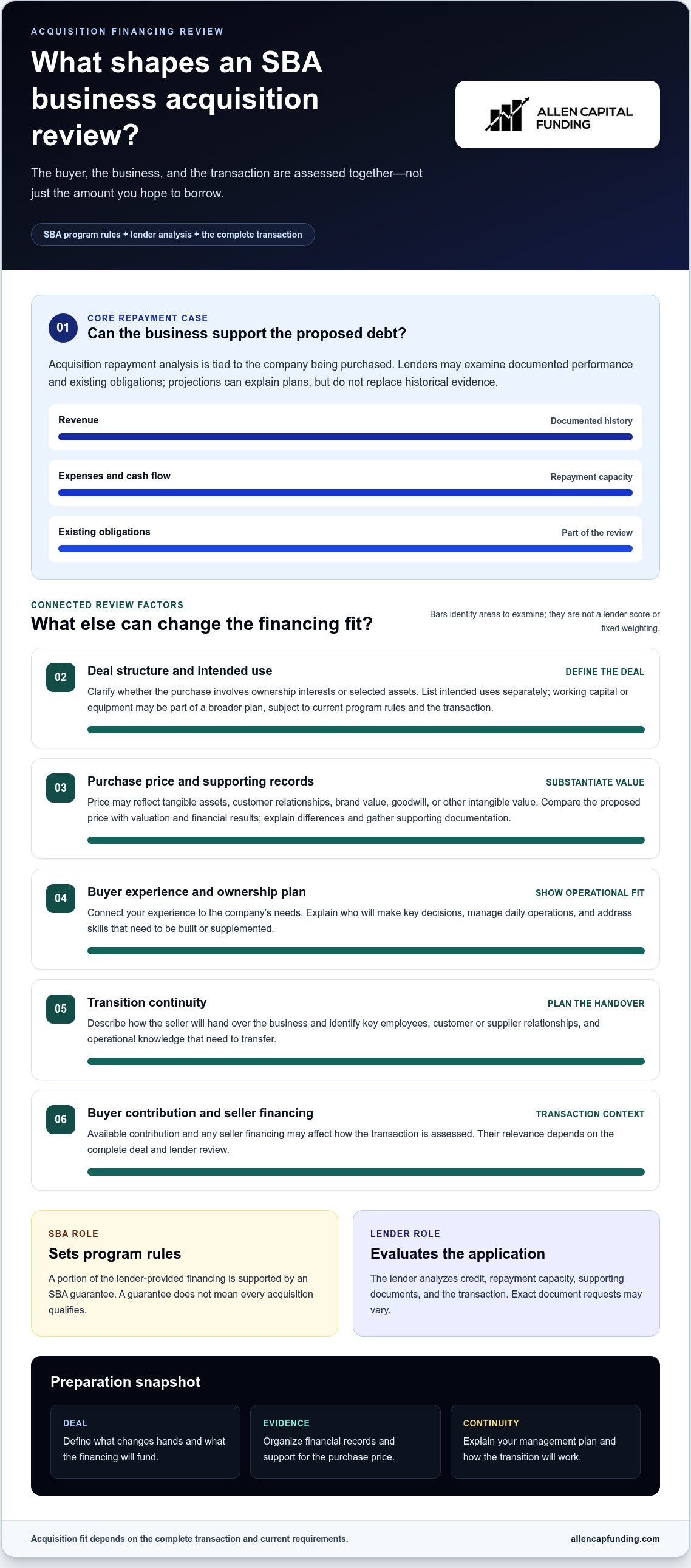
An SBA-backed loan is financing provided by a lender, with a portion supported by a guarantee from the U.S. Small Business Administration. The SBA sets program rules, while the lender evaluates the application and transaction. The Small Business Administration (SBA) supports small businesses through programs that include this type of financing, but a guarantee does not mean every acquisition qualifies.
Acquisition financing depends on the buyer’s ability to lead the business and the business’s ability to support repayment. The review may consider the deal structure, buyer, target business, financial records, and current SBA requirements together. Start with the business being purchased and the transaction itself, not just the amount you hope to borrow.
Buying an operating business differs from funding a startup or covering routine expenses. An established company may have financial history and operations to examine, although past performance does not guarantee future results. A startup may not have the same operating record, and a request for ordinary working capital has a different purpose from financing a change of ownership. Be clear about what the financing will fund and how it relates to the acquisition.
What parts of a business acquisition may need financing?
A purchase may involve acquiring ownership interests or buying selected business assets. The structure affects what changes hands and how the purchase is documented. Work through those details with qualified legal, tax, and financial advisers, such as Massingill Attorneys & Counselors at Law, rather than treating them as minor financing details.
Give the purchase price the same careful review. It may reflect tangible assets, customer relationships, brand value, goodwill, or other intangible value. These elements can be harder to substantiate than equipment or inventory, so the financing review may focus on how the price was determined and whether the records support it. If a valuation differs from the proposed price, identify the reason and gather documentation that explains the difference.
Working capital or equipment may also be part of a broader acquisition plan, but whether those costs fit depends on current program rules and the transaction. List each intended use separately in your deal outline instead of assuming every cost can be included in one financing request.
What makes acquisition financing different from an ordinary business loan?
For an acquisition, repayment analysis is tied to the company being purchased, not only to the buyer’s personal financial picture or future growth plans. A lender may review documented revenue, expenses, cash flow, and existing obligations to assess whether the business can support the proposed debt. Projections can explain your plans, but they do not replace evidence of historical performance.
Your experience and transition plan provide important context. The review may consider how your skills relate to the company, who will manage daily operations, and how the seller will hand over the business. Identify key employees, customer or supplier relationships, and operational knowledge that need to transfer. These details help explain how the business may continue after the ownership change.
No single factor determines eligibility. Use the initial review to identify gaps in the deal, records, or transition plan, then organize questions for a financing discussion. This makes an SBA loan for buying a business a specific transaction to assess against current requirements, rather than a general possibility.
SBA loan eligibility for buying a business: assess buyer and target
Eligibility has two parts. SBA program rules set the framework for who and what may qualify, while the lender analyzes credit, repayment capacity, and supporting documents. The SBA.gov loan programs page provides an overview of program categories, but acquisition details and lender requirements also shape the review.
Approval depends on program rules, lender analysis, and the complete transaction. Prepare to explain not only the business opportunity, but also how you plan to own, manage, and finance it. For the target company, examine whether its documented performance and obligations support the purchase plan.
Readiness involves more than a strong personal profile. A buyer with relevant management experience may still need to resolve gaps in the target’s records. A business with an operating history may still need a clear leadership plan for after closing. Treat the buyer and target as connected parts of one financing case.
What should a buyer be ready to explain?
Describe your experience with specific examples, such as managing a team, overseeing a similar operation, or working in the target’s industry. Explain the intended ownership structure and who will make key decisions after closing. A lender may request personal and business financial information to assess the application, although the exact documents vary. Present your experience and responsibilities accurately, and support plans for growth with clear assumptions.
Prepare a concise account of how you’ll take over daily operations and address any skills you’ll need to build or supplement. Specific details connect your background to the practical demands of the business.
Why do valuation and business records matter?
An independent valuation can inform purchase-price discussions and provide a documented basis for assessing the business. It does not automatically establish that a proposed price is supportable. Compare the valuation with the asking price, transaction structure, and company financial results. If those figures tell different stories, identify why and gather evidence to explain the difference.
For due diligence, organize available materials such as tax returns, financial statements, debt schedules, and operating records. Check that the information is consistent, and note questions about changes in revenue, expenses, liabilities, or customer concentration. For example, if a large share of sales comes from one customer, review how that relationship is documented and whether it may continue after the sale. Use the financing team’s document instructions to complete the file.
Before discussing financing, summarize your contribution and role, the purchase price and structure, the company’s earnings and obligations, and any unresolved record gaps. This gives the conversation a practical starting point without assuming the deal will qualify. Explore tailored SBA loan options with Allen Capital Funding as you shape the transaction and consider potential next steps.
SBA 7(a) vs. 504 for an acquisition: compare the financing fit
Start the comparison with what you plan to finance. A purchase may involve ownership interests, goodwill, equipment, real estate, or working capital, and these components do not automatically fit the same program. SBA 7(a) is a program to investigate for eligible acquisition financing. The 504 program focuses on eligible fixed assets, so it may be more relevant when a project includes qualifying property or equipment than when the main need is goodwill or an ownership purchase.
Use this overview to frame a financing discussion, not to assume a specific cost is eligible. Current SBA rules and lender review determine whether a transaction and its proposed uses fit. The SBA 7(a) loan program details explain the program framework. The deal’s structure and requested uses still need to be assessed together.
When might a buyer investigate an SBA 7(a) loan?
Buyers considering an ownership change can explore 7(a) financing as one potential route. Start by separating the purchase price into components, such as ownership interests, tangible assets, goodwill, and proposed post-close needs. Then map each item to its intended use of funds. Current program requirements and lender assessment determine what may be included, so do not assume that a familiar loan purpose means the full transaction qualifies.
How does an SBA 504 loan differ?
A 504 financing discussion centers on eligible fixed assets. It should not be assumed to cover every element of a business purchase. For example, qualifying real estate or equipment may warrant review, while goodwill and ownership interests are different purchase components that should not be presumed eligible under 504. If the acquisition also creates a separate need for post-close liquidity, a business line of credit may merit a distinct discussion. It is not interchangeable with acquisition financing, and its fit depends on the business’s needs and review.
For an SBA loan for buying a business, build the comparison around the actual uses of funds. Identify which costs relate to the ownership transfer, which relate to fixed assets, and which are separate operating needs. This helps distinguish program purpose, transaction structure, and lender analysis.
How to prepare for an SBA business acquisition loan application
A well-organized file turns an acquisition idea into a more focused financing discussion. Start with a clear account of what you plan to purchase, how the price was developed, and how you expect to operate the business. Then assemble the documents that support those assumptions. Preparation does not guarantee approval, but it can make gaps easier to identify and address.
Define the deal. Summarize the purchase structure, price, assets or ownership interests involved, proposed buyer contribution, and expected closing steps. Include a letter of intent or transaction summary when available and appropriate.
Gather records. Organize the target company’s financial statements, tax records, existing debt information, and relevant operating records. Label materials clearly by period and note missing documents.
Review assumptions. Compare the proposed price with financial performance and due diligence findings. Prepare projections that explain their assumptions, such as expected revenue, expenses, and transition costs, rather than presenting forecasts without context.
Discuss financing. Share the transaction summary and supporting materials in a financing conversation. The specific application checklist may differ from the documents that are useful for your own planning.
Which materials help clarify the acquisition plan?
Alongside the target’s financial records, prepare a concise buyer background, intended ownership structure, and outline of post-close responsibilities. Keep the purchase-price rationale consistent across the transaction summary, valuation materials, and financial records. If due diligence identifies a liability or a material difference in reported performance, explain how it affects the deal rather than leaving conflicting information unaddressed. Planning documents help organize the discussion, but they are not a universal application checklist.
How should buyers address seller financing and transition details?
If the seller may finance part of the transaction, document the proposed amount, repayment expectations, and any conditions under discussion. Treat seller financing as one part of the overall deal, not as an automatic substitute for the buyer’s contribution or a guaranteed way to meet program requirements. Include the proposal in your financing discussion and have qualified advisers review it, since current SBA rules and lender requirements can affect how it is treated.
Also outline the seller’s expected role after closing, the scope of any transition support, and who will handle key responsibilities. Put proposed arrangements in writing where appropriate, and keep draft terms consistent with the transaction summary. Clear documentation helps explain how ownership and operations will change.
How can buyers compare financing options responsibly?
Compare more than the headline payment. Review repayment obligations, collateral expectations, timing, and how each option fits the complete transaction. Asset-based lending is a separate financing category that may be considered for liquidity needs. Do not assume it serves the same purpose or has the same structure as an SBA acquisition loan. Review timelines and documentation needs as part of your planning, and allow for possible requests for additional information.
Allen Capital Funding offers tailored guidance as you organize your acquisition plan. Explore SBA loan guidance to learn more about financing options.
Explore an SBA loan for buying a business with Allen Capital Funding
A clear financing discussion starts with a clear picture of the acquisition. Define what you plan to purchase, how the transaction is structured, and what capital the business may need at closing and afterward. Then organize the financial information and due diligence materials you have. This preparation gives the conversation a practical focus, even if some details are still being resolved.
Allen Capital Funding helps businesses explore SBA Loans and other financing solutions through expert guidance and tailored funding options. The team can help you focus the discussion on your acquisition and financing needs. An SBA loan for buying a business may be one option, but the appropriate path depends on the transaction, business, buyer, and applicable program and lender requirements. Financing guidance is not a guarantee of approval.
What to bring into a financing conversation
Gather information that explains both the proposed purchase and your plans for the business. A complete application file can take shape over time. Begin with a concise summary and supporting materials:
The target business, its core operations, and your rationale for pursuing the acquisition.
The proposed purchase structure, price, and available valuation information.
Financial records and due diligence materials that describe the company’s performance and obligations.
Your intended ownership and management responsibilities after closing.
Key questions about the transaction, including unresolved assumptions that could change the amount or purpose of financing.
Separate confirmed information from estimates. If the purchase price or transition arrangements are still under discussion, label them as proposed rather than final. That distinction helps focus the conversation and shows where additional diligence may be needed.
How to move from acquisition idea to financing discussion
Bring your records and questions together around the deal’s capital requirements. Identify the amount intended for the purchase, any separate needs tied to eligible assets or operations, and what may be needed to support the transition. A focused outline makes it easier to distinguish settled parts of the plan from details that still depend on diligence or negotiation.
Financing paths should reflect the business and deal context, not just the loan label. Allen Capital Funding provides guidance to help businesses explore SBA loan options and consider how the transaction structure relates to their financing needs. A focused discussion can help you organize the next questions and identify useful information as you evaluate the acquisition.
If you’re ready to discuss your acquisition plan, book an online consultation with Allen Capital Funding. Bring the information you have, including open questions. You do not need every detail resolved to start a focused financing discussion.
Turn your acquisition plans into a clear financing conversation
An acquisition can move from possibility to decision quickly, so give your next step a practical focus: identify what you still need to learn before committing to the deal. Use that list of open questions to guide a financing discussion and clarify how an SBA loan for buying a business could fit your plans. You can begin exploring options before every detail is settled.
Allen Capital Funding offers SBA Loans and tailored funding options, with expert guidance to help businesses explore financing. A focused discussion can help you frame your acquisition needs and consider a path that reflects your deal. Financing decisions remain subject to program requirements and lender review.
Book an online consultation to explore tailored SBA financing and take a practical next step toward your acquisition.
Frequently Asked Questions
Can you use an SBA loan to buy an existing business?
Yes, an SBA loan for buying a business may support an eligible acquisition, but not every purchase meets the requirements. Before signing a binding agreement, map each planned use of funds to the transaction documents and identify conditions that still need to be satisfied. For example, clarify whether the deal transfers business assets or ownership interests. Review current SBA guidance and the proposed structure with Allen Capital Funding before relying on financing.
How much money do I need down to buy a business with an SBA loan?
There is no single down-payment amount that applies to every business acquisition. The buyer contribution can depend on the transaction structure, lender requirements, applicable SBA rules, and the buyer’s financial profile. Prepare a sources-and-uses outline that separates purchase funds, other transaction costs, and your available contribution. Then consider whether the plan still works if the final financing structure differs from your initial estimate.
What credit score do I need for an SBA business acquisition loan?
No single credit-score threshold applies universally to every SBA acquisition loan. A lender may consider credit alongside repayment capacity, financial history, the target company’s records, and the complete transaction. Before applying, review your credit information for errors or unexplained changes, and prepare context for any items that may raise questions. Allen Capital Funding can help you frame a financing discussion around the full transaction rather than a general online cutoff.
Can an SBA loan cover goodwill when buying a business?
Goodwill may be part of a business’s purchase value, but whether it can be financed depends on current program rules, deal structure, valuation, and lender review. Be prepared to explain how the seller arrived at the goodwill figure and how it relates to the overall purchase price. Keep that support with the valuation and transaction records, then review how the proposed use is treated before relying on it.
Can the seller finance part of a business purchase alongside an SBA loan?
Seller financing may be part of an acquisition structure, but its treatment depends on the agreement, lender review, and current SBA requirements. Do not assume a seller note automatically counts toward a buyer contribution or satisfies program conditions. Document the proposed balance, payment terms, and any seller role after closing. Include the arrangement in your financing discussion and have qualified advisers review it before making it a necessary part of your funding plan.
How long does it take to get an SBA loan to buy a business?
There is no universal timeline for an SBA business acquisition loan. Timing can be affected by incomplete records, valuation questions, due diligence findings, transaction complexity, lender workload, and applicable SBA review. Identify dates that could affect the purchase agreement, such as financing or diligence deadlines, and communicate them early in your financing discussion. Build flexibility into the plan in case additional information is needed.
Is an SBA 7(a) or 504 loan better for buying a business?
Neither program is automatically the better choice for every acquisition. A 7(a) loan may be worth exploring for an eligible ownership change, while 504 financing is generally associated with eligible fixed assets. If the deal combines a business purchase with property or equipment, separate those uses before comparing options. Review current program guidance and lender analysis to understand which parts of your specific transaction may fit each program.



Comments