
SBA 504 Loan for Real Estate: A 2026 Guide for Business Owners
Updated: Oct 22
Could your next commercial property qualify for an SBA 504 loan, or would another financing path fit better? The answer depends on more than the building. How your business will use the property, how much space it will occupy, and what the project needs funded all matter. An SBA 504 loan for real estate is designed for eligible fixed-asset projects, not every business expense.
The structure can be confusing, especially when a lender and a Certified Development Company (CDC) share the financing. A typical 504 project includes a private lender, a CDC-backed portion, and a borrower contribution, though the final mix can vary. Understanding occupancy rules and program limits can help you assess fit before discussing funding.
This guide explains which property projects may qualify, how the 504 structure works, and when the more flexible SBA 7(a) program may be a better match. You’ll also find practical ways to organize information before a financing discussion. Allen Capital Funding helps business owners evaluate SBA and commercial real estate financing options in light of their project goals.
Table of Contents
What an SBA 504 Loan for Real Estate Can Finance
An SBA 504 loan for real estate helps eligible small businesses finance major fixed assets that support operations and growth. The program may fund commercial property and certain long-term equipment, but it isn’t designed to cover every business expense. Working capital and inventory, for example, don’t fit its fixed-asset focus.
Think of the property as part of the operating plan, not simply an investment. A manufacturer seeking production space, a distributor expanding warehouse capacity, or a company moving into a facility it will occupy may have a project worth evaluating. The SBA 504 Loan Program overview provides context on the program’s purpose and fixed-asset focus. Specific eligibility and permitted uses depend on current SBA requirements.
Which commercial property projects may fit a 504 loan?
Potential projects include buying land or an existing commercial building, constructing a new facility, or making eligible improvements to a building. The central question is how the property investment will serve the operating business.
Purchase: A business may explore buying a facility for manufacturing, customer service, storage, or another core operation.
Construction: A company outgrowing its current space might plan a purpose-built facility to support operations or expansion.
Renovation: Eligible building improvements may adapt an existing property to the business’s needs, subject to program rules.
These examples describe possible project goals, not automatic approval. Property type, project scope, business eligibility, and intended use all matter. A 504 project may also include long-term machinery or equipment as part of an eligible fixed-asset plan. Review current SBA rules when a project combines property work with other expenses, since not every cost will necessarily qualify.
Why business use and occupancy matter
A 504 real estate project is intended to support the borrower’s operating business through ownership and active use of the facility.
That purpose distinguishes an operating location from property held mainly to earn rental income or appreciate in value. A business buying a site for its own production or distribution needs has a different purpose from an investor acquiring a building to lease to unrelated tenants. The 504 program generally focuses on the former, not passive property investment.
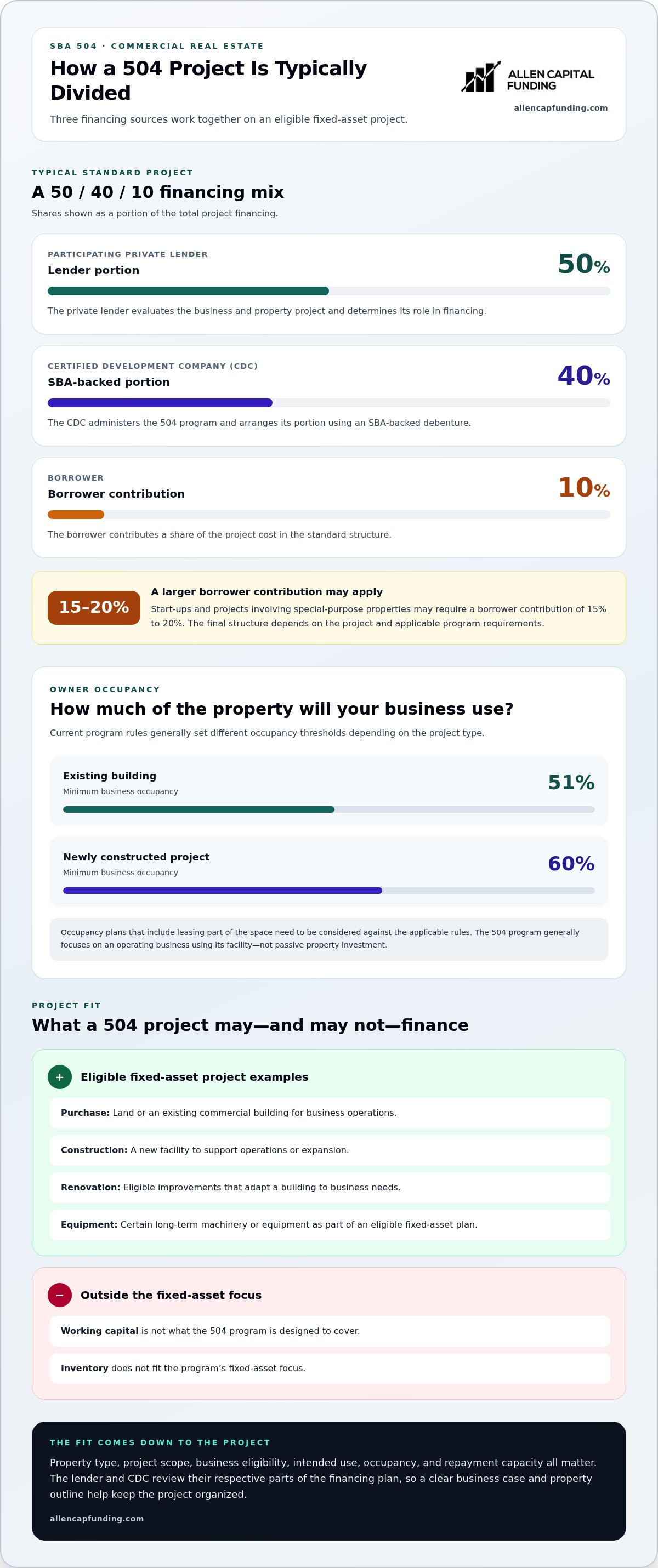
Owner occupancy is a central fit consideration. Current program rules generally require the business to occupy at least 51% of an existing building or 60% of a newly constructed project. These thresholds can affect a plan that includes leasing part of the space. Organizations evaluating their facility needs can turn to occupier-focused advisors like Resolute Global to help plan space requirements. Consider how the rules apply to the specific property and occupancy plan before moving forward.
The business must also meet applicable SBA size standards and other program requirements. Before evaluating a property, outline what the business will do there, which operations will occupy the space, and how the project supports growth. This practical outline helps clarify whether 504 financing may fit.
How the SBA 504 Real Estate Financing Structure Works
A 504 project typically involves the borrower, a participating private lender, and a Certified Development Company (CDC). Rather than relying on one source for the full project, financing is divided between the lender’s portion and an SBA-backed portion arranged through the CDC. Each participant reviews the project from a different angle, so a clear plan helps the process stay organized.
For a standard project, the typical structure is 50% from a private lender, 40% through a CDC using an SBA-backed debenture, and a 10% borrower contribution. Those shares aren’t universal. Start-ups and projects involving special-purpose properties may require a borrower contribution of 15% to 20%. The final structure depends on the project and applicable program requirements.
What the participating lender and CDC each do
The participating lender evaluates the business and property project, determines its role in financing, and reviews whether the proposed debt fits the borrower’s financial position. The CDC is an SBA-licensed nonprofit that administers the 504 program and serves as the main point of contact for its SBA-backed portion. The lender and CDC coordinate their respective parts of the financing plan.
For the borrower, this means the process involves more than submitting one application and waiting for a decision. The lender and CDC assess the project within their respective roles, and the information needs to explain both the business case and property details. An SBA 504 loan for real estate is best approached as a coordinated financing plan, with the project scope and repayment capacity clearly presented from the start.
What happens during review and repayment planning
Start with a defined project plan. Describe the property, its intended business use, the purchase or work involved, and how the project supports operations. Then organize materials that show the company’s financial position and ability to manage the proposed debt.
Business finances: Prepare financial statements, tax records, and relevant business information that show the company’s financial performance.
Property details: Gather purchase or construction information, project costs, and a clear outline of intended business use.
Repayment outlook: Build projections around realistic revenue, expenses, and cash flow, including the effect of the property on ongoing operations.
Review may involve follow-up questions, supporting documents, and coordination between the lender and CDC. Requested documents and timing depend on the project and the participants’ processes. Avoid building the repayment case around best-case growth alone. Show how the business expects to make payments under practical assumptions, accounting for existing obligations and the costs of operating the property.
Preparation can help surface questions early. Allen Capital Funding provides tailored guidance for businesses evaluating SBA and commercial real estate financing. Owners considering an SBA financing discussion can bring a project outline, financial records, and cash-flow assumptions to make the conversation more focused.
SBA 504 vs. 7(a) for Real Estate: How to Compare the Options
Both SBA 504 and 7(a) financing may support a commercial property project, but they address different needs. A 504 loan centers on eligible fixed assets. A 7(a) loan offers a broader range of potential business uses, which may matter when a property purchase is only one part of the funding plan. Compare the full project, not just the property price.
Program requirements, eligible uses, rates, limits, and terms can change. Use this as a general comparison, then review current SBA guidance and the details of your project. Avoid relying on outdated figures when evaluating either option.
When a property-focused 504 structure may suit the project
A 504 structure may be worth exploring when the main goal is to acquire, construct, or improve a facility the business will use over the long term. Consider how much of the property the company plans to occupy, what operations will take place there, and whether the investment fits an eligible fixed-asset purpose. A potential program match is only a starting point. The borrower and project must still satisfy applicable requirements and pass review.
When to compare a 7(a) loan instead
Compare 7(a) if the property project also involves other eligible funding needs. For example, an owner acquiring a facility may need working capital to support the transition or maintain operations during expansion. Because 7(a) can cover a broader range of potential business uses, it may better suit a combined project, subject to current rules and underwriting.
List every planned use of funds before comparing options. Separate property costs from operating needs, then decide whether the project is primarily a fixed-asset investment or a broader financing package. That distinction helps frame a focused discussion about the SBA 504 loan for real estate and its alternatives. Consider how SBA financing options align with the project’s full funding needs.
How to Prepare Your Business for an SBA 504 Real Estate Loan
A focused preparation process helps explain what the property will do for your business and how the project fits its finances. Start with the operating plan, then gather records that support the project scope and repayment assumptions. Requirements vary by project and financing participants, so use this as an organizing checklist, not a definitive list of required documents.
Build a clear property and project plan
Describe the property’s intended business use, the work involved, and the expected effect on operations. For an SBA 504 loan for real estate, reviewers need to understand the connection between the property and the operating business, not just the purchase plan. Include occupancy assumptions and a realistic timeline, since both can shape eligibility review and project assessment.
Define the purpose and occupancy plan. Explain why the business needs the property, which activities will take place there, and what portion of the space it expects to occupy.
Set out the project scope. Summarize whether the plan involves a purchase, construction, or renovation. Separate property work from other business needs so the proposed uses are easy to understand.
Collect available property information. Organize purchase details, construction plans, renovation estimates, and other documents that describe the site and project. Identify assumptions or open items instead of presenting estimates as final facts.
Show the operating impact. Explain how the facility may affect capacity, workflow, storage, customer access, or another business function. Connect expected changes to the company’s operating plans.
Organize business finances and repayment assumptions
Prepare accurate financial statements, tax information, and records that show how the business operates. Organize materials by period and check that the figures tell a consistent story. Build projections that account for proposed loan payments alongside payroll, existing obligations, property operating costs, and other regular expenses. Use supportable assumptions rather than best-case growth alone.
Financial records: Assemble business statements, tax filings, and operating records that are available for review.
Cash-flow projections: Explain projected revenue and expense assumptions, including how the business expects to manage payments during a transition or expansion.
Project documents: Keep property and business materials together, clearly labeled, with a short summary of what each item supports.
Before submitting information, compare your package against current SBA requirements and the participating lender’s documentation process. Requested materials can vary, so track what’s ready and what still depends on project decisions. Commercial real estate financing considerations can also help you organize questions about the property’s role in the business plan.
With a defined project, organized records, and realistic cash-flow assumptions, you can make the financing conversation more productive. Explore SBA and real estate financing options with guidance tailored to your business project.
Explore an SBA 504 Loan for Your Business Real Estate Project
Choosing a financing path starts with the project itself. Before exploring an SBA 504 loan for real estate, consider how the property will serve your business, what portion of the space you plan to occupy, and whether the project fits the program’s fixed-asset focus. Weigh repayment capacity and current SBA requirements against your longer-term facility plans. These questions can guide a financing discussion, but they don’t determine approval.
What to bring to a financing conversation
You don’t need every detail finalized to discuss your goals. Bring the information you have, identify open questions, and explain how the property supports your business. A clear starting point makes it easier to explore options and identify details that need further review.
Property plan: Summarize the property, its intended business use, occupancy plans, and how the space supports operations.
Project scope and timing: Outline the purchase, construction, or improvement plans, along with the expected timeline and major assumptions.
Business financials: Gather available financial statements, tax information, operating records, and existing debt details.
Repayment assumptions: Prepare realistic cash-flow projections that account for regular expenses and the proposed financing.
Questions for discussion: Note what you want to understand about eligibility, financing structure, documentation, repayment planning, and how project details may affect the process.
Keep estimates distinct from confirmed costs or decisions. If construction plans are still developing, for example, explain which elements are established and which remain preliminary. This context keeps the financing discussion grounded in the project as it stands, rather than assumptions that may change.
How tailored funding guidance supports the next step
Allen Capital Funding helps businesses explore SBA and commercial real estate financing options in light of their project goals. An online consultation is an opportunity to discuss the property plan, broader capital needs, and potential financing paths. It can help organize the questions to address as you evaluate fit, but it isn’t a promise of approval or a substitute for program and lender review.
The most useful discussion connects the property to the business as a whole. A facility purchase may be central to the plan, while occupancy, project timing, cash flow, or other funding needs shape the questions that follow. Tailored guidance can help frame those considerations and clarify what information may be relevant as you explore options.
Bring your project outline and financial assumptions, even if some details are still taking shape. Allen Capital Funding can help you discuss financing options around your business’s needs and real estate plans. Discuss your real estate financing options as a practical next step, without assuming that one program fits every project.
Turn Your Property Plan Into a Clear Financing Conversation
Your next step doesn’t have to be a final decision. Use the discussion to test project assumptions, understand what information may be needed, and consider whether an SBA 504 loan for real estate fits your business plans. A focused conversation can bring the property goal and broader financing needs into alignment.
Allen Capital Funding offers SBA loan and real estate financing solutions, with tailored guidance and online consultations to help business owners explore options for their projects. Bring your goals and the questions you still need to resolve. You can discuss possible paths without assuming approval or committing to a particular program.
When you’re ready, discuss your real estate financing options with Allen Capital Funding and take a focused next step toward understanding what may support your business’s growth.
Frequently Asked Questions
Can a startup apply for an SBA 504 loan for real estate?
Yes, a startup may apply, but it must meet applicable SBA and lender requirements, and approval isn’t automatic. A newer business may face additional review because it has less operating history to demonstrate repayment capacity. Startups and projects involving special-purpose properties may also require a borrower contribution of 15% to 20%, compared with the typical contribution for a standard project. Prepare a detailed business plan and supportable financial projections.
Can an SBA 504 loan be used to refinance commercial real estate debt?
Sometimes, but refinancing is subject to specific SBA program rules, and not every commercial property debt qualifies. The debt, property, and borrower must meet the requirements for the proposed refinance. Gather the existing loan documents and property details, then review eligibility under current SBA guidance. Don’t assume a 504 loan can replace any existing commercial mortgage simply because the property is business-related.
How long does it take to close an SBA 504 real estate loan?
There isn’t one reliable closing timeline for every SBA 504 real estate loan. Timing can depend on how complete the application is, the complexity of the property or construction plan, and the review and documentation processes of the participating lender and CDC. A purchase agreement with deadlines may add urgency. Organize financial and property records early, and include key transaction dates in the financing discussion.
Does an SBA 504 loan require a personal guarantee?
Yes. Under the program information provided for this guide, business owners must personally guarantee the loan. A guarantee is a personal commitment connected to the business’s borrowing, so understand the obligation before proceeding. Review the proposed financing documents carefully and discuss how the guarantee applies to the owners involved. The specific documents and requirements are determined during the financing review.
Can an SBA 504 loan cover renovation or construction of a business property?
It may finance eligible construction or building improvements when they form part of a qualifying fixed-asset project. For example, a business planning a facility expansion could explore whether the proposed building work fits the program’s permitted uses. Keep project plans and cost information organized, and distinguish building improvements from unrelated operating expenses. Eligibility depends on the project details and current SBA requirements, so don’t assume every renovation cost qualifies.
Is an SBA 504 loan suitable for an investment property?
Generally, the program is intended to support a business’s own operations, not passive property investment. A building acquired mainly to collect rent from unrelated tenants may not fit the owner-occupied purpose of 504 financing. The business’s planned use and occupancy are central to assessing fit. If a property has both business and rental use, review its occupancy plan and structure carefully against current SBA rules.
What documents should I prepare for an SBA 504 real estate application?
Start with business financial statements, tax information, and operating records, then gather documents that explain the property and project. Depending on the transaction, useful items may include a purchase agreement, construction or renovation plans, project estimates, and occupancy details. Prepare cash-flow projections that account for existing obligations and expected property expenses. The lender and CDC determine what documentation they need, so requirements can vary by project.



Comments