
SBA 504 Loan Eligibility: Requirements and Terms Explained
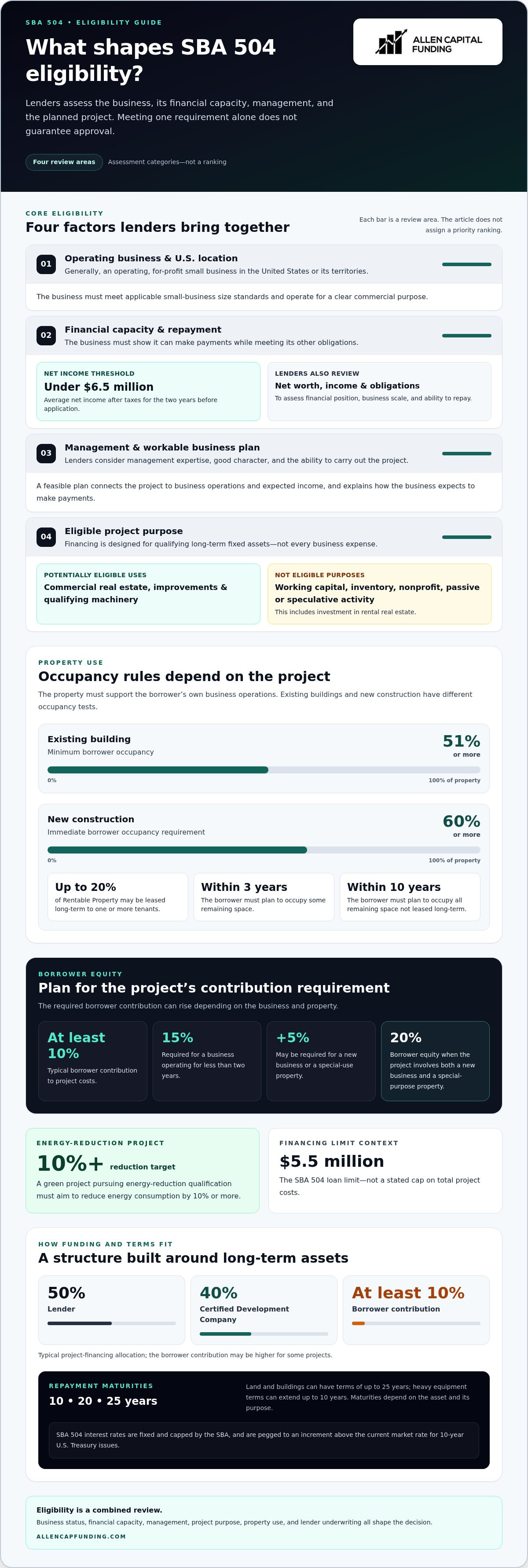
SBA 504 loan eligibility starts with the business and the project, not just the borrower’s credit profile. A qualifying applicant is generally an operating, for-profit small business in the United States or its territories, and the financing must support an eligible business purpose. For an existing building, the U.S. Small Business Administration requires the borrower to occupy at least 51% of the property.
It’s reasonable to want a clear answer before investing time in an application. Eligibility also depends on financial capacity, business size, property use, and lender underwriting, so meeting one requirement doesn’t automatically mean approval. This guide explains the basic rules, the lender requirements that shape a decision, how owner occupancy works, and the terms that can affect your financing plan. You’ll also see where SBA 504 financing fits best, and when another funding approach may better match the need.
Table of Contents
What Are Lender Requirements with an SBA 504 Loan?
Qualifying businesses are generally operating, for-profit small businesses in the United States. They must pursue an eligible business purpose, meet financial and size standards, and show they can repay. What businesses qualify for an SBA 504 loan? Those that meet these core tests and aren’t engaged in nonprofit, passive, or speculative activities.
Business Size and Financial Thresholds
Financial and size thresholds help determine whether a company fits the program and can support repayment. A business must meet applicable small-business size standards and have average net income under $6.5 million after taxes for the two years preceding its application.
Net worth is part of the eligibility assessment. Lenders review the business’s financial position, income, and ability to make payments while meeting other obligations. These measures help determine whether the proposed financing fits the company’s scale and financial capacity.
For-Profit and U.S. Operations
The applicant must operate for profit in the United States, and its activities must meet program rules. This requirement reflects the program’s purpose: supporting an operating business with a clear commercial objective, not nonprofit operations or passive investment.
Business purpose matters, too. SBA 504 financing cannot support nonprofit, passive, or speculative activities, including investment in rental real estate. A company planning to buy property for its own operations should distinguish that project from purchasing property solely to earn rental income. The use of the financed asset helps shape the eligibility review.
Management Experience and Business Plans
Lenders assess whether management has the expertise to carry out the project and run the business. Repayment depends on more than the asset being financed: the company also needs capable leadership and a workable operating plan.
A feasible business plan links the project’s purpose to the company’s operations and expected income. Lenders also consider good character and ability to repay. For example, a plan to acquire equipment should explain how it will support business activity and how the company expects to make payments from operating income.
In practice, SBA 504 loan eligibility brings these tests together: business status, financial capacity, management, and project purpose. Lender and program requirements can vary, so organize financial records and a clear project rationale to show how the business meets the relevant criteria.
What Are SBA 504 Loan Terms and Why Choose an SBA 504 Loan?
The U.S. Small Business Administration sets the maximum SBA 504 loan amount at $5.5 million. That is the loan limit, not a stated cap on total project costs. Total project financing depends on the project budget and how the borrower, lender, and Certified Development Company divide the funding.
A typical SBA 504 structure allocates 50% of the project financing to a lender, 40% to a Certified Development Company, and at least 10% to the borrower. This arrangement can help a business plan a major fixed-asset purchase without funding the entire cost through one loan. The actual borrower contribution may be higher for some projects.
Repayment terms depend on the asset and its purpose. SBA 504 loans have maturities of 10, 20, or 25 years. Land and buildings can have terms of up to 25 years, while heavy equipment terms can extend up to 10 years. Matching the term to the asset’s useful life helps a business plan its payments against the benefits the asset is expected to provide.
Interest rates on SBA 504 loans are fixed, and the SBA caps them. The rate is pegged to an increment above the current market rate for 10-year U.S. Treasury issues. A fixed rate makes scheduled principal and interest more predictable, while the loan balance declines through repayment. The specific term and rate structure relate to the project and debenture.
These loans are designed for long-term assets such as commercial real estate, improvements, and qualifying machinery, rather than working capital or inventory. That distinction matters: a building purchase may suit the program, while a short-term cash-flow gap calls for a different financing structure. Businesses weighing a property purchase can explore commercial real estate financing as part of their funding plan.
Owner-occupancy requirements
For an existing building, the U.S. Small Business Administration requires an SBA 504 borrower to plan to occupy at least 51% of the property. New construction follows a separate occupancy schedule, with rules for immediate use, later expansion, and tenant space.
For new construction, the U.S. Small Business Administration allows long-term leasing of up to 20 percent of the Rentable Property to one or more tenants if the Borrower immediately occupies at least 60 percent. The Borrower must plan to occupy some remaining space within three years and all remaining space not leased long term within ten years.
These standards connect the project to the business’s operations. A lender considers the planned use, property layout, and business plan to determine whether the space supports the applicant’s own activities. Buying a building mainly to rent it out is different: SBA 504 loans cannot fund speculation or investment in rental real estate.
Equity requirements can also affect project planning. A typical borrower contributes at least 10% of project costs. A business operating for less than two years must provide 15% equity; a new business or special-use property may require an additional 5%. If the project involves both a new business and a special-purpose property, borrower equity is 20%.
Project purpose matters beyond occupancy. A green project pursuing energy-reduction qualification must aim to reduce energy consumption by 10% or more. That target shapes eligible improvements and the project’s supporting plans.
How do SBA 504 eligibility rules differ from SBA 7(a) loan requirements? Their basic eligibility requirements are nearly the same, but 504 financing is tied to qualifying fixed-asset projects and owner occupancy. Both programs assess the business and its ability to repay, while the 504 project must also satisfy its property-use rules.
Basic SBA 504 loan eligibility
Understanding SBA 504 loan eligibility means looking beyond the property or equipment being financed. The applicant must be an operating, for-profit small business in the United States or its territories, with a sound business purpose and the ability to repay. The project must also meet program objectives, such as job creation or public policy goals. Nonprofit, passive, and speculative activities are ineligible.
Financial capacity is a central part of the review. The business must meet SBA size standards, and its average net income after taxes must be under $6.5 million for the two years preceding the application. Lenders also assess net worth, existing obligations, and cash flow to judge whether the business can make payments and keep operating. There is no single credit score that overrides these broader financial measures.
The applicant must show it cannot obtain financing on reasonable terms elsewhere. It must also have no delinquencies on government loans, including federal student loans. Review business and ownership obligations before applying, and explain relevant financial history clearly. Approval still depends on the lender’s underwriting, the project’s purpose, and evidence that repayment is feasible.
Management and project readiness matter alongside the numbers. Qualified managers, good character, and a feasible business plan help show that the company can complete the project and use the asset productively. For example, a facility purchase plan should connect the property to business operations, projected income, and public benefit. The lender also evaluates whether the project use is eligible and reviews supporting financial information.
A practical first step is to compare the proposed project with these tests: eligible business, sound purpose, repayment capacity, and program objectives. A commercial property purchase may warrant exploring real estate financing options alongside the SBA 504 path.
Allen Capital Funding: Credit Lines
Allen Capital Funding helps businesses consider financing options suited to their needs, including Credit Lines, SBA Loans, Real Estate, and Working Capital. If your project involves an eligible fixed asset, an SBA loan may be worth exploring. For other business needs, a credit line or working capital may be a better fit.
Start with what the funds need to support: a property purchase, planned business expenses, or an ongoing need for capital. Comparing the financing purpose with available options can clarify your next step. Allen Capital Funding provides expert guidance and tailored funding options to help you evaluate the possibilities.
Contact Allen Capital Funding to discuss financing options that may fit your business goals.
Plan Your Next Financing Move
Turn your eligibility review into a practical funding plan. Define the asset or business need, then consider how its timing and purpose fit your broader capital strategy. This creates a clearer basis for discussing financing options and preparing for next steps.
Your SBA 504 loan eligibility assessment can also help identify when another funding route deserves consideration. Allen Capital Funding offers SBA Loans, Credit Lines, and Real Estate solutions, giving business owners options to explore in relation to their goals. The right direction depends on what your business needs the capital to accomplish.
Bring your project goals and financing questions into a focused conversation. Contact Allen Capital Funding to discuss a path forward for your business. A clear plan can help you approach your next growth decision with confidence.
Frequently Asked Questions
What is the 504 loan program?
The 504 loan program provides long-term financing for qualifying fixed assets through Certified Development Companies (CDCs). Businesses may use it for projects such as acquiring or improving operating property or purchasing major equipment. It isn’t a general-purpose cash reserve. A useful first test is whether the requested funds connect to a specific asset that supports the business’s operations.
How do I apply?
Start by defining the project, its purpose, and the asset the financing would support. SBA 504 financing is available through CDCs, and a lender also participates in the typical project structure. Applicants need personal and business tax returns for the most recent three years. Organizing those records alongside a clear project plan gives the financing review a practical starting point.
What Is a 504 SBA Loan and How Do 504 Loans Work?
An SBA 504 loan pairs financing from a lender with funding through a CDC for an eligible fixed-asset project. The borrower repays the financing over a term suited to the project. For example, a business planning to acquire a facility and install machinery should present both costs as parts of the defined project. The funds support eligible project assets, not everyday cash needs.
Can I Get an SBA 504 Loan for a Startup?
A startup can meet SBA 504 loan eligibility rules, but its equity contribution may be higher. A business operating for less than two years must provide 15% equity. If the project involves both a new business and a special-purpose property, the borrower equity requirement is 20%. A startup should account for that contribution while planning its project budget and available capital.
What Are Certified Development Companies?
Certified Development Companies, or CDCs, are organizations through which SBA 504 financing is made available. They participate in the project alongside a lender and the borrower. For a business owner, the CDC’s role is especially relevant when assessing whether a proposed fixed-asset project fits the program. The project plan should clearly connect the asset to the business’s operations and purpose.
What Industries Can Benefit from SBA 504 Loans?
The program is not limited to one named industry. Eligibility depends on meeting program rules and pursuing an eligible fixed-asset project. A manufacturer could consider financing long-term machinery, while a business operating from commercial property could explore an eligible purchase or improvement. Nonprofit, passive, and speculative activities are excluded, so both the business’s activities and the project’s purpose matter.



Comments