
My Bank Rejected My Business Loan Application, Now What? A 2026 Guide
Updated: Oct 20
Does a bank’s “no” mean your business isn’t financeable? Not necessarily. If you’re asking, “my bank rejected my business loan application now what,” start by treating the decision as a signal to investigate, not a final verdict. A rejection can reflect a specific concern about credit, cash flow, time in business, or documentation. It doesn’t automatically mean every lender or financing structure will reach the same decision.
It’s understandable to feel stuck, especially when a purchase, payroll need, or growth opportunity can’t wait. Rushing into another application without understanding the first decision may leave the same issue unresolved. The right next step depends on why the bank declined the request, how soon you need funds, and what repayment the business can support.
This guide explains how to get clarity on a denial, identify what may need attention, and decide whether to reapply or consider another funding path. You’ll also learn how options such as a credit line, working capital, equipment financing, factoring, purchase order financing, or an SBA loan may fit different business needs. The goal is to make your next financing decision with a clearer view of the trade-offs.
Table of Contents
My Bank Rejected My Business Loan Application: What Should I Do First?
Why Banks Reject Business Loan Applications, and What Each Reason Signals
Which Business Financing Options Could Fit After a Bank Loan Denial?
How to Strengthen Your Business Loan Application Before Reapplying
How Allen Capital Funding Can Help You Map Your Next Funding Step
My Bank Rejected My Business Loan Application: What Should I Do First?
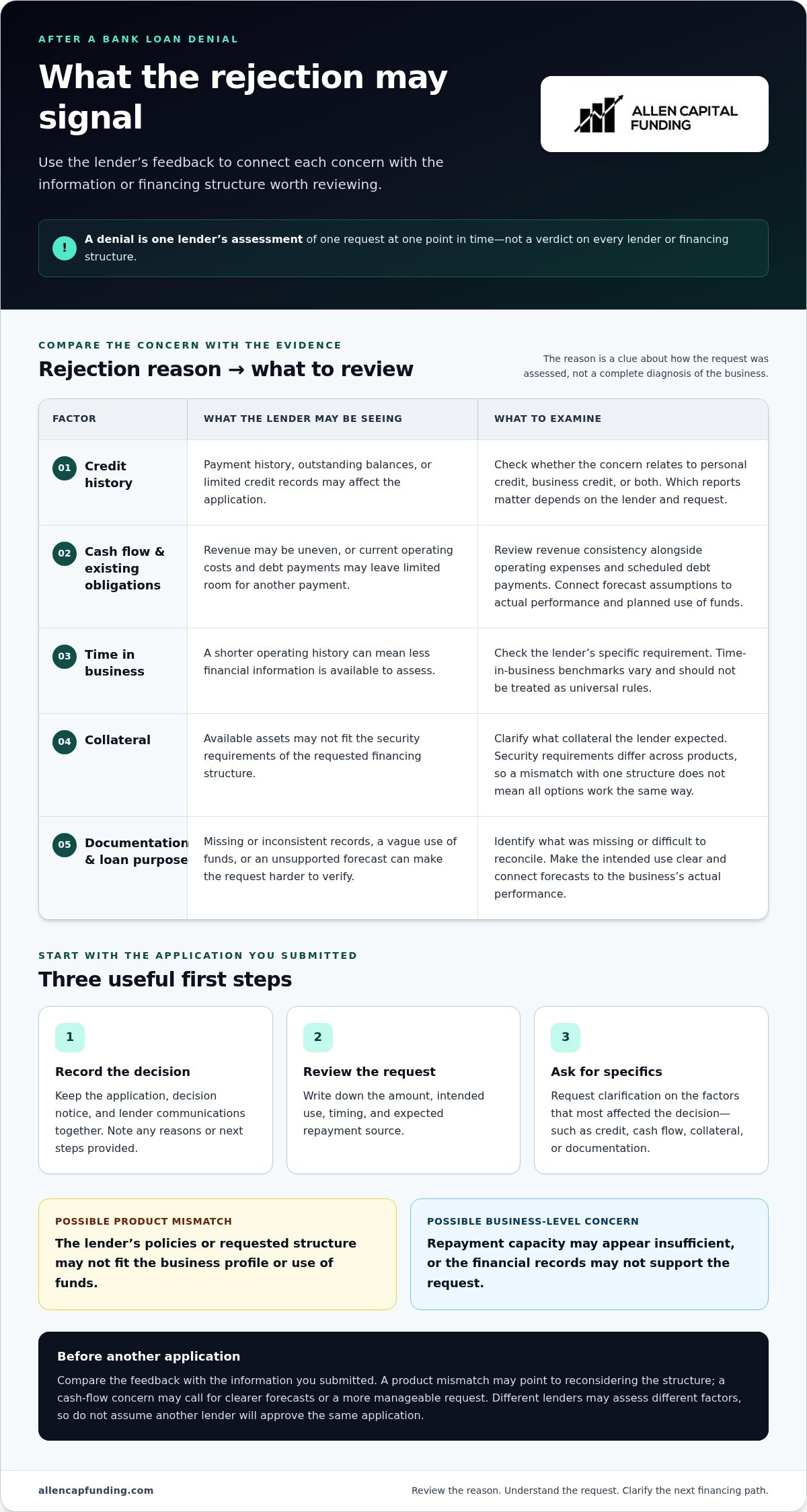
A bank rejection can feel like a final judgment, especially when the business has an immediate need for capital. But a denial is one lender’s assessment of one request at one point in time. Find out what informed that assessment before deciding whether to revise the application, pursue a different structure, or wait.
If you’re thinking, “my bank rejected my business loan application now what,” resist the urge to submit the same request everywhere. Applying again without understanding the lender’s criteria may leave the original concern unresolved. Responses can also be difficult to compare because lenders may assess different factors or offer different financing products.
What to do in the first few days after a denial
Take an organized approach. Keep the decision and your original funding request together so you can connect the lender’s feedback to the application you submitted.
Record the decision. Save the application, decision notice, and lender communications in one place. Note the decision date and any reasons or next steps the lender provided.
Review what you requested. Write down the amount, intended use, timing, and expected repayment source. Equipment purchased to increase production, for example, has a different repayment rationale from funds intended to cover a temporary operating expense gap.
Ask for specific feedback. Request clarification about which application factors most affected the decision. Ask whether the concern involved credit, cash flow, existing obligations, collateral, time in business, documentation, or the requested loan structure. The goal is to get actionable detail, not to argue with the outcome.
Compare the feedback with the information you submitted. If the lender points to cash flow, review the figures and forecasts in the application. If documentation was the issue, identify what was missing or difficult to reconcile. This turns a broad “no” into a question you can investigate.
Does one business loan rejection mean you cannot get financing?
No single rejection establishes that every financing path is closed. Lenders can have different underwriting criteria, risk appetites, and products. A bank may decline a request because its policies don’t fit the business’s profile or the proposed use of funds. That differs from a business-level concern, such as repayment capacity that appears insufficient or financial records that don’t support the request.
The distinction matters. A product mismatch may point toward reconsidering the structure, while a cash-flow concern may call for clearer forecasts or a more manageable request. A basic overview of Understanding Business Loans can help explain how business borrowing varies by purpose and structure, but the lender’s feedback should guide your review.
Don’t assume another lender will approve the same application. First identify what the denial does and doesn’t tell you, then decide whether you can address the issue or whether a different funding structure better matches the need and repayment source.
Why Banks Reject Business Loan Applications, and What Each Reason Signals
A rejection reason is a clue about how the lender evaluated the request, not a complete diagnosis of the business. Read it alongside the application, financial records, and proposed use of funds. The same issue can carry different weight depending on the lender, financing product, and evidence available to support repayment.
Credit history: Personal credit, business credit, or both may affect an application. A concern could relate to payment history, outstanding balances, or limited credit records. Which reports matter depends on the lender and request.
Cash flow and existing obligations: Lenders may compare revenue consistency with operating expenses and current debt payments. Strong sales alone may not resolve concerns if cash flow is uneven or existing obligations leave little room for another payment.
Time in business: A shorter operating history can mean less financial information to assess. Requirements vary, so a time-in-business benchmark used by one lender shouldn’t be treated as a universal rule.
Collateral: Available assets may matter for some financing structures, but collateral expectations differ across products. A request that doesn’t fit one lender’s security requirements may need a different structure. It doesn’t mean every option works the same way.
Documentation and loan purpose: Missing or inconsistent records can make it difficult to verify business performance. A vague use of funds or unsupported forecast can also leave the lender unsure how the financing is expected to support repayment.
How cash flow, debt, and credit affect a lender's assessment
Lenders may review revenue patterns against expenses and scheduled debt payments to assess whether the business can take on another obligation. Repayment capacity means the business can make required payments from available cash flow while meeting its other obligations. Forecasts can help explain future repayment, but their assumptions should connect to the business’s actual performance and planned use of funds.
Credit is another part of the picture. Depending on the application, a lender may consider the owner’s personal credit history, the business’s credit profile, or both. A score, coverage ratio, or operating-history cutoff used by one lender is a lender-specific example, not a standard that applies to every product. For SBA-backed options, review the U.S. Small Business Administration’s SBA Loan Programs information.
How documentation, collateral, and lender fit influence the decision
Tax returns, bank statements, and financial statements help a lender compare reported results with account activity. Gaps, mismatched figures, or unclear forecasts can obscure a viable business case. Collateral requirements and industry preferences can also vary by lender and financing type, so a decline may reflect product fit as well as a business concern.
Use the reason for the decision to identify what evidence needs attention and which financing structure aligns with the business’s repayment source. Allen Capital Funding’s Financial Check-Up can help you map potential capital options against those factors.
Which Business Financing Options Could Fit After a Bank Loan Denial?
If you’re still asking, “my bank rejected my business loan application now what,” start with the purpose of the funds rather than searching for a one-size-fits-all replacement. Financing is a better fit when its structure matches what the business needs, where repayment will come from, and when that cash is expected. The options below are categories to compare, not promises of eligibility or approval.
When an SBA loan, credit line, or working capital solution may fit
An SBA-backed loan may be worth evaluating when the business purpose and circumstances fit a program’s requirements. It isn’t automatically the right alternative after a bank decline. Compare the proposed use, repayment plan, documentation needs, and lender criteria before choosing that route.
A credit line can suit recurring cash-flow needs because it provides revolving access to funds, unlike a loan disbursed as one lump sum. That flexibility calls for a clear plan for draws and repayment. A business line of credit guide explains how revolving access differs from borrowing a fixed amount. Working capital financing, by contrast, should be tied to a specific operating need and a realistic source of repayment.
When equipment financing, factoring, or purchase order financing may fit
Equipment financing is designed around an identifiable asset and its expected role in the business. Factoring may fit when eligible invoices are awaiting payment, while purchase order financing may help address costs linked to qualifying orders. These asset-based approaches depend on the transaction, assets, supporting documentation, and lender criteria. When comparing them, focus on what supports the financing and how repayment is expected to occur.
Compare the repayment source and trade-offs before choosing a route. A structure tied to invoices or orders may not address a general operating need, just as equipment financing may not suit expenses unrelated to an asset purchase. Match the funding to the business objective, then assess whether the repayment plan remains workable under realistic cash-flow conditions, which can be modeled using tools and commercial finance guidance from TMS Finance.
How to Strengthen Your Business Loan Application Before Reapplying
If your question is “my bank rejected my business loan application now what,” make the next submission deliberate. Work through the denial, financial records, funding request, and financing route in sequence. Reapplying before you understand what needs attention can leave the same gaps in place.
Clarify the denial. Translate the lender’s feedback into specific issues to address. Separate concerns about the business’s financial position from application problems, such as missing records or an unclear use of funds.
Review and reconcile records. Compare financial statements with tax records and bank activity. Check that revenue, expenses, debt obligations, and cash-flow forecasts tell a consistent story. Investigate differences before submitting documents again.
Adjust the request. Tie the amount to a documented business purpose, such as a defined purchase or operating need. Explain how the funds will be used and identify the expected repayment source. A realistic request should reflect both the business need and its capacity to manage repayment.
Select a suitable route. Compare financing criteria with the business’s operating profile, intended use, and repayment source. If considering an SBA-related path, consult an SBA loan funding guide to understand the relevant program and requirements.
Build a clear, consistent financial picture
Before applying, check that figures agree across statements, returns, bank activity, and forecasts. If forecast revenue differs from recent deposits, be ready to explain the assumptions behind the projection. Prepare concise context for unusual account activity, one-time expenses, or recent business changes. A stronger application makes the funding purpose and repayment plan easy to understand. Organize requested documents so the lender can review a complete, coherent picture.
Choose when and where to apply again
Apply again when you’ve addressed material gaps, not simply because another application is possible. Some issues may call for corrected paperwork; others may require time to strengthen cash flow or reduce existing obligations. Match lender criteria to the business’s purpose and available repayment source rather than assuming the same request fits every financing route. For an SBA-related option, understand the program and requirements that apply to your intended use before preparing a new submission.
Use the review to decide whether to revise the request, improve the supporting evidence, or consider a structure better aligned with the need. Allen Capital Funding can help you assess the denial and map potential capital options. Book an online funding consultation to discuss a practical next step.
How Allen Capital Funding Can Help You Map Your Next Funding Step
A bank’s decision is useful context, but it doesn’t have to be the only lens for reviewing your financing needs. Allen Capital Funding helps small businesses connect the reason for a denial with the business objective, available repayment source, and funding structure worth exploring. That means looking beyond “loan or no loan” to consider whether the request and financing type fit the job the capital needs to do.
Options include SBA loans, credit lines, working capital, equipment financing, factoring, and purchase order financing. Each serves a different purpose. A credit line may be relevant for recurring cash-flow needs; equipment financing is connected to a business asset; factoring involves eligible receivables; and purchase order financing relates to fulfilling qualifying orders. An SBA loan or working capital solution may suit other business purposes, depending on the circumstances and lender criteria. No category guarantees approval or particular terms.
If you’ve been searching “my bank rejected my business loan application now what,” a focused funding review can help turn that question into a more specific plan. A Financial Check-Up offers a way to discuss the business’s financing needs and potential options in light of its objective and financial information.
What to prepare for a funding conversation
Bring the information that helps explain both the lender’s decision and the current request. An organized overview makes it easier to discuss what the business needs and how it expects to repay financing.
The denial details: Bring the decision notice or lender feedback, if available, along with the original application details.
The funding request: Summarize the amount needed, intended use, timing, and anticipated repayment source. Connect the request to a specific business objective rather than a general desire for extra cash.
Relevant business records: Gather current financial and business documents related to the request, such as financial statements, tax records, bank activity, or information about the asset, receivable, or order involved.
If you don’t have a written explanation of the denial, bring your own notes about what the lender communicated. Be ready to explain changes since the application, such as a revised project scope or updated cash-flow outlook. Clear context helps distinguish an issue with the request from a broader financing concern.
How to move forward with a tailored funding review
Allen Capital Funding helps businesses explore debt-based and asset-based financing options. A review can relate the denial reason to the requested purpose, then consider which structures may align with the business’s records and repayment source. The aim is a grounded comparison, not a promise of approval, funding, speed, rates, or terms. The more clearly you describe the need and supporting information, the more focused the discussion can be.
Bring the facts, identify the business goal, and take the next step with a clearer financing picture. Book an online consultation to discuss your funding needs and potential options with Allen Capital Funding.
Turn the Next Funding Decision Into a Clear Plan
If you’re still asking, “my bank rejected my business loan application now what,” focus on the decision ahead, not just the one already made. Identify what the business needs capital to accomplish, how soon it needs to act, and what repayment would look like under realistic conditions. Those priorities can help shape a funding plan that supports the business without adding an obligation it can’t comfortably carry.
You don’t have to assess every possible structure alone. Allen Capital Funding offers guidance across debt-based and asset-based financing categories, and a Financial Check-Up can help frame the business’s capital needs and potential options. Use that discussion to clarify your objective and consider a thoughtful next move, without assuming any particular financing outcome.
Book an online consultation to discuss your next business funding step. A clear plan can help you move forward with greater confidence.
Frequently Asked Questions
Can I apply for another business loan after my bank rejects me?
Yes. A bank’s rejection doesn’t automatically prevent you from applying elsewhere or returning to the same lender. Before you do, find out whether the decline came from the requested structure, a specific underwriting concern, or missing information. If you’re asking, “my bank rejected my business loan application now what,” use that answer to decide whether to correct the application, change the request, or consider another financing route. Another lender may assess the request differently, but approval isn’t assured.
How long should I wait to reapply after a business loan denial?
There’s no single waiting period that fits every denial. Some common guidance suggests waiting three to six months, but the right timing depends on what caused the decline and how quickly you can address it. If the issue was a missing document, you may be able to correct it sooner. If the business needs to establish a clearer operating record or improve cash flow, applying again before those changes are evident may not help.
Will a business loan denial hurt my business credit?
A denial doesn’t automatically mean your business credit score will fall. The effect can depend on whether the lender checked business credit, personal credit, or both, and how the relevant credit bureau records inquiries. If you personally guaranteed the application, a personal credit inquiry may also be relevant. Review your business and personal credit reports after applying, and dispute any information you believe is inaccurate through the appropriate bureau process.
What are the most common reasons banks reject business loan applications?
Common concerns include weak or limited credit history, inconsistent cash flow, substantial existing debt, a short operating record, insufficient collateral for the requested structure, and incomplete or conflicting records. A lender may also have difficulty assessing an application if the intended use of funds or repayment source isn’t clear. These factors can overlap. For example, a forecast that doesn’t match recent account activity can raise questions even if revenue is growing.
Can I get an SBA loan after a bank denies my application?
Possibly. A bank’s decision doesn’t automatically rule out an SBA-backed loan, but SBA financing still involves eligibility requirements and lender underwriting. First determine whether the bank declined the business, the proposed use, or the specific loan structure. If the issue relates to eligibility or repayment capacity, changing lenders alone may not resolve it. A revised request or a different financing category may be more appropriate, depending on the circumstances.
What should I do if I need business funding urgently after a bank denial?
Start by identifying the payment deadline, the minimum amount needed, and the business cash expected to repay any financing. Then compare options against that timeline and repayment source instead of accepting the first available offer. For example, eligible receivables or a specific equipment need may point to a different structure than general operating expenses. In urgent situations where personal or short-term financing is considered, platforms such as iloveyourloans.com offer installment loans and cash advances to help bridge immediate gaps. Review the full repayment obligation before committing, and consider whether a payment arrangement could reduce the immediate funding gap.
Should I use a business line of credit instead of reapplying for a loan?
It depends on the purpose. A line of credit may suit recurring cash-flow gaps where the business needs access to funds at different times. A term loan may be a better fit for a defined project that calls for a single amount and a planned repayment schedule. Compare how funds can be accessed, when repayment is due, and the total borrowing cost. Don’t choose a revolving facility simply because a loan application was declined.



Comments