


How to Secure Heavy Equipment Financing: A Strategic Roadmap for 2026
- anthonyarallen
- 6 days ago
- 11 min read
Purchasing your next excavator or paving machine with a massive down payment isn't a sign of financial strength; it's often a strategic mistake that starves your business of essential liquidity. You likely recognize that staying competitive requires the latest technology, yet the reality of high upfront costs and sluggish bank approvals can feel like a constant barrier to growth. It's frustrating to watch project deadlines approach while your capital is tied up or your loan application sits on a desk.
Master the process of securing high-value machinery through tailored structures that keep your cash reserves intact. This guide explains how to leverage heavy equipment financing to obtain 100% funding, covering everything from the sticker price to necessary soft costs. We provide a clear path to rapid approvals and detail how to utilize the 2026 Section 179 deduction limit of $2,560,000. By the end of this article, you'll have the tools to align your capital strategy with your equipment's lifecycle for maximum growth and accelerated success.
Table of Contents
What is Heavy Equipment Financing and Why Does it Matter?
Heavy equipment financing is a specialized form of asset-based lending where the machinery you purchase serves as the primary security for the debt. Unlike general business capital, which might require a lien on all company assets or personal real estate, this structure focuses on the specific value of the equipment. It's a strategic tool designed to help you acquire high-value assets without depleting your operating cash. For many business owners, understanding loans of this nature is the first step toward scaling operations without overextending their balance sheets.
The primary advantage of this financing model is cash flow preservation. Rather than spending hundreds of thousands of dollars upfront, you distribute the cost over the asset's useful life. This keeps your liquid capital available for payroll, emergency repairs, and marketing. While traditional term loans often involve rigid covenants and higher interest rates due to their unsecured nature, equipment loans typically offer more favorable terms because they are inherently lower risk for the lender. If a borrower defaults, the lender has a tangible asset with a known resale value to recover their investment.
This financing covers a broad spectrum of machinery essential for modern industry. It includes "yellow iron" like excavators and bulldozers for construction, but it also extends to specialized manufacturing lines, medical imaging technology, and commercial transportation fleets. Whether you're a local contractor or a national logistics firm, the ability to match your debt to a specific piece of equipment creates a cleaner financial profile.
The Role of Collateral in Equipment Loans
The value of your machinery dictates the interest rates and repayment terms you'll receive. Lenders prioritize assets with high resale value and slow depreciation rates. Because these are "self-collateralizing" loans, they protect your other business assets from being seized in the event of a financial downturn. The loan-to-value ratio represents the percentage of the equipment's appraised value or purchase price that a lender is willing to finance. High-quality machinery often allows for higher ratios, sometimes reaching 100% of the purchase price plus soft costs.
Strategic Growth vs. Capital Preservation
Successful business owners balance the need for new technology with the cost of capital. Operating outdated equipment often leads to higher maintenance costs and project delays, which can be more expensive than a monthly loan payment. Financing enables "forced growth" by allowing you to take on larger contracts that require specialized machinery you couldn't otherwise afford. To explore how this fits into your broader financial plan, review our Strategic Business Equipment Financing Pillar for a deeper look at long-term growth strategies.
How to Prepare Your Business for a Heavy Equipment Loan
Securing heavy equipment financing requires more than just selecting the right machinery. You must present your business as a reliable, low-risk partner. Start by reviewing your business credit profile through bureaus like Dun & Bradstreet or Experian to identify potential red flags. Late payments to suppliers or high credit utilization can stall an application or lead to less favorable terms. In July 2026, the most competitive rates, ranging from 6% to 15% APR, are generally reserved for borrowers with a FICO score of 680 or higher. If your score is closer to 600, you can still secure funding, but expect higher APRs and stricter underwriting requirements.
Lenders look for an "Equipment Justification" that clearly outlines how the asset generates revenue. If you're purchasing a new excavator, explain how it allows you to bid on larger infrastructure projects or reduces the high maintenance costs of an older machine. Obtain a formal quote from a dealer that includes full specifications, delivery fees, and any installation costs. Providing this level of detail upfront demonstrates professional competence. It also helps the lender understand the true value of the collateral they are financing.
Financial Documentation Checklist
Standardize your records before the first call to avoid delays. Most national lenders view two years of federal tax returns as the gold standard for verifying your business's financial stability. If you're applying mid-year, prepare interim Profit & Loss statements and a current Balance Sheet to show recent performance. This documentation is essential whether you're considering private funding or SBA 7(a) loan options. Additionally, maintain a clean debt schedule that lists all current loans, leases, and credit lines to show your total capital commitments.
Assessing Your Debt-Service Coverage Ratio (DSCR)
Lenders use the Debt-Service Coverage Ratio (DSCR) to determine if your cash flow can comfortably support the new machinery payments. They calculate this by dividing your annual EBITDA (Earnings Before Interest, Taxes, Depreciation, and Amortization) by your total annual debt obligations. A DSCR above 1.25 significantly improves your approval odds because it indicates a 25% cash cushion after all debts are paid. If your ratio is lower, you may need to provide a larger down payment to reduce the monthly obligation. Performing a financial check-up with a specialist can help you optimize these numbers before you approach a lender.
Comparing Financing Structures: Loans, Leases, and SBA Options
Selecting the right capital structure is just as critical as choosing the right machine. While some businesses prioritize long-term ownership, others require the flexibility to upgrade as technology evolves. Heavy equipment financing isn't a one-size-fits-all solution; it's a strategic matching exercise. You must align the expected lifespan of your machinery with the terms of your capital to ensure your debt doesn't outlast the asset's utility.
Equipment loans are the primary choice for contractors who want to build equity. These structures allow you to own the asset outright once the term ends, making them ideal for "yellow iron" like cranes or dozers that maintain value for decades. If you prefer agility, equipment leasing provides a path to acquire technology-sensitive assets with lower monthly payments. You can choose between a Fair Market Value (FMV) lease for easy upgrades or a $1 Buyout lease if you intend to keep the equipment while still enjoying lease-style benefits during the term.
Government-backed programs offer additional pathways for significant acquisitions. SBA 504 loans are particularly effective for high-value machinery, providing fixed-rate financing with terms ranging from 10 to 25 years. For businesses that need a combination of equipment and working capital to support a new contract, SBA 7(a) loans offer the necessary versatility. These programs often require more documentation but provide the stability needed for massive growth initiatives.
Lease vs. Buy: The 2026 Decision Matrix
Deciding between a lease and a loan requires a deep look at your Total Cost of Ownership (TCO). You must account for maintenance, insurance, and the eventual resale value of the machinery. Operating leases can keep debt off your balance sheet, while capital leases are treated more like traditional ownership for tax purposes. For a detailed breakdown of how to evaluate these choices, consult our Equipment Financing Buying Guide.
Leveraging Section 179 for Immediate ROI
The tax benefits of heavy equipment financing can significantly lower your effective cost of capital. In 2026, the maximum Section 179 deduction has reached $2,560,000, with a phase-out threshold starting at $4,090,000. This allows you to deduct the full purchase price of qualifying equipment in the year you place it in service rather than depreciating it over several years. When you combine this with the restored 100% bonus depreciation, the immediate tax savings can often cover your first year of loan payments. Always consult with a tax professional to ensure your specific equipment qualifies for these accelerated benefits.
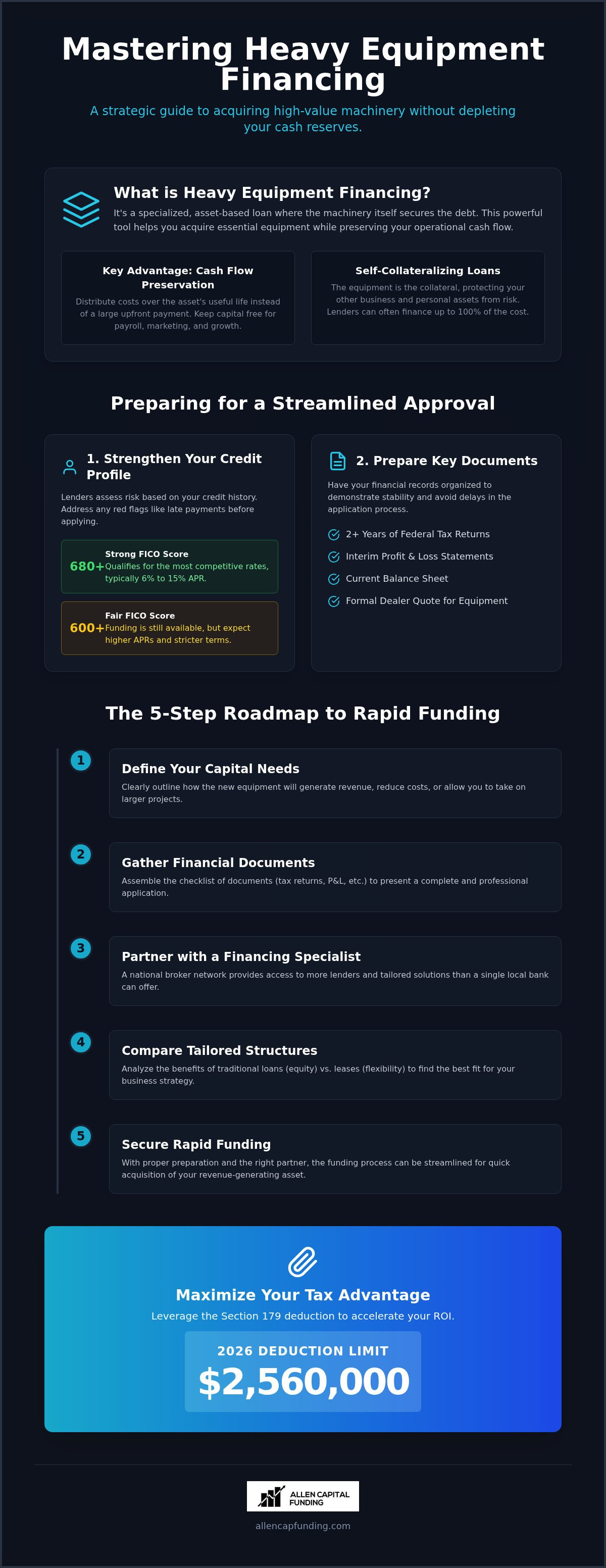
The 5-Step Roadmap to Securing Your Equipment Financing
Securing high-value machinery requires a methodical approach to ensure you receive the best terms available in the 2026 market. While the credit approval rate for equipment financing rose to 77.1% in February 2026, the most favorable structures are reserved for those who follow a disciplined path. This roadmap moves you from initial need to operational deployment with professional efficiency.
Step 1: Define Capital Needs and Specifications. Identify the exact machinery required and obtain a formal quote. You must account for the full purchase price plus soft costs like shipping and installation.
Step 2: Consult with a Financing Specialist. Partner with an expert who understands the nuances of various lending pools. A specialist helps you identify whether a lease, loan, or SBA structure aligns with your growth goals.
Step 3: Submit a Comprehensive Application. Package your financial statements, tax returns, and equipment justification into a single, professional submission. Completeness at this stage prevents back-and-forth delays.
Step 4: Review and Negotiate. Carefully examine the loan covenants and interest rates. Look for flexibility in repayment schedules that match your seasonal cash flow patterns.
Step 5: Finalize UCC Filing and Payment. Complete the Uniform Commercial Code (UCC) filing to perfect the lender's security interest. Once documentation is signed, the lender facilitates the direct payment to your vendor.
Navigating the Underwriting Process
After you submit your package, underwriters evaluate the risk profile of your specific industry. For example, construction equipment is often viewed through the lens of current federal infrastructure spending, while manufacturing machinery is judged on its production capacity. During this due diligence phase, you might be asked about your contract backlog or how the new asset replaces existing rental costs. Providing clear, data-backed answers helps the underwriter feel confident in your business's stability. For a deeper look at these requirements, see our Commercial Equipment Loans Guide.
Closing the Deal and Vendor Coordination
The final stage involves heavy coordination between you, the lender, and the equipment dealer. The lender typically pays the vendor directly to ensure the funds are used for the intended collateral. Before this happens, you'll sign a "Certificate of Acceptance." This document confirms that the equipment has been delivered in good working order and officially triggers the start of your loan term. To begin this process and secure your machinery, apply for equipment financing with our dedicated team today.
Why Allen Capital Funding is Your Strategic Equipment Partner
Choosing a financial partner is as vital as choosing the machinery itself. Most traditional banks operate within a very narrow credit box, often rejecting applications that don't fit their rigid criteria. Allen Capital Funding takes a different approach. We act as your dedicated guide, leveraging a vast network of national lending partners to find the specific capital structure that matches your unique operational goals. Our role is to remove the friction from heavy equipment financing, allowing you to focus on project execution rather than paperwork.
The broker advantage means you get access to diverse capital pools through a single point of contact. We don't force your business into a pre-packaged loan product. Instead, we analyze your cash flow, tax objectives, and equipment lifecycle to build a customized financing solution. Whether you need an SBA 504 structure for long-term stability or a flexible lease to keep your technology current, our team handles the heavy lifting of negotiation and underwriting on your behalf.
Access to National Markets: We connect you with specialized lenders that understand the resale value of your specific assets.
Tailored Structures: Our solutions account for seasonal revenue fluctuations and specific tax needs.
Accelerated Timelines: We prioritize speed to ensure your equipment is job-site ready when your contract begins.
Expert Navigation: Our team manages the complexities of SBA requirements and UCC filings to prevent closing delays.
National Reach with a Personal Touch
We combine the resources of a national firm with the attentive service of a dedicated consultant. By maintaining deep relationships with diverse lenders, we secure competitive rates that reflect the true strength of your business. Our team specializes in connecting growing companies with capital pools that traditional local banks often overlook. Our commitment is to your long-term growth strategy, ensuring your equipment debt remains a strategic asset rather than a financial burden.
Get Started with a Strategic Consultation
Securing the right funding begins with a clear understanding of your current financial position and future needs. Our initial strategy session is designed to be efficient and highly productive. We'll review your equipment specifications, discuss your cash flow requirements, and identify the most advantageous tax strategies for 2026. This streamlined process respects your time while providing a clear roadmap to funding. Book Your Equipment Financing Consultation Today and let us help you accelerate your success.
Accelerate Your Business Growth in 2026
Securing high-value machinery in 2026 requires a balance of financial preparation and strategic execution. By organizing your financial profile and choosing between loans, leases, or SBA options, you position your business to acquire essential assets without sacrificing cash flow. Remember that heavy equipment financing is more than just a transaction; it's a tool for scaling your operations and maximizing tax advantages like the Section 179 deduction.
The path from application to the job site is much smoother when you have a dedicated guide. Our team provides access to national lending networks and specializes in complex SBA and asset-based structures. We focus on delivering tailored capital solutions that align with your specific growth goals and project deadlines. This partnership-driven approach ensures you have the support needed to navigate the complexities of modern business finance with confidence.
Stop letting capital constraints hold back your potential. Secure Your Heavy Equipment Funding with Allen Capital today and take the first step toward a more productive future. Your business is ready for the next level, and we're here to help you reach it.
Frequently Asked Questions
What is the typical down payment for heavy equipment financing?
Typical down payments range from 0% to 20% depending on your credit profile and the type of machinery you are acquiring. Many modern financing structures offer 100% funding for qualified borrowers, which allows you to keep your liquid capital available for other business needs. Lenders may require a higher down payment for specialized or high-risk assets to offset potential depreciation.
Can I finance used heavy equipment or does it have to be new?
You can finance both new and used heavy equipment through most asset-based lending programs. Lenders evaluate used machinery based on its age, service hours, and overall condition to determine its collateral value. While new equipment often qualifies for longer terms, used machinery remains a cost-effective choice for businesses looking to expand their fleet without the premium price tag of a new model.
How long does the approval process take for an equipment loan?
The approval process for heavy equipment financing typically takes between 24 hours and three business days for standard applications. Digitalization and AI-assisted underwriting have significantly accelerated these timelines, allowing for rapid decisions that help you meet project deadlines. More complex structures, such as SBA 504 loans or high-value manufacturing lines, may require additional time for thorough due diligence.
Does equipment financing require a personal guarantee?
Most lenders require a personal guarantee from business owners who hold a 20% stake or more in the company. This provides an extra layer of security for the lender, even though the machinery itself serves as the primary collateral. While the asset's value is the focus, your personal commitment demonstrates a shared risk that often leads to more favorable interest rates and terms.
What credit score is needed for heavy equipment financing in 2026?
A FICO score of 600 or higher is generally required to qualify for heavy equipment financing in 2026. For the most competitive rates, which currently range from 6% to 15% APR, lenders typically look for a score of 680 or above. Borrowers with scores below 600 may still find options through specialty lenders, though these often come with higher interest rates or larger down payment requirements.
What are the tax benefits of financing vs. paying cash for equipment?
Financing allows you to utilize the Section 179 deduction to write off the full purchase price of the equipment in the first year, even if you haven't paid for it in full. When you pay cash, you are often limited to standard depreciation schedules that spread the tax benefit over several years. Financing effectively lowers your tax liability immediately, providing a significant cash flow advantage that cash purchases don't offer.
Can I finance soft costs like delivery, installation, and training?
You can often bundle soft costs into your total financing package to ensure you don't have to pay for these expenses out of pocket. This includes delivery fees, professional installation, and essential operator training. Including these costs in your loan or lease ensures your machinery is fully operational and generating revenue from day one without depleting your working capital.
What happens to the equipment at the end of a lease term?
Your options at the end of a lease term depend on the specific structure you choose at the beginning of the agreement. With a Fair Market Value lease, you can choose to return the equipment, upgrade to a newer model, or purchase it at its current market value. A $1 Buyout lease is designed for ownership, allowing you to take full title of the asset for a nominal one-dollar fee once the final payment is made.


Comments