


Equipment Financing Companies: A 2026 Buying Guide for Commercial Assets
Did you know that as we enter 2026, businesses are now financing more than 75% of their equipment and software purchases rather than buying them outright? It is a strategic shift driven by the necessity to stay agile in a fast-paced market. However, identifying the right equipment financing companies New York can often feel like a maze of complex jargon and rigid terms that don't account for your seasonal cash flow. You want to modernize your fleet without getting trapped by hidden fees or slow approval processes that stall your momentum.
We understand that your capital structure must align with your specific operational goals to be effective. This guide provides the expert clarity you need to evaluate providers and choose a path that preserves your working capital for other growth opportunities. You will discover how to leverage the $1.16 million Section 179 deduction limit and navigate the 2026 UCC amendments with confidence. We'll compare $1 buyout options with Fair Market Value leases to ensure your monthly payments remain predictable while your business achieves accelerated success.
Table of Contents
Strategic Equipment Financing in the 2026 Economy
Commercial equipment financing is more than just a loan; it's a primary tool for preserving liquidity. In 2026, staying competitive requires rapid adoption of new technology, especially with AI infrastructure spending hitting $48 billion last year. Many equipment financing companies New York provide the speed and flexibility that traditional banks often lack. By using the equipment itself as collateral, you can often secure lower interest rates than you'd find with other forms of capital. This strategy also ensures your business line of credit remains untouched and ready for emergencies.
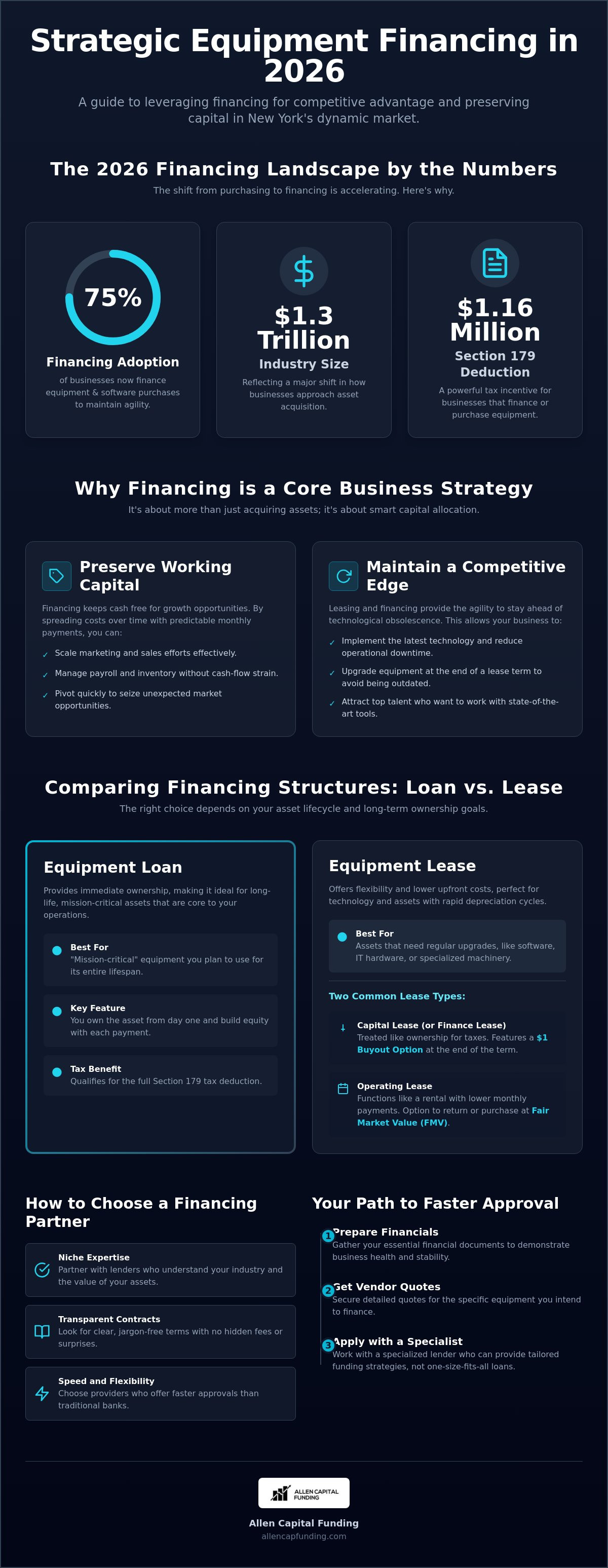
The equipment financing industry has grown to $1.3 trillion as of early 2026. This growth reflects a major shift in how businesses approach acquisition. Today, more than 75% of companies finance their equipment rather than purchasing it with cash. This trend isn't just about saving money; it's about agility. In New York's fast-moving market, waiting months for a bank approval can mean missing out on a major contract. Specialized lenders understand the value of the machinery you're buying, which allows for faster approvals and more customized terms.
The Impact of Modernization on Competitive Edge
Partnering with the right equipment financing companies New York allows you to implement a CapEx strategy for 2026 that focuses on the total cost of ownership rather than just the purchase price. Upgraded assets reduce operational downtime and eliminate the mounting maintenance costs of aging machinery. There's also a clear link between modern equipment and employee retention. Top talent prefers working with efficient, state-of-the-art tools. If your team is fighting with outdated systems, your productivity and morale will eventually suffer.
In 2026, technological obsolescence happens faster than ever. If you buy a machine today, it might be outdated in three years. Financing through a lease structure allows you to upgrade at the end of the term, ensuring your operations never fall behind the curve. This proactive approach to asset management keeps your business at the forefront of your industry.
Preserving Working Capital for Growth
Keeping cash on hand is vital for scaling your marketing and managing payroll. When you tie up all your capital in fixed assets, you lose the ability to pivot when new opportunities arise. Financing allows you to spread the cost over time, making your monthly payments predictable and manageable. It's helpful to understand What is a finance lease? to see how different structures impact your balance sheet and your long-term ownership goals.
Predictability is the foundation of a healthy business. With fixed monthly payments, your accounting team can forecast expenses with pinpoint accuracy. You won't have to worry about a sudden large cash outflow that could strain your operations. Instead, you pay for the equipment as it generates revenue for you. This alignment of costs and income is the hallmark of a sophisticated financial strategy that prioritizes growth over mere asset ownership.
Comparing Financing Structures: Loans vs. Leases
Choosing between a loan and a lease is a strategic decision that directly affects your tax liability and monthly cash flow. While some equipment financing companies New York might push a specific product, the right choice depends on the asset's lifecycle and your long-term ownership goals. An equipment loan provides immediate ownership, making it a strong choice for "mission-critical" assets. These are the pieces of machinery or technology that your business cannot function without. Lenders often prioritize these assets for approval because their essential nature makes them high-quality collateral.
Conversely, an equipment lease offers flexibility and lower upfront costs. It acts as a powerful tool for businesses that need to conserve cash or those acquiring assets with rapid depreciation cycles. The goal is to align the financing term with the useful life of the equipment. If a piece of technology will be obsolete in three years, a three-year lease ensures you aren't stuck paying for a "paperweight" long after its operational value has vanished. This alignment keeps your fleet modern and your operations efficient.
Capital Leases vs. Operating Leases
The accounting differences between lease types are significant for your balance sheet. A capital lease, often referred to as a finance lease, is treated like ownership for tax purposes. This structure is ideal for businesses wanting to claim the full Section 179 deduction, which has a limit of $1.16 million in 2026. At the end of a capital lease, you typically have a $1 buyout option to take full title of the asset.
Operating leases function more like a traditional rental. The payments are often lower, and the asset stays off your balance sheet, which can help maintain a healthier debt-to-equity ratio. At the end of the term, you can choose a Fair Market Value (FMV) buyout, return the equipment, or upgrade to a newer model. If you are unsure which structure best supports your goals, a strategic financial check-up can provide the clarity needed to decide.
When an Equipment Loan Makes Most Sense
Loans are the superior choice for long-term assets with slow depreciation, such as heavy construction machinery or specialized medical tools. Because you own the asset from day one, you build equity over time. This ownership also allows you to use the equipment as leverage for future needs. For example, you might combine an equipment loan with asset-based lending for small business to unlock additional liquidity from your existing balance sheet.
Equipment loans are also an excellent way to build a robust business credit history. Consistently meeting these fixed payments demonstrates reliability to future institutional partners. For businesses seeking the most stable, long-term rates for fixed assets, the SBA 504 loan program remains a highly authoritative and reliable option. This government-backed program is specifically designed to help small businesses acquire major fixed assets that promote local economic growth.
How to Evaluate Equipment Financing Companies
Choosing the right partner from the many equipment financing companies New York offers requires looking beyond the interest rate. You need a provider that understands your specific niche, whether that's medical, transport, or construction. Specialist lenders understand the resale value of your assets; this often leads to more favorable terms than a generalist bank could offer. They recognize that a crane and a laser cutter have very different lifecycles and collateral values.
Speed is another critical differentiator. While a traditional bank might take three weeks to process an application, specialized firms often provide 24-hour approvals. In a competitive market, this speed prevents growth from stalling. You should also look for flexibility in payment structures. If your business experiences seasonal fluctuations, seek out lenders who offer seasonal payment plans or step-up structures that align with your cash flow. This level of customization ensures you don't feel the squeeze during slower months. For more foundational advice on vetting these options, the SBA guide to equipment financing offers excellent criteria for small business owners.
Direct Lenders vs. Equipment Financing Brokers
Direct lenders use their own capital, but equipment financing brokers act as a strategic bridge to a wider network. When comparing equipment financing companies New York, you'll find that brokers often provide more options for challenged credit profiles. They provide a single point of contact while shopping your deal to multiple sources. This approach facilitates accelerated success by handling the heavy lifting of paperwork and negotiation. It allows you to focus on your core operations while experts secure the best possible capital structure for your needs.
Red Flags to Watch For in Financing Contracts
Transparency is paramount in any financial agreement. Always scan contracts for soft costs and hidden documentation fees that can inflate the total cost of capital. Be wary of automatic renewal clauses in lease agreements; these can trap you into paying for equipment you intended to return or buy out. Another common trap is exorbitant interim rent charges. These apply between the delivery of the equipment and the start of the official lease term. Finally, look out for restrictive covenants that limit your ability to borrow from other sources. A reliable partner will prioritize your long-term growth over restrictive legal traps that hinder your future flexibility.
Steps to Secure Your Equipment Funding
Securing capital for your next commercial asset is a methodical process that rewards preparation. While many equipment financing companies New York offer digital-first experiences, the speed of your approval depends on how well you organize your initial request. A streamlined application prevents growth from stalling and ensures you secure the most competitive rates available in the 2026 market. Following a clear roadmap allows you to move from a vendor quote to a funded contract with confidence and clarity.
Step 1: Obtain a formal quote. Request a detailed invoice from your equipment vendor that specifies the make, model, and year of the asset.
Step 2: Prepare your financial package. Gather your Profit and Loss (P&L) statements and Balance Sheets to demonstrate your business's ability to service the debt.
Step 3: Review credit scores. As of July 2026, businesses with a 680+ FICO score typically see bank rates between 6% and 9% APR, whereas online lenders may range from 10% to 15%.
Step 4: Consult with a financial guide. Work with a specialist to determine if a $1 buyout or a Fair Market Value structure best serves your long-term tax strategy.
Step 5: Sign the commitment letter. Once you review the terms and ensure there are no hidden fees, sign the letter to lock in your rate and initiate the funding.
Documentation Checklist for 2026
The implementation of the CFPB's Section 1071 rule in 2026 means lenders now collect more detailed demographic and transactional data on deals over $50,000. To ensure a smooth process, have your last two years of business tax returns and current year-to-date interim financial statements ready. You should also provide a clear delivery timeline and technical specifications for the equipment. This transparency helps equipment financing companies New York verify the collateral value quickly, leading to faster funding cycles.
The Role of the Financial Check-Up
Before taking on new debt, it's vital to identify any gaps in liquidity that could affect your approval or your overall business health. A dedicated guide can help you look beyond the immediate purchase to see how a new payment fits into your total capital structure. This preparation phase is where we remove barriers to progress by ensuring your balance sheet is optimized for the best possible terms. If you're ready to evaluate your current position, you can schedule your financial check-up to prepare for your next major acquisition.
Why Allen Capital Funding is Your Strategic Partner
Allen Capital Funding acts as more than a source of capital. We are your strategic bridge. Many equipment financing companies New York operate as simple transactional vendors, but we prioritize the long-term health of your balance sheet. Our commitment is to provide tailored funding options that outmatch generic bank products. We understand that your business needs are unique; that's why our solutions are never one-size-fits-all. We focus on providing the expert guidance you need to make decisions that foster strategic growth.
By leveraging our national network of lending partners, we offer maximum flexibility for businesses in any industry. Whether you're financing AI infrastructure or heavy machinery, we provide the expert guidance necessary to navigate the 2026 financial landscape. We help you manage the asset lifecycle effectively, ensuring you maximize tax advantages like the $1.16 million Section 179 deduction. Our role is to bridge the gap between your current operations and your most ambitious growth goals by delivering capital with calm efficiency.
A Partnership-Driven Approach to Capital
We focus on fostering long-term business security rather than just closing a deal. This partnership-driven approach is rooted in supportive empowerment. We provide a steady, reliable hand for entrepreneurs who need to navigate complex financial structures. If you've faced rejection from traditional banks due to industry-specific risks or credit profiles, our team is here to help. We specialize in handling complex deals by focusing on the collateral's value and your business's potential for accelerated success. We remove the barriers that often stall progress, acting as a proactive ally in your journey.
Our team acts as a dedicated guide because we believe that clarity builds trust. We avoid unnecessary jargon and focus on providing actionable solutions that keep your working capital intact. Unlike other equipment financing companies New York, we view every transaction as a step toward a long-term relationship. By choosing a partner that values your success as much as you do, you gain a facilitator who is deeply invested in your future stability and expansion.
Ready to Modernize Your Business?
Modernizing your equipment fleet should be a smooth, methodical process. We've streamlined our online consultation booking to ensure you get the answers you need without delay. You'll have direct access to our team of funding specialists who are ready to analyze your specific needs and offer a clear path forward. We respect your time and your vision for the future. To start your journey toward a more efficient operation, Book your consultation with Allen Capital Funding today.
Secure Your Competitive Advantage in 2026
Scaling your business operations requires a balance between modernizing your fleet and preserving your working capital. Identifying the right partner among equipment financing companies New York is the first step toward achieving this equilibrium. By matching your capital structure to the asset's useful life and leveraging tax advantages like Section 179, you ensure your business remains agile. Clarity builds trust, and a well-structured agreement provides the predictable monthly payments needed for long-term stability.
Our dedicated team focuses on your strategic growth by providing expert guidance on SBA and commercial loans. We offer national coverage for diverse industries, acting as a facilitator to remove barriers and accelerate your success. We're ready to help you bridge the gap between your current state and your future goals with a steady, reliable hand. Take the next step in your modernization journey today.
Secure your equipment financing with a tailored consultation at Allen Capital Funding
We look forward to supporting your progress and helping your business thrive in a competitive landscape. Your success is our primary objective.
Frequently Asked Questions
What is the difference between equipment financing and leasing?
Equipment financing is a loan where you take ownership of the asset from day one and the equipment serves as collateral. Leasing is a contractual agreement where you pay for the use of the equipment over a set period, similar to a rental. While financing builds equity immediately, leasing often provides lower monthly payments and more flexibility for upgrading technology at the end of the term.
Can I get equipment financing with a low credit score?
Yes, many specialized lenders offer solutions for businesses with "challenged" credit profiles. For businesses with credit scores between 580 and 640, equipment financing rates in 2026 typically range from 16% to 22% APR. These approvals often require a higher down payment, usually between 15% and 25%, to mitigate the lender's risk while helping you secure the tools needed for growth.
How long are the typical terms for commercial equipment loans?
Typical terms for commercial equipment loans range from 24 to 72 months. The specific length usually aligns with the expected useful life of the asset you are acquiring. Leading equipment financing companies New York often customize these terms to match your business's seasonal cash flow, ensuring that your repayment schedule remains manageable throughout the year.
Is a down payment required for equipment financing in 2026?
Down payment requirements vary based on your credit strength and the type of equipment. Borrowers with strong financial profiles can often qualify for 100% financing with zero money down. However, if your credit is still developing or you're purchasing highly specialized machinery, lenders may require a down payment of 10% to 20% to secure the commitment.
What types of equipment can be financed?
You can finance almost any tangible asset essential to your business operations. Common examples include commercial vehicles, construction machinery, medical devices, and restaurant equipment. In 2026, there's a significant increase in financing for AI infrastructure and automated hardware as businesses seek to modernize their operations and reduce long-term labor costs.
How does Section 179 benefit my equipment purchase?
Section 179 allows your business to deduct the full purchase price of qualifying equipment from your gross income in the year it's put into service. For the 2026 tax year, the deduction limit is $1.16 million. This incentive is designed to encourage small businesses to invest in themselves by providing an immediate tax break rather than spreading the depreciation over several years.
Can startups qualify for equipment financing?
Startups can certainly qualify, though lenders typically look for additional indicators of stability. You may need to provide a detailed business plan, proof of relevant industry experience, or a strong personal credit score. Because the equipment itself serves as collateral, startups often find it easier to secure an equipment loan than a traditional unsecured business loan.
What happens at the end of an equipment lease?
Your end-of-term options depend on the specific lease structure you chose at the beginning. With a $1 buyout lease, you pay a nominal one-dollar fee to take full ownership of the equipment. In a Fair Market Value (FMV) lease, you can choose to purchase the asset at its current market price, return it to the lender, or upgrade to a newer model to keep your business modern.


Comments