
How to Present a Loan Request and Prepare for Underwriting
A well-prepared loan request shows the lender what you need, why you need it, and how your business expects to repay it. To understand how to present a loan request to a lender, bring your financial information, projections, collateral details, and supporting documents together in one consistent package. Review timelines vary, but a complete request can reduce follow-up questions and help move the file forward.
It’s reasonable to want a clear timeline when funding matters to a business decision. There is no single underwriting period for every business loan: the lender’s review and any requests for additional information affect the process. A focused, accurate request helps the underwriter assess your business’s finances and repayment plan.
This guide explains what to prepare, how to tie the loan amount to specific business needs, and how projections and collateral support your request. You’ll also learn how to organize documents a lender may review, making your financing request clear, credible, and ready for underwriting.
Table of Contents
How a funding professional can help you avoid major financial changes during the application
How a funding professional reviews your credit report before you apply
How a funding professional prepares financial projections and documents collateral details
How a funding professional confirms which documents the loan officer needs
How a funding professional can help you avoid major financial changes during the application
A funding professional can shape your request around the amount, its specific business purpose, and a realistic repayment plan. The package should connect your financial information and projections with your credit report and collateral details.
Common missteps include opening new credit lines, making large purchases, or leaving recent deposits unexplained during the review. A funding professional can flag these changes and help organize the explanations and supporting documents.
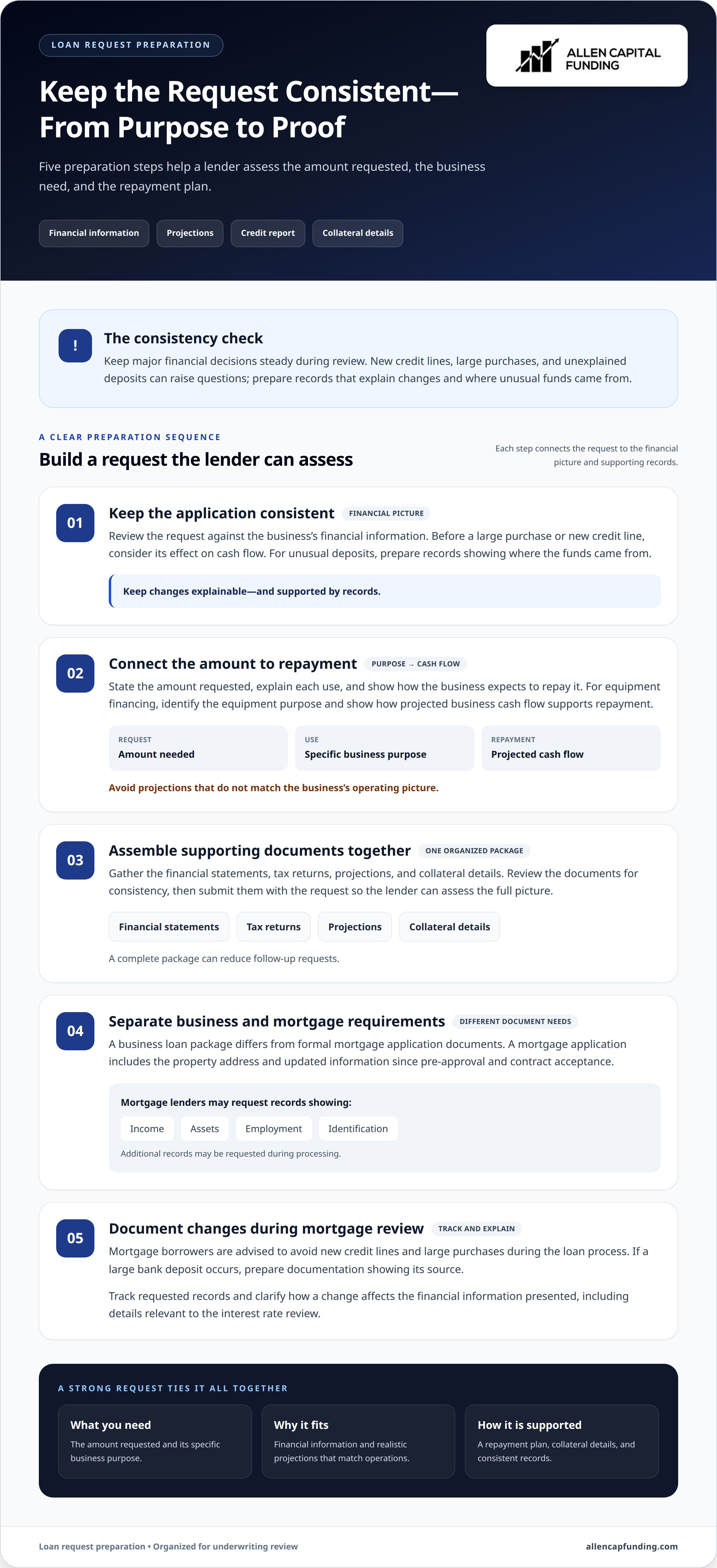
Keep the application consistent. The professional reviews the request against the business’s financial information and identifies changes that could affect the lender’s assessment. If a large purchase or new credit line is under consideration, discuss its effect on cash flow before proceeding. For unusual deposits, prepare records showing where the funds came from.
Connect the request to repayment. The application should state the amount requested, explain each use, and show how the business expects to repay it. For example, equipment financing should identify the equipment purpose and show how projected business cash flow supports repayment. Avoid presenting projections that do not match the business’s operating picture.
Prepare and submit supporting documents together. A funding professional can gather financial statements, tax returns, projections, and collateral details into one organized package. They can review the documents for consistency, then submit them with the request so the lender can assess the full picture. A complete package can reduce follow-up requests.
Separate business and mortgage requirements. A business loan package differs from formal mortgage application documents. A mortgage application includes the property address and updated information since pre-approval and contract acceptance. Mortgage lenders may request documents showing income, assets, employment, and identification, then ask for additional records during processing.
Respond carefully to changes during mortgage review. Mortgage borrowers are advised to avoid new credit lines and large purchases during the loan process. If a large bank deposit occurs, prepare documentation showing its source. The funding professional can help track requested records and clarify how a change affects the financial information presented, including details relevant to the interest rate review.
How a funding professional reviews your credit report before you apply
A funding professional reviews your credit report alongside your business’s financial information, existing obligations, assets, and loan purpose. This context helps shape how to present a loan request to a lender and explain the repayment plan. SBA Loans and conventional business loans can involve different program and lender criteria, so assess requirements for the specific request.
Review the credit report in context. A professional examines the report for information that may affect the application, such as outstanding obligations or entries needing explanation. They compare those details with the business’s financial position rather than treating a score as the complete picture. Reviewing your own report doesn’t create a lender inquiry or start an application.
Clarify the inquiry before prequalification. Ask the loan officer whether an initial review uses a soft or hard inquiry. A soft credit pull during personal-loan prequalification doesn’t affect the applicant’s credit score, while a participating lender’s later hard inquiry may affect credit. Business lending inquiries can follow their own process, so the professional explains the inquiry connected to the application.
Assess affordability using cash flow. The professional maps the expected payment against cash flow and current debt obligations. They show how revenue supports repayment and whether the proposed schedule fits the loan’s purpose. This makes how to present a loan request to a lender more persuasive by grounding the repayment plan in the business’s financial picture.
Compare complete loan terms. A professional can organize offers by APR, repayment schedule, and applicable fees. Compare the payment with the total amount repaid: a longer term may lower each payment but increase the total repaid. Credit score requirements vary by lender and product; mortgage score thresholds shouldn’t be assumed to apply to business financing.
Include assets in the review. Credit is one part of underwriting. For a mortgage, lenders may evaluate assets alongside income and debts, while property value also matters. A funding professional helps present relevant financial information with the credit report, so the loan officer can assess repayment capacity and supporting details together.
How a funding professional prepares financial projections and documents collateral details
A funding professional organizes financial records, forecasts, and collateral information so the lender can assess your business’s financial situation. There is no single debt-service coverage ratio expectation for every request; lenders consider whether projected cash flow can cover scheduled debt payments as well as existing obligations.
How a funding professional gathers financial statements and tax returnsHave a funding professional assemble the financial statements, tax returns, projections, and collateral details for your request. They can compare the records for consistency across revenue, expenses, debt, and available assets, then address gaps or mismatches before submission. For example, a recorded transfer should match the supporting account records. Accurate, consistent documents help the lender evaluate your business’s finances.
How a funding professional shares your financial data for pre-approvalAsk the funding professional to organize the financial information needed for the lender’s initial review. For mortgage pre-approval, borrowers provide information about income, assets, and debts. If automated financial data collection is used, the professional reviews imported figures against statements and tax returns, correcting inconsistencies before sharing them. This makes the financial picture easier to assess, while keeping the submitted information aligned with its source documents.
Build projections around realistic business activity. The professional prepares projections that connect expected revenue and expenses with the requested borrowing. They explain the assumptions behind expected changes, such as increased sales after an inventory purchase, and show how those changes affect cash available for debt payments. A business loan proposal should bring together the amount, specific uses, forecasts, collateral, and repayment plan in a clear account of the request.
Describe collateral and repayment capacity clearly. The professional documents what assets support the request and presents relevant details alongside the projections. Lenders review a borrower’s ability and willingness to repay, as well as collateral value where applicable. The proposal should show how forecast cash flow supports scheduled payments and how the asset relates to the financing purpose. Clear supporting records help the lender assess the request as a whole.
How a funding professional confirms which documents the loan officer needs
A funding professional can clarify the lender’s document requirements, organize your application, and track what has been submitted. Before sending the package, make sure the request explains how your business will use the funds.
Clarify the lender’s requirements. Before submitting, ask the loan officer which documents support this application, how to send them, and who should receive them. Confirm whether the lender needs financial statements, tax returns, bank statements, income records, or collateral details. The exact package depends on the loan and business situation, so the funding professional aligns the document list with the lender’s request.
Describe the proceeds in specific terms. Have the professional connect each use of funds to an amount and business purpose. For example, a request for inventory expansion should explain what the purchase supports and how it fits the business plan. A clear breakdown helps the lender understand the request and assess whether the proposed financing matches its intended use.
Submit a complete, readable package. The professional checks that forms are accurate, multi-page records include every page, and copies are legible before submission. They follow the loan officer’s instructions for sending documents, keep a record of what went out, and confirm the right person received the package. Prompt responses to follow-up requests can help keep processing moving.
Track verification and outstanding items. During processing, the lender may verify information using supporting records, including income documentation, bank statements, and tax returns. The funding professional tracks questions and identifies which document answers each one. If an item is incomplete or inconsistent, they coordinate a clear correction rather than sending unrelated records that may slow review.
Review final documents and closing details. For a mortgage, the lender may request additional documents during the application process. Before closing, borrowers review final loan documents and figures, including the terms and interest rate. A funding professional can help organize the requested information and clarify which records relate to the purchase, closing funds, or final loan terms.
Allen Capital Funding: SBA Loans
Allen Capital Funding helps business owners prepare financing requests and consider SBA Loans for eligible business needs. A focused request connects the amount sought and its intended use with your business’s financial position and a realistic repayment plan. Organized records and clear projections give the lender useful context for reviewing your request.
Turn to Allen Capital Funding when you’re shaping an SBA Loan request or weighing other business financing needs, such as Credit Lines, Real Estate, or Working Capital. The right fit depends on the purpose of the funds and your business’s financial situation. Preparation can clarify your request, but it does not guarantee approval.
Contact Allen Capital Funding to discuss preparing your business financing request.
Move Your Financing Request Forward With Confidence
Knowing how to present a loan request to a lender means connecting your financing goals with a clear business case. Consider what the funds will help your business accomplish and how the request fits its plans. This framing gives underwriting useful context and helps you make informed decisions as the process moves forward.
A focused request can make your business case easier to assess, though it cannot control every underwriting decision. A funding professional can help refine how to present a loan request to a lender based on your goals and financial position. Allen Capital Funding offers SBA Loans, Credit Lines, and Real Estate financing for different business funding needs.
Take the next step by discussing how to present a loan request to a lender with Allen Capital Funding. Contact Allen Capital Funding today to explore a practical direction for your business.
Frequently Asked Questions
What financial documents do lenders require for a loan application?
Business lenders commonly review financial statements, tax returns, cash-flow projections, and details about available collateral. The documents required depend on the financing purpose and lender review. For example, an Equipment Financing request may need information identifying the asset being financed. Label records clearly by period and include supporting pages so the lender can interpret each document in context.
How can a funding professional explain the loan amount and how you will use the funds?
A funding professional can connect the requested amount to specific business expenses and explain how each supports your company’s plans. For example, a request might allocate funds between equipment purchases and inventory, with each use tied to its business purpose. This breakdown helps the lender understand why the amount is appropriate and what the financing is intended to accomplish.
How do lenders evaluate credit score, income, cash flow, and collateral?
Lenders consider these details together to assess your business’s financial position and ability to repay. A credit score and report provide information about credit history, while income and cash flow help show repayment capacity. Collateral may support a secured request, with its value considered alongside your finances. Lenders set their own criteria, so one score alone does not explain an approval decision.
What collateral and personal guarantees might a lender require?
Collateral may include an asset connected to the financing, such as equipment or property, depending on the loan structure. A lender may also request a personal guarantee, but requirements vary by lender and request. Before signing, understand which assets are pledged, who guarantees repayment, and what responsibilities the agreement assigns if your business cannot make its payments.



Comments