
Finding an SBA lender for your small business
Startups can qualify for SBA loans: in fiscal year 2025, more than 23,000 SBA loan approvals went to brand-new startups and businesses less than two years old. Finding a lender for an SBA loan starts with identifying a participating lender and matching your funding need with a program that fits. Approval depends on factors such as your business’s purpose, eligibility, repayment ability, and financing options already explored.
A short operating history does not automatically rule your business out. You’ll need to show how the business can repay the loan and why the financing supports a sound business purpose.
This guide explains where to look for SBA lenders, how to compare their application support, and what to prepare, including a business plan and financial statements. You’ll also learn how Preferred Lenders differ and which questions can help you choose a lender and decide what to do next.
Table of Contents
What is an SBA Preferred Lender?
An SBA Preferred Lender participates in the government’s 7(a) program and has delegated authority to approve eligible loans without final SBA approval. That authority can reduce an approval handoff, but it doesn’t remove the lender’s responsibility to assess the borrower’s application and repayment capacity. Participating 7(a) lenders must be able to evaluate, process, close, disburse, service, and liquidate small-business loans on an ongoing basis.
In the United States, you apply for a 7(a) loan through a participating lender, not directly through the SBA. The lender reviews your business purpose, financial position, and ability to repay, then handles the loan process. Finding a lender for an SBA loan means comparing more than delegated approval authority: ask who will guide your application and what support they provide as documents and questions arise.
Prepare core materials before applying. SBA applicants need a business plan and financial statements to explain how the funding supports the business and how repayment fits its finances. For example, a startup seeking working capital should connect the request to planned operations and projected revenue. Ask each lender which additional records it requires and how it evaluates interest, collateral, and cash flow.
The application can be involved because lenders must examine both documentation and repayment risk. SBA 7(a) applications and approvals typically take 60 to 90 days, so organize records early and respond promptly to requests. Before choosing a lender, discuss the practical terms that affect your plans and the help available during review.
Ask what application guidance the lender provides and who will work with you.
Discuss prepayment penalties, grace periods, and whether the lender can demand full repayment of principal.
Compare each lender’s process with your business needs, not just its Preferred Lender status. Clear answers about required documents, review steps, and repayment terms help you understand what to expect.
What credit score is required for an SBA loan?
No single credit score threshold applies to every SBA loan. SBA programs and lenders set their own eligibility requirements, and lenders use credit scores to assess risk and set interest rates. Ask each lender about its minimum score and how it weighs an owner’s credit against business cash flow and other qualifications.
Community banks, credit unions, and online lenders can be compared by their SBA participation, application requirements, interest rates, and support. A Certified Development Company (CDC) serves a different role: these community-based, mission-oriented organizations make SBA 504 loans available. For a 7(a) loan, apply through a participating lender. Compare each option against the loan type and support you need, rather than assuming one category has identical standards across institutions.
Before applying, organize information about the business and its owners. Lenders assess the business’s ability to repay, while owner credit helps them evaluate risk. Explain the business’s finances and how the requested funding supports its purpose. For an established business, connect revenue and cash flow to the expected payments. Ask which owner and business records the lender considers.
Compare lender requirements directly. Ask about the minimum credit score, cash-flow expectations, interest rate, and other qualifying factors. Credit scores inform risk assessment and pricing, but lenders also consider the business’s ability to repay. Explaining revenue, expenses, and the funding purpose gives the application useful context beyond a score alone.
Plan for the equity contribution, too. A 10 percent equity injection is common for an SBA loan, but the amount depends on the circumstances and lender. A typical SBA 504 project includes at least 10 percent of total project cost from the borrower. Ask how the lender calculates your contribution and what funds or assets it accepts.
Compare lenders using the same questions about score minimums, cash flow, interest, and documentation.
Gather owner and business information, then connect the requested funding to a realistic repayment plan.
For a 504 project, include the expected equity contribution in your financing plan.
There is no single credit score threshold for every SBA loan. Each lender sets its own minimum and weighs owner credit alongside business cash flow and other qualifications. Lenders assess whether revenue and cash flow can support the expected payments.
Loan amounts, uses and down payments
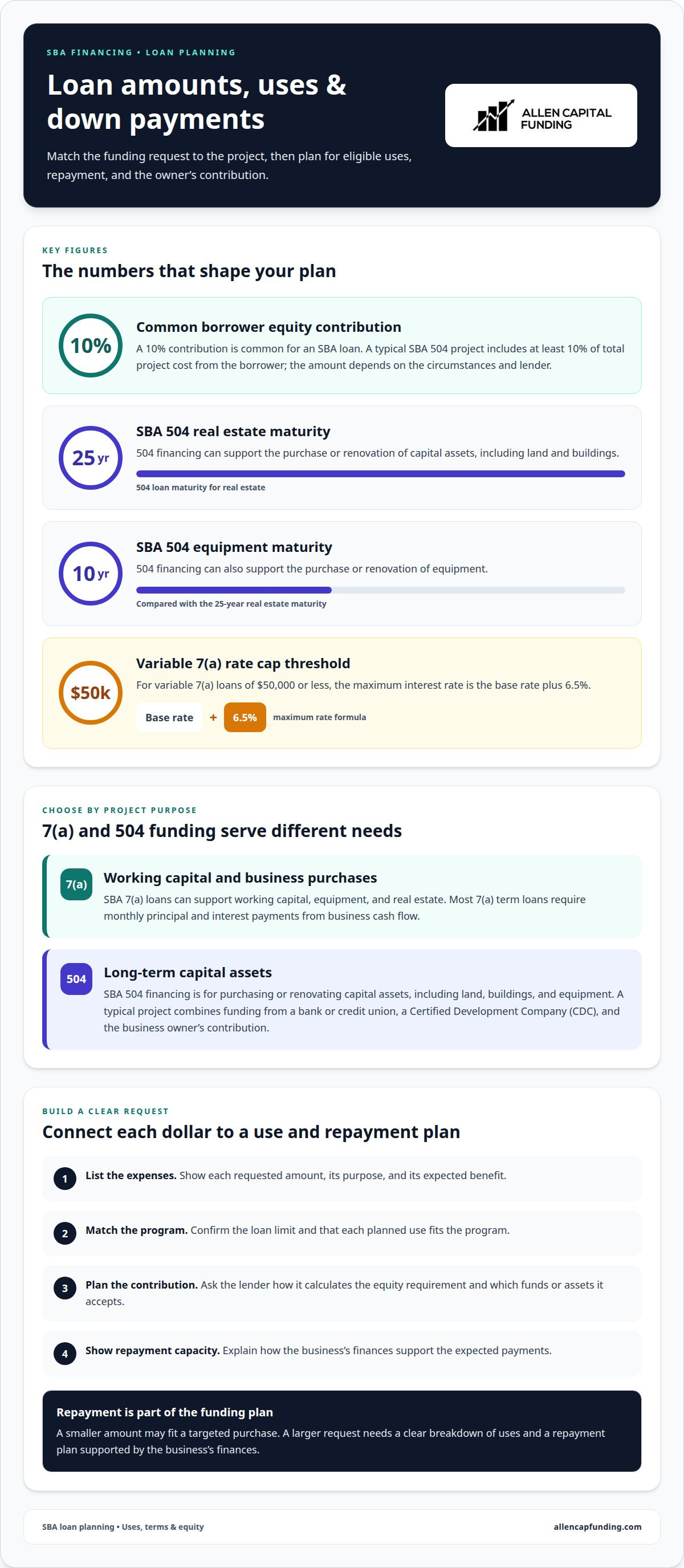
Match the loan amount to the specific purchase or operating need, then confirm the program’s limit and eligible use. SBA 7(a) loans can support working capital, equipment, and real estate.
SBA 504 financing serves a different purpose: businesses can use it to purchase or renovate capital assets, including land, buildings, and equipment. A typical 504 project combines funding from a bank or credit union, a Certified Development Company (CDC), and the business owner’s contribution. The owner’s contribution is commonly 10% of project cost, though the circumstances affect the amount.
Plan repayment alongside the requested amount. Most 7(a) term loans require monthly principal and interest payments from business cash flow. SBA 504 loans have maturities of 25 years for real estate and 10 years for equipment. A smaller loan amount may fit a targeted purchase, while a larger request needs a clear breakdown of uses and a repayment plan supported by the business’s finances.
Interest rates on SBA loans are capped, and SBA-guaranteed loans generally have rates and fees comparable to non-guaranteed loans. For variable 7(a) loans of $50,000 or less, the maximum interest rate is the base rate plus 6.5%. The applicable rate and repayment structure depend on the loan program and terms.
Before applying, prepare a simple funding schedule listing each expense, its purpose, and its expected benefit. This helps the lender assess eligibility and whether the requested amount matches the project. Credit score is one part of the review, along with repayment ability and the planned use of funds.
How do I find an SBA-approved lender near me?
Start with the SBA’s Lender Match tool, which connects prospective 7(a) borrowers with participating lenders. Treat a match as a starting point, not a loan approval. Before using it, define the project, the funding purpose, and the type of SBA loan you want to explore. A clear request helps you compare lenders on relevant criteria rather than location alone.
Define the financing need. Write down what the funds will support, such as working capital, equipment, or a real estate project. Separate essential costs from optional purchases so your request has a clear purpose.
Use SBA Lender Match. Submit your request through the tool to connect with a participating 7(a) lender. Review the responses against your business purpose and the assistance you want during the application process.
Compare the next steps. Ask each matched lender about its application process, document requirements, and communication during review. Compare the answers side by side, including how the lender explains repayment and interest terms.
Prepare for the discussion. Keep your funding purpose, business details, and financial information organized. Use the first conversation to explain the project and understand what the lender needs to assess it.
Searching “near me” can help you find accessible support, but proximity alone does not show whether a lender fits your project. Compare the lender’s SBA participation, experience with the relevant loan type, and the clarity of its process. For example, a business financing equipment can ask how the lender evaluates the purchase and expected repayment from business cash flow.
SBA District Offices can also provide assistance with the 7(a) loan process in person, online, or by telephone. Use that support to understand process steps, then continue discussions with participating lenders about your application and financing needs. Keep notes on each lender’s answers so you can compare options consistently.
Discuss your SBA financing needs and identify a practical next step for your business.
Allen Capital Funding: Credit Lines
Allen Capital Funding can help you consider financing options when your business’s needs extend beyond a single SBA application. If you’re weighing an SBA loan against a credit line, working capital, or real estate financing, first define the expense, timing, and repayment plan your business can support. This gives the financing discussion a practical focus.
A credit line may suit ongoing funding needs, while an SBA loan may better fit a defined project or eligible use. The right path depends on what you’re financing and how it fits your business plans. Allen Capital Funding also works with businesses considering real estate and working capital solutions.
Contact Allen Capital Funding to discuss your business financing needs.
Turn your financing plan into a next step
Before moving forward, write down what the financing needs to accomplish and what your business can comfortably repay. This gives lender conversations a practical focus and helps you compare options against your plans, not just an advertised loan type. A clear funding purpose can also help you decide whether to pursue an SBA loan or explore another route.
Finding a lender for an SBA loan is part of a broader financing decision. Choose an option that fits the project, repayment capacity, and timing your business can manage. Allen Capital Funding can discuss your financing needs and the direction you’re planning to take.
Contact Allen Capital Funding to discuss your next financing step. A clear plan can help you move ahead with confidence.
Frequently Asked Questions
Can startups qualify for SBA loans?
Startups can qualify if they meet the relevant SBA and lender requirements. A new business should explain its purpose, show a realistic repayment plan, and present a business plan linking expected revenue to operating costs. Projections and the owners’ relevant industry knowledge can help explain the business model. Lenders also assess whether the business has explored other financing options.
Are any of these SBA loans easy to apply for?
SBA loan applications can be involved, so no application should be treated as automatically easy. The workload partly depends on how clearly the business documents its finances, ownership, funding purpose, and repayment plan. A startup with limited financial history may need to explain its projections carefully. Before applying, organize records and ask the lender to clarify its process and required application materials.
How long does SBA loan approval take?
SBA 7(a) applications and approvals typically take 60 to 90 days. Approval timelines can vary with the lender’s review, the application’s completeness, and how quickly the borrower responds to document requests. Build time for gathering records and follow-up into your funding plan. If a purchase or project has a deadline, discuss the schedule early so you can understand how the application process fits.
What are SBA loan interest rates based on?
Interest rates depend on the loan program and the lender’s assessment of credit risk. Credit scores help lenders assess risk and set rates, while SBA rules cap interest on SBA loans. For example, variable 7(a) loans of $50,000 or less have a maximum rate of the base rate plus 6.5%. Compare the rate structure, not just the initial payment, when reviewing financing options.
How can I compare SBA 7(a) lenders by rates, fees, and loan terms?
Request each lender’s proposed rate structure and repayment terms in writing, then compare them using the same loan amount and purpose. Include fees, payment schedule, prepayment penalties, grace periods, and conditions that could require full principal repayment. Compare how clearly each lender explains its requirements and application steps, too. A side-by-side review reveals the overall cost and obligations beyond the headline interest rate.
What is the SBA Lender Match program and how does it work?
SBA Lender Match is a tool that connects prospective 7(a) borrowers with participating lenders. Use it to identify lenders to approach, then discuss your business’s financing purpose and application with them. A match is a connection, not a loan decision, so compare the lenders’ proposed terms and requirements directly. Your next step is to prepare the business information needed for those conversations.



Comments