
Financing for Warehouse Purchase: Costs, Rates and Risks
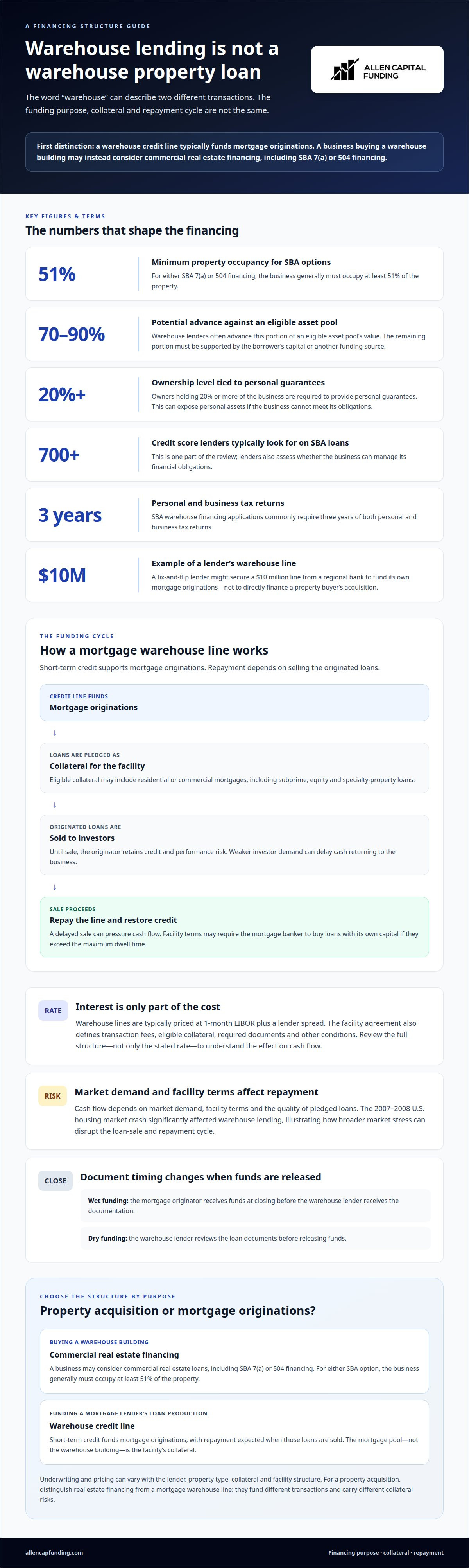
A warehouse line of credit usually funds mortgage originations, not a business buying a warehouse. For financing for warehouse purchase, businesses may consider commercial real estate loans, including SBA 7(a) and 504 financing. For either SBA option, the business generally must occupy at least 51% of the property.
It’s easy to confuse these financing terms, especially when buying a property is part of a larger growth plan. The right structure depends on how you’ll use the warehouse, your business’s financial strength, the property’s value, and the repayment terms your cash flow can support.
This guide explains how financing for a warehouse purchase works, what lenders assess, and how rates, fees, down payments, and collateral affect the total commitment. It also covers repayment and property-related risks, helping you compare the trade-offs and identify a financing path suited to your business.
Table of Contents
Repayment, market, compliance, and collateral risks
Warehouse lending funds mortgage originations through short-term credit, which is repaid when the originated loans are sold. Cash flow therefore depends on market demand, facility terms, and the quality of the loans pledged as collateral.
Repayment, Market, and Compliance Risks
Repayment risk arises when a mortgage originator cannot sell loans quickly enough to repay its warehouse line. Until sale, the originator retains credit and performance risk, while weaker investor demand can delay cash coming back. The 2007-2008 U.S. housing market crash significantly affected warehouse lending, illustrating how broader market stress can disrupt the cycle.
For a private lender, reliable demand in the secondary market and alternative liquidity strategies can help manage delayed or weaker-than-expected loan sales. The lending and banking agreements also set requirements for funding, documentation, and repayment. Missing a facility requirement can restrict access to credit, even when the underlying mortgage remains sound.
Collateral and Personal Guarantees
Collateral gives the warehouse lender security for the credit facility, while a personal guarantee can make an owner responsible for repayment obligations. Lenders require personal guarantees from owners who hold 20% or more of the business. That commitment can expose personal assets if the business cannot meet its obligations, so it affects the acquisition’s overall risk beyond the property and company cash flow.
Facility terms may require mortgage bankers to buy loans with their own capital if those loans exceed the maximum dwell time. A delayed sale can therefore put direct pressure on cash flow. Before committing, borrowers need to understand how collateral eligibility, loan performance, and timing interact under the agreement.
Mortgage Collateral
Mortgage collateral is the pool of loans originated by a lender and pledged to secure its warehouse credit line. Eligible collateral may include residential or commercial mortgages, including subprime, equity, and specialty-property loans. This facility supports a mortgage lender’s origination business, not the purchase of a warehouse building.
If pledged loans underperform or buyers withdraw, the collateral may not support timely repayment. The lender remains exposed until the loans are sold, and weaker demand can disrupt the facility’s repayment cycle. For a property investment, distinguish loan-backed warehouse lending from commercial real estate financing: they fund different transactions and involve different collateral risks.
Warehouse lending rates and transaction fees
Warehouse lenders charge interest and fees for extending credit to mortgage originators. Warehouse lines are typically priced at 1-month LIBOR plus a spread, so the base rate and lender’s spread shape borrowing costs. The facility agreement also defines the transaction fees, eligible collateral, required documents, and other conditions. Review the full structure, not just the stated rate, to understand how costs affect cash flow.
Rates and requirements vary by lender, property type, collateral, and facility structure. State and local property conditions and applicable lending requirements can also affect underwriting. These factors influence eligibility and pricing, so a commercial property acquisition and a pool of mortgage loans should not be treated as the same transaction.
Warehouse lending is distinct from direct hard-money or private lending. A private lender may use a warehouse line to fund its own mortgage originations, then repay the line after selling those loans. For example, a fix-and-flip lender might secure a $10 million warehouse line from a regional bank. That is financing for the lender’s loan business, not a loan directly funding a property buyer’s acquisition.
Commercial asset-based lending also uses eligible assets as collateral, but the borrowing base depends on the assets accepted under the agreement. Warehouse lenders often advance 70% to 90% of an eligible asset pool’s value. The remaining portion must be supported by the borrower’s own capital or another funding source, which affects the facility’s overall liquidity.
Smaller banks use warehouse credit to originate more mortgages without exhausting cash reserves. After closing, they can sell mortgages and use the proceeds to repay the line, restoring credit for further originations rather than holding each loan for its full term. Commercial banks and large consumer banks typically provide this lending to smaller institutions. Businesses assessing a building acquisition can explore commercial real estate financing, a different funding structure from mortgage warehouse lending.
How a lender manages the application, underwriting, approval, and funding process
Underwriting evaluates whether the borrower, property, and repayment plan support the requested capital. For a warehouse acquisition, this review helps establish suitable funding terms and the required equity contribution.
How a lender manages the application and funding process
The lender assesses the application, business finances, property, and repayment capacity before approval. For SBA warehouse financing, applications commonly require three years of personal and business tax returns. Lenders also typically look for a personal credit score of 700 or above for SBA loans, alongside evidence that the business can manage its obligations.
Funding follows the lender’s review and approval of the transaction documents. With wet funding, the mortgage originator receives funds at closing before the warehouse lender receives the documentation. With dry funding, the warehouse lender reviews the loan documents before releasing funds. These approaches show why document timing and liquidity matter during a transaction.
Down Payment and Credit Score Requirements
Down payment and credit requirements depend on the financing structure, so there is no single figure for every warehouse loan. SBA 7(a) warehouse financing may require a down payment as low as 10%, while conventional warehouse loans often require 20% to 30%. For SBA loans, lenders typically look for a personal credit score of 700 or above.
The borrower’s contribution affects how much outside capital the acquisition needs and how much equity remains in the business. SBA 504 down payments may rise to 15% or 20% for startups or specialized properties. Lenders also weigh repayment capacity, business finances, and the property’s role in the company’s operations.
Loan-to-Value and Debt Service Coverage Ratios
Loan-to-value (LTV) compares the loan amount with the property’s value. Debt service coverage ratio (DSCR) measures the income available for loan payments against required debt service. Lenders use these measures to assess collateral and repayment capacity before approving funding.
For the listed commercial loan terms, the maximum LTV is 75%, and the minimum DSCR is 1.40. Listed CMBS loans also allow a maximum LTV of 75%, with a minimum DSCR of 1.25. These are product-specific terms, not universal thresholds for every lender or property. A lender’s review connects the property valuation and projected cash flow to the requested loan structure.
Financing for warehouse businesses
A U.S. business can purchase a warehouse with SBA 7(a), SBA 504, or conventional commercial real estate financing. The right financing for warehouse purchase depends on occupancy, property use, available equity, and the payment schedule the business can support.
For SBA 7(a) and 504 loans, a business generally must occupy at least 51% of the warehouse property. SBA 7(a) financing can provide up to $5 million, may require a down payment as low as 10%, and can have repayment terms up to 25 years for commercial real estate. SBA 504 financing also supports qualifying owner-occupied property acquisitions.
An SBA 504 project is typically financed with at least 50% from a bank or private lender, up to 40% from a Certified Development Company, and at least 10% from the borrower. The CDC portion can have a fixed interest rate and terms of 10, 20, or 25 years. Down payments may rise to 15% or 20% for startups or specialized properties, which changes the equity the business must bring.
Conventional financing is another route for an acquisition. Conventional warehouse loans often require down payments of 20% to 30%. Available terms and payment structures vary, so businesses should assess the full repayment commitment alongside the property’s expected role in operations.
Owner-occupied financing can suit a company that will use most of the warehouse itself. The 51% occupancy rule for SBA 7(a) and 504 loans helps distinguish an operating business purchase from an investment property acquisition. A business planning to lease most of the space may not meet that owner-occupancy threshold.
A warehouse line serves a different purpose: mortgage originators use it to fund loans before selling them, not to buy a warehouse building. For financing for warehouse purchase, focus on commercial real estate terms, occupancy, equity, and whether long-term payments fit your business’s cash flow.
Allen Capital Funding: Purchase Order Financing
Allen Capital Funding helps businesses explore funding options for their specific needs. For a warehouse acquisition, Real Estate and SBA Loans are relevant options to discuss. Purchase Order Financing may suit a separate need to fund purchase orders. These options address different financing purposes, so the right fit depends on whether you need property ownership or order-related capital.
If buying a warehouse is your priority, discuss the property, its intended business use, and your financing goals. If customer orders create a separate funding need, Purchase Order Financing may also fit your broader plan. Allen Capital Funding can help you consider how its options align with your business needs.
Contact Allen Capital Funding to discuss the financing path that fits your plans.
Put Your Warehouse Plans Into Motion
Buying a warehouse can shape how your business operates, serves customers, and plans for growth. Treat financing for a warehouse purchase as part of that broader plan: match the property to your operating needs, available capital, and capacity for future commitments. Clarifying these priorities can make your financing discussion more focused.
Allen Capital Funding offers Credit Lines, SBA Loans, and Real Estate options for businesses with different funding needs. Connect your property goals with the type of capital your business needs, rather than treating the purchase as an isolated transaction.
Bring your acquisition plans and financing priorities into a conversation with Contact Allen Capital Funding. A thoughtful financing plan can help you move toward the right space with greater clarity and confidence.
Frequently Asked Questions
What Is Warehouse Financing?
Warehouse financing usually means a revolving credit facility that mortgage originators use to fund mortgage loans before selling them to permanent investors. The sale proceeds repay the facility, making credit available for future originations. It differs from a business loan used to purchase a warehouse building. For a company buying property, financing options instead depend on the building’s business use, occupancy, and the borrower’s repayment capacity.
Can I use an SBA 504 loan to purchase or refinance a warehouse for my business?
An SBA 504 loan can finance a qualifying owner-occupied warehouse purchase, provided the business generally occupies at least 51% of the property. The financing structure combines funding from a bank or private lender, a Certified Development Company, and the borrower. SBA 504 funds cannot be used for working capital or inventory. Whether the transaction is a purchase or refinance affects the project details and lender review.
What are current interest rates and loan terms for warehouse purchase loans?
There is no single rate or term for every warehouse property loan. SBA 7(a) rates are variable and tied to the Prime Rate, subject to SBA caps. The CDC portion of an SBA 504 loan can have a fixed rate and terms of 10, 20, or 25 years. The property, borrower’s finances, loan structure, and lender’s terms all affect the financing offer.
How do SBA 504 and SBA 7(a) loans work for buying a warehouse?
Both programs can support an eligible business property purchase, but their financing structures differ. SBA 7(a) can provide up to $5 million and may offer repayment terms up to 25 years for commercial real estate. SBA 504 combines bank or private-lender financing with a Certified Development Company portion and borrower contribution. For either program, owner occupancy generally must reach 51%.
What costs and fees should buyers budget for when financing a warehouse?
Budget for the borrower’s down payment, interest, and lender fees, then review the financing agreement for other transaction charges. Down-payment needs vary by structure: SBA 504 projects typically include at least 10% from the borrower, while conventional warehouse loans often require 20% to 30%. Compare the full payment obligation and fees with projected business cash flow, rather than judging affordability from the interest rate alone.
What documents should a business provide, and what steps does a lender handle when arranging warehouse purchase financing?
For an SBA warehouse loan application, businesses commonly provide three years of personal and business tax returns. The lender reviews the application, financial records, property details, and repayment capacity before deciding whether to approve it. Funding follows document review and approval. With dry funding, the warehouse lender reviews loan documents before releasing funds; with wet funding, funds are released at closing before the documentation is received.



Comments