
Average Interest Rate for Working Capital Loan Costs Compared
A lower advertised rate can still mean a higher monthly payment if the repayment term is shorter. The average interest rate for a working capital loan varies by lender and financing type, while the monthly amount also depends on the loan size, term, and interest calculation. The rate alone does not show what borrowing will cost each month.
It’s reasonable to want a clear figure before deciding whether financing fits your cash flow. Compare advertised rates alongside interest calculations, repayment schedules, and loan terms, since the same rate can produce different monthly payments on different amounts. Understanding how working capital options differ helps you focus on the full repayment structure, not just the headline rate.
Table of Contents
Monthly repayments depend on the principal, interest, and term. The advertised rate alone cannot show the effect on cash flow.
Fixed and Variable Rates
A fixed rate stays unchanged through the loan term; a variable rate can move with its benchmark. For U.S. SBA 7(a) loans from $50,001 to $250,000, the U.S. Small Business Administration describes a maximum variable rate of prime plus 6.0%. The U.S. prime rate was 7.00% after the Federal Reserve’s September 2026 increase. SOFR is another benchmark used in variable-rate pricing; the lender’s margin and reset terms affect the final rate. SBA 7(a) loans can fund short- or long-term working capital.
Short-Term Loan Costs
Short-term financing can help cover a temporary cash-flow gap, such as payroll due before customer invoices are paid. But a shorter repayment schedule means higher payments. Merchant cash advances can carry high costs, so compare the total repayment and timing with expected incoming revenue.
Fees and APR Comparisons
Compare APR, origination fees, repayment frequency, and total repayment, not just the stated interest rate. U.S. working capital loan origination fees typically range from 1-6%. APR helps compare financing costs across terms, while a factor rate states a repayment multiplier rather than an annual interest rate. SBA working capital loans may suit longer funding needs; conventional loans can have different rates and qualification criteria.
Borrower Profiles and Loan Rates
Credit, revenue consistency, time in business, and loan term shape lender risk assessments. Businesses operating for two or more years usually unlock lower working capital rates; a credit score above 750 is considered excellent and can help secure a lower rate. To improve eligibility, strengthen credit and document stable revenue. A longer term can lower monthly payments but extend interest costs. Financing is worthwhile when its expected business benefit and repayment fit projected cash flow.
Compare APR, total repayment, payment schedule, and how reliably the financing will support business cash flow.
Advertised working capital interest rate
Online working capital loans typically carry rates of 12-35% APR in the United States. Online term loans had APRs of 14.00%-99.00% as of May 2026, a broader range reflecting differences in loan type and borrower profile. An advertised rate is a starting point, not necessarily the rate every applicant receives.
Check the rate alongside its eligibility conditions. Lenders may consider credit score, revenue patterns, time in business, collateral, and the requested term when reviewing an application. A low advertised rate may be available only to borrowers who meet the lender’s strongest qualification criteria. For example, an established business with consistent revenue may be assessed differently from a newer company with uneven cash flow.
Compare annual percentage rates (APRs), not just headline interest rates. APR offers a broader view of borrowing costs because it accounts for interest and certain fees. Check whether the quoted rate is fixed or variable, how often payments are due, and whether the offer uses a factor rate. A factor rate cannot be compared directly with an annual interest rate.
Use a simple review process before choosing financing:
Match the advertised rate to the loan type, such as a term loan or line of credit.
Read the eligibility criteria, including any credit score, revenue, or collateral requirements.
Compare APR, repayment frequency, and total repayment across offers.
Check whether the funding supports a specific need, such as inventory purchases, without straining operating cash flow.
Federal SBA programs have separate rate caps, while online lenders set their own pricing structures. A business seeking flexible access to funds may compare lines of credit with a lump-sum loan, then weigh each option’s rate and repayment terms against projected revenue. For a clearer view of available working capital funding options, focus on the structure that fits the business’s cash-flow cycle, not the smallest advertised percentage.
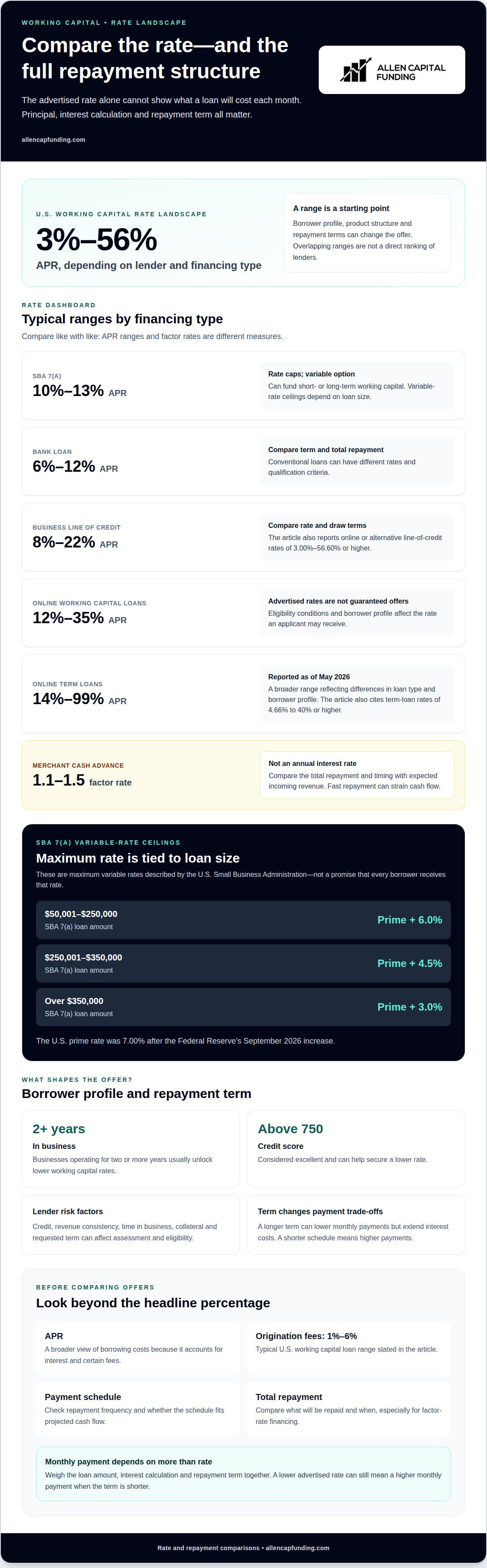
What are typical working capital loan interest rate ranges by lender type?
Working capital rates in the United States range from about 3% to 56% APR, depending on lender and financing type. SBA 7(a) loans typically carry 10-13% APR, while business lines of credit typically range from 8-22% APR. These ranges help frame comparisons, but each product’s rate structure and repayment terms matter too.
Online and alternative financing spans a wider range. Term-loan rates range from 4.66% to 40% or higher, while line-of-credit rates range from 3.00% to 56.60% or higher. Merchant cash advances are priced differently: providers often use factor rates of 1.1-1.5. A factor rate is a multiplier applied to the advance, not an annual interest percentage, so compare its total repayment and timing with an APR.
SBA 7(a) variable-rate ceilings depend on loan size. For a U.S. SBA 7(a) loan from $250,001 to $350,000, the U.S. Small Business Administration describes a maximum variable rate of prime plus 4.5%. For a U.S. SBA 7(a) loan over $350,000, the U.S. Small Business Administration describes a maximum variable rate of prime plus 3.0%. These are maximum rates, not a promise that every borrower receives that rate.
Use the table to narrow down options by financing structure, then compare the full repayment obligation. A revolving line can suit changing working capital needs, while a term loan provides a lump sum with scheduled payments. A merchant cash advance may require frequent repayments tied to sales, affecting daily cash flow. Compare each product’s pricing method with your revenue pattern and borrowing purpose.
What interest rates do banks charge for working capital loans?
U.S. bank working capital loans typically carry rates of 6-12% APR. Traditional bank term loans averaged 6.80%-11.00% as of May 2026, while well-qualified businesses might pay about 7.3% for working capital. These figures offer a comparison point, not a rate available to every applicant.
Federal Reserve data for the second quarter of 2025 lists traditional-bank term-loan rates at 7.23% fixed and 7.79% variable. For bank lines of credit, the same quarter’s figures are 7.20% fixed and 7.80% to 8.10% variable. The difference matters: a fixed rate holds steady, while a variable rate can change with its benchmark.
Bank pricing depends on the lender’s assessment of repayment risk. An established business with consistent revenue may fit a bank’s criteria more closely than a newer company with irregular deposits. The requested amount and loan term also shape the lender’s review.
To assess a bank offer, compare its APR with the payment schedule and total repayment. Then consider whether the funds address a specific working capital need, such as covering a predictable gap between expenses and customer payments. A lower rate may come with a longer term, so weigh monthly affordability against the full repayment period.
Rate: Compare APR, not only the stated interest rate.
Structure: Identify whether the rate is fixed or variable.
Fit: Match repayment timing to the business’s cash flow.
Use these criteria to assess whether bank financing fits your business’s operating needs. Explore working capital financing options to consider a funding structure aligned with your cash-flow plans.
Allen Capital Funding: SBA Loans
Allen Capital Funding helps small businesses explore SBA Loans and working capital funding options. If you’re weighing loan rates against monthly cash flow, its team provides guidance on funding choices suited to your business needs. SBA 7(a) loans can be used for short- or long-term working capital, making them one option to consider when planning business expenses or growth.
Allen Capital Funding can help you assess whether an SBA Loan or another financing structure fits your goals. A Credit Line may suit a business that needs access to funds over time rather than a single lump sum. Compare options based on how you’ll use the funds, the repayment structure, and expected cash flow.
Contact Allen Capital Funding to discuss your business financing needs.
Choose Financing That Supports Your Next Move
Start with the business goal your funding needs to support. The average interest rate for a working capital loan is only one part of the decision. Match the repayment structure to expected cash flow and the purpose of the funds, so financing supports operations without making future planning harder.
Allen Capital Funding can help you consider SBA Loans or Credit Lines for business funding, and Real Estate financing for property-related plans. Bring your priorities to the discussion, such as managing a cash-flow gap, preparing for growth, or evaluating a property opportunity. This gives the conversation a clear starting point and helps identify a suitable direction.
Contact Allen Capital Funding to discuss your business financing goals. Take the next step with a clear view of what your business needs, and move forward with confidence.
Frequently Asked Questions
What types of business loans can cover working capital?
Several financing options can support working capital, including SBA loans, term loans, lines of credit, factoring, and purchase order financing. A retailer preparing for seasonal inventory might consider a term loan, while a company managing uneven invoice payments could explore a line of credit or factoring. Match the funding structure to the timing and purpose of the business expense.
What are business loan interest rates in 2026?
Business loan rates in 2026 vary by product and borrower. SBA 7(a) fixed rates are listed at 12.00% to 15.00%, while variable rates are 10.00% to 13.50%. SBA microloans generally carry rates of 8.00% to 13.00%. Merchant cash advances had APRs of 40.00%-350.00% as of May 2026. Compare APR and total repayment, since factor rates use a different pricing method.
What is the average interest rate for a working capital loan in the U.S. in 2026?
There isn’t one universal average interest rate for a working capital loan in the United States in 2026. Rates depend on whether funding comes from an SBA loan, bank loan, online lender, or another financing structure, as well as the borrower’s qualifications and repayment terms. Use the relevant product range as a guide, then assess APR and total repayment for the specific offer.
What are current prime rate and SOFR benchmarks used to price business loans?
The U.S. prime rate was 7.00%. SOFR is another benchmark used for variable-rate pricing; the lender’s margin and reset terms affect the final rate.



Comments