
SBA 7(a) vs. 504 Loans: A Strategic Comparison for 2026 Business Growth
Your 2026 expansion strategy shouldn't just focus on getting funded; it should focus on how that capital protects your cash reserves during market shifts. You've likely felt the frustration of deciphering complex fee structures or the anxiety of watching approval timelines stretch while opportunities slip away. It's common to feel uncertain about which path offers the best interest rate protection when the prime rate sits at 6.75%. This guide clarifies the SBA 7a vs 504 loan debate to help you secure the capital structure that fuels your specific growth goals without depleting your operating cash.
We promise to provide a clear path toward lower down payments and long-term fixed-rate stability. By comparing the 7.0% to 8.0% blended project rates of the 504 program against the versatile 7(a) structure, you'll discover which option aligns with your 2026 balance sheet. We'll examine the latest 2026 fee waivers for manufacturing loans and the new combined ceiling rules that allow for up to $10 million in total funding. This breakdown ensures you move forward with the professional confidence needed to accelerate your success.
Table of Contents
Navigating the SBA Landscape: 7(a) Versatility vs. 504 Specialization
The SBA 7(a) Loan: Maximum Flexibility for Operations and Acquisitions
The SBA 504 Loan: Financing Long-Term Fixed Assets and Real Estate
Decision Matrix: Comparing Rates, Terms, and Eligibility in 2026
Why Strategic Guidance Matters: Partnering with an SBA Loan Specialist
Navigating the SBA Landscape: 7(a) Versatility vs. 504 Specialization
Choosing the right capital structure in 2026 requires more than just looking at interest rates. It's about aligning your funding with your operational goals. The SBA 7a vs 504 loan debate often boils down to one question: do you need versatility or specialization? The 7(a) program acts as the "Swiss Army Knife" of business lending, offering a solution for almost any business need. In contrast, the 504 program is a specialized economic development tool designed specifically for major fixed asset investments.
The primary trade-off between these programs involves balancing immediate flexibility against long-term rate stability. While the 7(a) offers broad usage, it often carries variable rates. The 504 provides the security of long-term fixed rates but limits your spending to specific assets like real estate or heavy machinery. Deciding which path to take depends on whether you're looking to bridge a cash flow gap or anchor your business with a permanent home.
The Role of the SBA in 2026 Lending
The Small Business Administration (SBA) doesn't actually lend money directly. Instead, it provides a government guarantee that reduces risk for private lenders. This structure allows banks to offer better terms and lower down payments than conventional products. The ultimate goal is the "graduation" philosophy. This means using SBA capital to grow your business until you're strong enough to qualify for conventional financing. Because 2026 regulations have introduced new complexities, working with an SBA loan specialist is vital. They help you navigate current guidelines to ensure your application meets evolving lender requirements.
Quick Comparison: Purpose and Scope
Understanding the scope of each program helps narrow your choices quickly. Evaluating an SBA 7a vs 504 loan requires looking at the specific asset you intend to purchase. Both programs share common "size standards," meaning they're reserved for businesses that meet specific revenue or employee counts. However, their applications differ significantly:
7(a) Loan Focus: Ideal for working capital, business acquisitions, debt refinancing, inventory, and equipment.
504 Loan Focus: Specifically for owner-occupied real estate, land acquisition, and long-term heavy machinery.
If you're buying a competitor, the 7(a) is your best bet. If you're building a new warehouse, the 504 is likely the superior strategic choice. Identifying these needs early prevents wasted time on the wrong application path.
The SBA 7(a) Loan: Maximum Flexibility for Operations and Acquisitions
The SBA 7(a) loan program stands out for its adaptability. It's the most common path for businesses that need capital for more than just a building. While the 504 restricts you to fixed assets, the 7(a) allows you to purchase a competitor, buyout a retiring partner, or secure funds for seasonal inventory spikes. This versatility makes it the premier choice for "soft asset" acquisitions where the value lies in goodwill or intellectual property rather than just equipment.
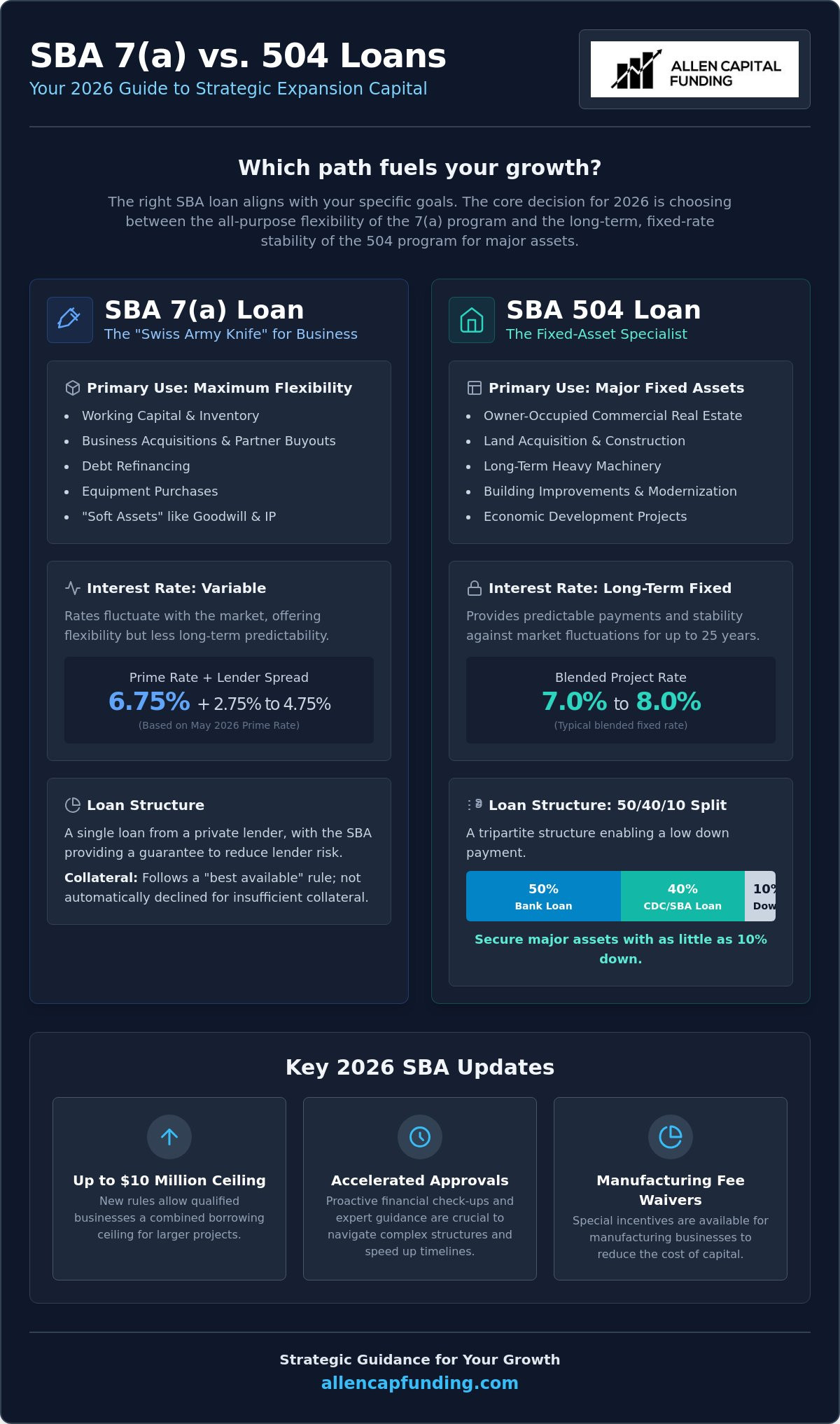
Managing interest rate exposure is critical when comparing an SBA 7a vs 504 loan. In the 2026 market, 7(a) loans typically feature variable rates tied to the prime rate, which sat at 6.75% in May 2026. Lenders usually add a spread between 2.75% and 4.75% depending on the loan size and credit profile. While these rates can fluctuate, the flexibility to use funds for nearly any legitimate business purpose often outweighs the desire for a fixed rate. Additionally, the SBA follows a "best available" collateral rule. They won't decline your application solely because you lack enough assets to fully secure the loan; they'll simply take a lien on the assets you do have.
Ideal Scenarios for 7(a) Funding
Strategic growth often requires moving faster than conventional lending allows. The 7(a) structure excels when you need to boost inventory for a sudden purchase order or fulfill a large contract. It's also a powerful tool for debt consolidation. You can refinance high-interest business debt into a single, lower monthly payment to improve your overall cash flow. For those operating in leased spaces, this program provides the necessary capital for leasehold improvements, ensuring your location reflects your brand even if you don't own the deed. Performing a financial check-up early can help determine which of your current obligations are eligible for this type of strategic refinancing.
Understanding 7(a) Terms and Limits
The repayment timelines are designed to match the life of the asset you're financing. You'll typically see 10-year terms for working capital, inventory, and equipment, while real estate portions can stretch to 25 years. The program has a maximum cap of $5 million. This limit is usually sufficient for most small to mid-sized growth projects, though it may require careful planning if you're eyeing a massive acquisition. For smaller, urgent needs, the SBA Express sub-program offers a streamlined path for loans up to $500,000 with faster turnaround times from approved lenders.
The SBA 504 Loan: Financing Long-Term Fixed Assets and Real Estate
If your 2026 growth strategy involves anchoring your business with a permanent location or heavy industrial equipment, the 504 program offers a level of stability that the 7(a) cannot match. Unlike the general-purpose nature of other programs, the SBA 504 loan program is a specialized economic development tool. It's designed to promote business expansion and job creation by providing long-term, fixed-rate financing. This structure is particularly advantageous in the 2026 market, where the CDC portion of the loan currently offers fixed rates in the 6% to 8% range, providing a hedge against the variable fluctuations common in other lending products.
One of the most compelling reasons to choose an SBA 7a vs 504 loan for large projects is the total funding capacity. While the 7(a) is capped at a total of $5 million, the 504 program can often facilitate much larger deals. The SBA's portion alone can reach $5.5 million for manufacturing projects or those meeting specific energy goals. When you factor in the private lender's 50% contribution, the total project size can easily exceed $10 million. To qualify, your project must meet specific public policy goals or job creation requirements, typically creating or retaining one job for every $75,000 to $120,000 guaranteed by the SBA.
The 504 Loan Structure Labeled
The 504 program utilizes a unique tripartite structure that minimizes the burden on your cash reserves. This collaborative approach involves three distinct parties:
Step 1: A private lender provides 50% of the project cost and holds the first lien position.
Step 2: A Certified Development Company (CDC) provides 40% of the cost via an SBA-guaranteed debenture, holding the second lien.
Step 3: The business owner contributes a 10% down payment as equity, though startups or special-use properties may require 15%.
Fixed Assets and Real Estate Requirements
This program is strictly reserved for fixed assets with a long useful life. For real estate, the "owner-occupied" rule is central; your business must occupy at least 51% of an existing building or 60% of a newly constructed facility. In 2026, borrowers can choose between 10, 20, and 25-year fixed-rate options, allowing you to lock in occupancy costs for decades. This makes the 504 superior for heavy machinery and equipment with a 10 plus year life cycle, as it aligns the repayment term with the actual utility of the asset. By securing these long-term rates now, you protect your future bottom line from unpredictable market shifts.
Decision Matrix: Comparing Rates, Terms, and Eligibility in 2026
Evaluating the SBA 7a vs 504 loan requires a look at the total cost of capital beyond the base interest rate. While the 7(a) program offers speed, it carries higher ongoing service costs. For 2026, the 7(a) annual service fee is up to 0.55% of the guaranteed portion of the loan. In contrast, the 504 program features a lower annual fee of approximately 0.21%. However, the 504 requires an upfront guarantee fee of 0.5%. It is vital to note that for the 2026 fiscal year, the SBA has waived these fees for qualifying manufacturing loans, providing a significant advantage for industrial expansion. When calculating all-in costs, remember that 7(a) loans often allow you to finance these fees, which preserves your immediate cash reserves for operations.
Speed to capital is often the deciding factor for time-sensitive growth. Because the 7(a) involves a single private lender, you can often secure funding in 30 to 60 days. The 504 process is more methodical. It involves both a private bank and a Certified Development Company (CDC), which typically extends the timeline to 60 or 90 days. Repayment flexibility also differs between the two paths. Most 7(a) loans for working capital or equipment have no prepayment penalties. If a 7(a) is used for real estate, a simple 3-2-1 penalty applies only for the first three years. The 504 debenture is less flexible, utilizing a declining prepayment penalty scale that lasts for half the term of the loan.
2026 Interest Rate Outlook for SBA Borrowers
With the prime rate at 6.75% as of mid-2026, 7(a) borrowers face higher monthly payments on their variable-rate debt. This makes the 504 debenture highly attractive. It locks in a fixed rate for up to 25 years on 40% of the project cost. This stability acts as a critical hedge against future market volatility. If your balance sheet doesn't meet the strict SBA requirements or you need even faster liquidity, you might consider asset-based lending for small business as a strategic alternative to unlock your current assets.
Eligibility and Size Standards
Both programs utilize the Alternative Size Standard to determine eligibility. Your business qualifies if its tangible net worth is under $20 million and its average net income for the previous two years is less than $6.5 million. You must also pass the "credit elsewhere" test. This proves that the requested financing is not available on reasonable terms without the SBA guarantee. In 2026, the SBA continues to require personal guarantees from any individual owning 20% or more of the business. This ensures a dedicated partnership between the owners and the lending institution. To ensure your application is positioned for success, schedule a financial check-up with our team to review your current debt-to-income ratios and collateral availability.
Why Strategic Guidance Matters: Partnering with an SBA Loan Specialist
Deciding between an SBA 7a vs 504 loan is only the first step in a multi-layered journey. While many business owners start by walking into their local bank, that approach often limits your options to a single institution's internal risk appetite. A small business loan broker acts as a strategic facilitator with a much broader view of the 2026 lending market. We maintain a national network of lending partners, allowing us to match your specific project with the lender most likely to offer the lowest rates and fastest approval times.
Preparation is the most critical factor in securing growth capital. Our comprehensive Financial Check-Up ensures you're loan-ready before you ever submit an application. We analyze your debt-to-income ratios, collateral coverage, and cash flow projections to identify potential red flags that could cause a bank to hesitate. By addressing these issues early, we remove barriers and streamline the path to progress. A specialist doesn't just hand over paperwork; they package your loan to meet both the technical requirements of the SBA and the credit criteria of the private lender. This meticulous attention to detail transforms a complex, high-pressure process into a manageable strategic move.
Beyond the Loan: Tailored Funding Solutions
Capital needs rarely exist in a vacuum. A major real estate acquisition might require a 504 loan, but your daily operations might still need a liquidity cushion. We often suggest using a business line of credit alongside your primary SBA loan to maximize your flexibility. This ensures you have access to cash for short-term opportunities while your long-term debt remains fixed. If your expansion involves specialized tools that don't fit the 10-year useful-life rule of the 504 program, we can integrate separate equipment financing into your capital structure. This holistic approach builds a foundation for long-term partnership rather than just a one-time transaction.
Getting Started with Allen Capital Funding
The 2026 lending environment moves quickly. You need an ally who prioritizes speed and accuracy without sacrificing professional guidance. At Allen Capital Funding, we focus on your "accelerated success" by acting as the bridge between your current state and your future growth goals. We invite you to schedule a strategic consultation to evaluate the feasibility of an SBA 7a vs 504 loan for your next project. Our team is ready to help you navigate the complex fee structures and regulatory changes of the current year. Book your consultation today to secure the capital you need to fuel your 2026 expansion.
Accelerate Your 2026 Expansion with Strategic Capital
The choice between an SBA 7a vs 504 loan isn't just a technical detail; it's a strategic decision that shapes your company's financial resilience. Whether you prioritize the operational flexibility of the 7(a) program or the long-term, fixed-rate stability of the 504 structure, your choice should align with your specific 2026 growth objectives. As we've explored, these programs offer lower down payments than conventional loans, preserving your cash reserves for the unexpected opportunities that lie ahead.
Navigating these complex options requires a steady hand and a proactive approach. At Allen Capital Funding, we provide expert guidance from a national team of lending specialists who understand the nuances of the current market. We offer customized funding options tailored to your 2026 growth strategy and provide proactive support through the entire SBA application process. Don't let uncertainty about interest rates or approval timelines stall your progress.
Book a Strategic Consultation with an SBA Specialist today to secure the capital structure your business deserves. We're here to act as your dedicated guide, removing barriers and simplifying your path to accelerated success. Your future growth starts with a single, well-informed step toward the right funding solution.
Frequently Asked Questions
Can I use an SBA 7(a) loan to buy commercial real estate in 2026?
Yes, you can use the 7(a) program to purchase owner-occupied commercial real estate. While the 504 is often the first choice for property, the 7(a) offers a 25-year term for real estate and allows you to include working capital in the same loan. This makes it a strong option if your expansion requires both a new location and immediate cash for inventory or hiring.
What is the minimum down payment for an SBA 504 loan?
The minimum down payment for a 504 project is 10% of the total cost. However, certain conditions require a higher contribution. If your business is a startup or if the property is considered "special-use," such as a hotel or a gas station, the required down payment increases to 15% or 20% depending on the specific risk profile.
How long does it typically take to close an SBA 7(a) vs a 504 loan?
A 7(a) loan typically closes within 30 to 60 days because it involves a single lender and the SBA. The 504 process generally takes longer, often 60 to 90 days, due to the coordination required between a private bank and a Certified Development Company. When comparing an SBA 7a vs 504 loan for a time-sensitive acquisition, the 7(a) often provides the necessary speed.
Are SBA loan interest rates fixed or variable in 2026?
SBA 7(a) loans are typically variable and tied to the prime rate, which was 6.75% in May 2026. In contrast, the CDC portion of a 504 loan offers a fixed rate for the entire 10, 20, or 25-year term. This makes the 504 an excellent tool for borrowers seeking long-term payment stability in a fluctuating rate environment.
Can a startup business qualify for both SBA 7(a) and 504 loans?
Yes, startups are eligible for both programs provided they meet the SBA's credit and character requirements. Startups using the 504 program should expect to contribute at least 15% equity instead of the standard 10%. For a 7(a) loan, lenders will focus heavily on the strength of your business plan and your relevant industry experience.
What happens if I want to pay off my SBA loan early?
Prepayment penalties depend on the loan type and the length of the term. For a 7(a) real estate loan, a 3-2-1 penalty applies only during the first three years. The 504 program has a more complex declining penalty scale that lasts for half of the loan term. Most 7(a) loans used for working capital or equipment have no prepayment penalties at all.
Do I need to provide a personal guarantee for an SBA loan?
Yes, the SBA requires a full unconditional personal guarantee from anyone who owns 20% or more of the business. This requirement is standard for both the 7(a) and 504 programs. Lenders may also request guarantees from key managers or owners with smaller stakes if the business's credit profile needs additional support.
What is the "Alternative Size Standard" for SBA eligibility?
The Alternative Size Standard allows larger businesses to qualify for an SBA 7a vs 504 loan even if they exceed traditional industry-specific caps. Under this standard, your business is eligible if its tangible net worth is $20 million or less and its average net income after federal income taxes for the previous two full fiscal years is $6.5 million or less.



Comments