


Invoice Factoring vs. PO Financing: Strategic Cash Flow Solutions for 2026
- anthonyarallen
- Jul 21
- 12 min read
What if the biggest obstacle to your company’s growth isn't a lack of sales, but the very contracts you’ve already won? It's a frustrating reality for many business owners who find themselves turning down massive orders because they lack the upfront capital for inventory, or are forced to wait out 60 to 90 day payment terms while expenses pile up. You know your business is capable of more, but the cash gap between securing a deal and receiving payment feels like a constant hurdle. Understanding the nuances of invoice factoring vs po financing is the first step toward reclaiming your momentum and ensuring your cash flow remains as robust as your ambition.
In this guide, you'll discover whether funding your supply chain or your sales ledger is the fastest path to scaling your operations in 2026. With the global supply chain finance market projected to exceed $14.5 billion this year, choosing the right tool is essential for maintaining 100% order fulfillment. We'll compare how these strategic solutions bridge the 90-day cash gap and provide scalable capital that grows alongside your sales volume. By the end, you'll know which option protects your margins while giving you the agility to say yes to every opportunity that comes your way.
Table of Contents
Understanding the Working Capital Gap in Modern Supply Chains
Invoice Factoring: Accelerating Liquidity from Completed Sales
Purchase Order Financing: Funding Growth Before the First Shipment
Strategic Comparison: Which Asset-Based Solution Fits Your Business?
Implementing a Tailored Funding Strategy with Allen Capital Funding
Understanding the Working Capital Gap in Modern Supply Chains
Every business owner understands the frustration of a sales report that looks great on paper while the bank account remains empty. This disconnect is the cash flow gap. It represents the specific timing difference between when you must pay your suppliers and when your customers finally settle their invoices. In the current 2026 economic environment, this gap has become more dangerous. Supply chain volatility and shifting global trade regulations have extended lead times, forcing companies to hold more "just-in-case" inventory. Working capital is the lifeblood of operational agility in 2026.
Traditional banking institutions have struggled to keep pace with these shifts. Recent data shows the global SME financing gap exceeds $5 trillion annually, as banks tighten lending criteria in response to fluctuating profit margins. Asset-based lending has emerged as the primary non-debt alternative for firms that need to scale without the burden of high-interest compound debt. Instead of focusing on your credit score alone, these solutions leverage the value of your orders and invoices to create immediate liquidity. When evaluating invoice factoring vs po financing, the first step is identifying exactly where your capital is currently trapped.
The Pre-Delivery vs. Post-Delivery Funding Dilemma
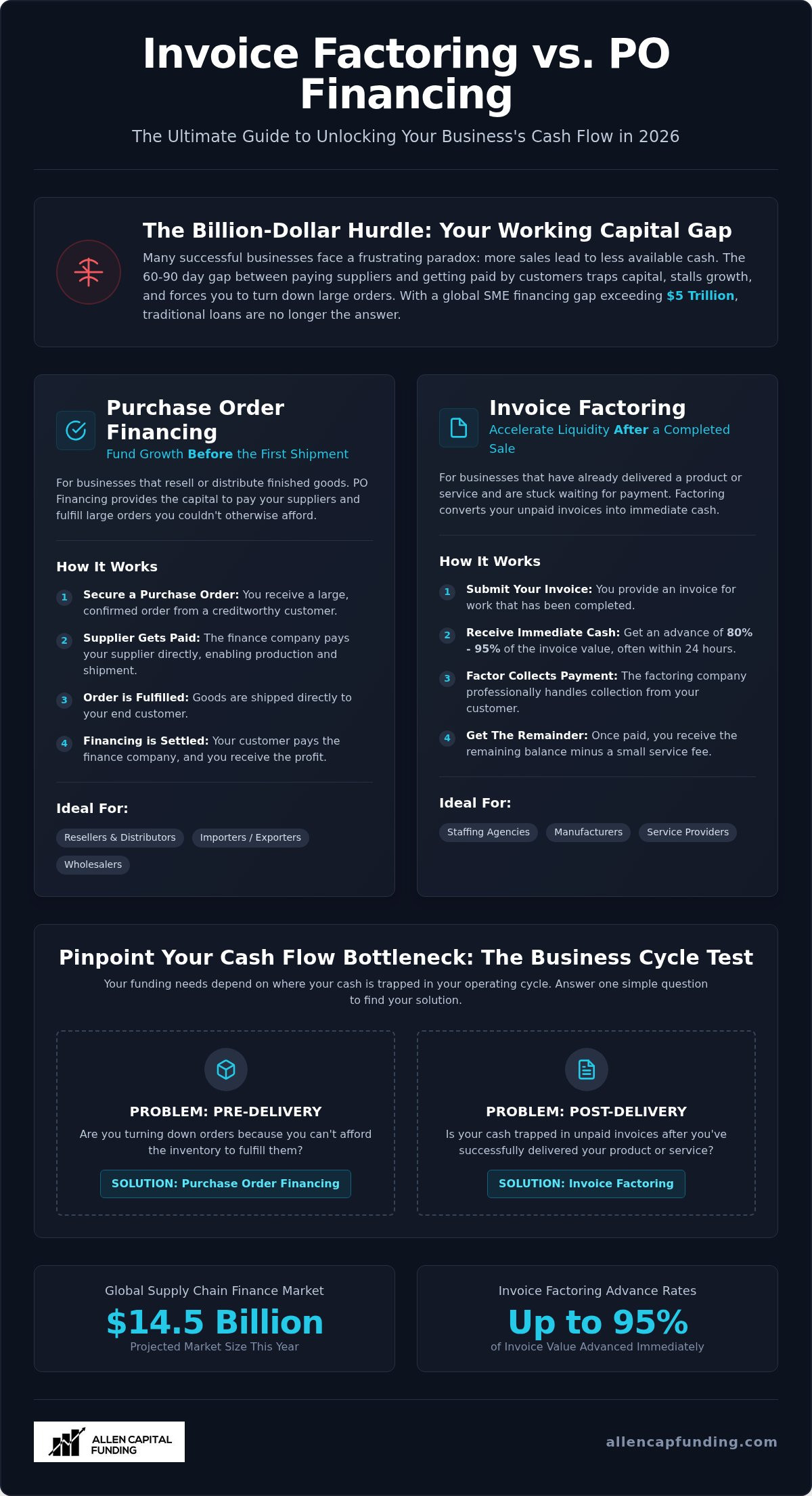
The funding bottleneck usually occurs at one of two stages. Pre-delivery needs arise when you secure a large contract but don't have the cash to buy the raw materials or finished goods required to fulfill it. This is a supply chain problem. If you can't pay your manufacturer, the order never ships. Post-delivery needs occur after you've successfully delivered the goods. You've done the work, but you're now stuck waiting 60 or 90 days for payment. To identify your bottleneck, map your cash cycle. Are you losing deals because you can't buy inventory, or are you stalling because your cash is tied up in your sales ledger?
Why Traditional Loans Often Fail High-Growth B2B Firms
High-growth firms often hit a "Credit Wall" when dealing with local banks. Banks typically demand years of profitable tax returns and physical collateral like real estate. For a rapidly scaling B2B company, your most valuable assets are often your contracts and your accounts receivable. Asset-based lending shifts the focus from your balance sheet to the performance and creditworthiness of your customers. This framework allows you to unlock liquidity based on the strength of your sales. You can explore how this works in detail through our guide on asset-based lending for small business. By prioritizing performance over personal guarantees, you maintain the flexibility needed to capture market share in a competitive year.
Invoice Factoring: Accelerating Liquidity from Completed Sales
You've delivered the product or completed the service. The job is finished, but the financial cycle is just beginning. In many B2B industries, this marks the start of a grueling 60 or 90-day wait for payment. This delay often creates a "success trap" where more sales actually lead to less available cash. Invoice factoring solves this by turning your completed sales into immediate liquidity. Instead of waiting months, you can access your funds within 24 hours of issuing an invoice. This speed is a primary differentiator when comparing invoice factoring vs po financing, as factoring focuses on the end of the sales cycle rather than the beginning.
The mechanics of factoring are straightforward and designed for rapid execution. When you submit an invoice, a factor typically provides an advance rate of 80% to 95% of the total value. The remaining percentage is held in a reserve account. Once your customer pays the invoice in full, the factor releases the reserve to you, minus a small service fee. This structure provides a predictable flow of capital that scales automatically with your sales volume. It's particularly effective for staffing agencies, manufacturers, and service providers who face high recurring overhead like payroll.
Beyond the cash, factoring offers strategic administrative support. The factoring company often handles collections and performs credit checks on your potential customers. This essentially outsources your accounts receivable department, allowing you to focus on operations rather than chasing payments. A quick Financial Check-Up with a specialist can help determine if your current ledger is ready to be leveraged for this type of immediate growth.
Recourse vs. Non-Recourse Factoring: Managing Risk
Choosing the right factoring structure depends on your appetite for risk. In recourse factoring, which is the most common model in the U.S., your business remains liable if the customer fails to pay the invoice. This usually comes with lower fees because the factor takes on less risk. Non-recourse factoring is different; the factor assumes the credit risk if your customer becomes insolvent. While this offers more security, it typically carries a premium fee of 0.5% to 1.5% above standard rates. Your industry's typical bad-debt ratio should dictate which path you choose.
Cost Drivers and Fee Structures in 2026
Factoring costs aren't one-size-fits-all. The primary driver is the creditworthiness of your customers, not your own business credit. In 2026, factors also look at the duration the invoice remains outstanding and your total monthly volume. Fees generally range from 1% to 4.5% depending on whether the invoice is settled in 30 or 90 days. Be sure to look past the initial discount rate. You should also account for secondary costs like ACH transfer charges or monthly minimum volume requirements to understand your true cost of capital.
Purchase Order Financing: Funding Growth Before the First Shipment
Landing a major contract is a milestone for any growing company. However, that celebration often turns to stress when you realize your current cash reserves won't cover the inventory costs required to fulfill the deal. This is where purchase order (PO) financing becomes essential. It provides the capital necessary to pay your suppliers upfront, ensuring you never have to turn down a profitable opportunity due to a lack of liquidity. Purchase order financing is a transaction-specific capital injection that focuses on the potential of a future sale rather than the history of your balance sheet.
This tool is particularly powerful because it scales directly with your contract volume. If you secure a $100,000 order today and a $1 million order next month, your funding capacity grows alongside your success. When looking at invoice factoring vs po financing, the primary difference is the point of intervention. While factoring requires a completed sale and a generated invoice, PO financing steps in at the very beginning of the supply chain. This makes it the ideal choice for wholesalers, distributors, and government contractors who act as intermediaries and need to move goods quickly without tying up their own working capital.
The 6-Step Purchase Order Financing Process
The workflow for PO funding is methodical and designed to protect all parties involved. It typically follows this progression:
Step 1: You receive a valid purchase order from a creditworthy customer.
Step 2: You apply for funding and provide your supplier's cost estimate.
Step 3: The financier pays your supplier directly, often via a Letter of Credit.
Step 4: The supplier produces and ships the goods. The financier may oversee inspections to ensure quality.
Step 5: The goods are delivered to your customer, and you issue an invoice.
Step 6: The customer pays the financier directly. The financier deducts their fees and remits the remaining profit to you.
This process closes the loop on the transaction, often transitioning seamlessly into a factoring arrangement if the customer requires long payment terms after delivery.
Qualifications and Requirements for PO Funding
Because the financier is taking on the risk of production and delivery, the qualifications are specific. Most lenders focus exclusively on "finished goods" that require no further assembly or manufacturing. This minimizes the risk of production delays or technical failures. Financiers also scrutinize your supplier's track record. They need to know your vendor is reliable and capable of meeting the order's specifications on time. Finally, profit margins are a critical factor. Most PO financing arrangements require a minimum gross profit margin of 15% to 20% to ensure the transaction is economically viable for both your business and the lender. This ensures that even after the cost of capital, your firm retains a healthy return on the contract.
Strategic Comparison: Which Asset-Based Solution Fits Your Business?
Deciding between invoice factoring vs po financing isn't about finding a superior tool, but about identifying where your capital is currently trapped. To make the right choice, you must apply the 'Business Cycle' test. If your bottleneck occurs before you can even ship a product, your problem is inventory. If your bottleneck occurs after the product is delivered, your problem is accounts receivable. Each solution offers a different balance of speed, cost, and control. Factoring is generally faster and less expensive because the work is already done and the invoice is a verified asset. PO financing is more complex and carries higher fees, but it's the only option that allows you to fulfill orders that far exceed your current cash on hand.
Both solutions impact your gross margins. For PO financing to remain economically viable, your transaction should ideally carry a gross profit margin of at least 15% to 20%. This ensures that even after the financier takes their fee, your business retains enough profit to cover overhead and fuel further growth. For companies with a more established track record and steady, predictable revenue, a business loc might serve as a more flexible, long-term alternative to these transaction-specific tools. However, for rapid scaling, asset-based lending remains the most responsive path to liquidity.
Decision Matrix: Factoring vs. PO Financing
Your choice should align with your specific industry needs and current operational hurdles:
Choose PO Financing if: You are a wholesaler or distributor with a confirmed order from a creditworthy customer but lack the 100% upfront cash needed to pay your supplier. This is common in retail and government contracting.
Choose Factoring if: You've already delivered the goods or services. You need cash now to meet payroll or take on new projects while your customer sits on the invoice for 60 days. This is the standard for staffing, construction, and consulting firms.
The Hybrid Strategy: Using Both Tools Simultaneously
The most successful firms in 2026 often ignore the "either/or" debate and use a hybrid strategy to fund the entire supply chain. This approach allows PO financing to transition naturally into invoice factoring. The PO financier pays your supplier to get the goods produced and shipped. Once the customer receives the shipment and you generate an invoice, a factoring company steps in to buy that invoice. This immediate cash injection is used to pay off the PO financier and puts the remaining profit in your pocket months before the customer actually pays. This seamless transition maximizes your leverage and ensures that cash flow never stops your momentum. Capturing this level of operational leverage starts with a tailored approach. You can book a consultation with our team to find the specific lender network that fits your industry's unique demands.
Implementing a Tailored Funding Strategy with Allen Capital Funding
Allen Capital Funding operates as a national brokerage, which provides a distinct advantage over traditional direct lenders. Instead of forcing your business into a rigid, one-size-fits-all loan, we leverage a specialized network of lenders to find a solution that fits your specific operational reality. This brokerage model naturally drives more competitive rates because multiple lenders compete for your business. When weighing invoice factoring vs po financing, having an expert guide ensures you select the instrument that addresses your actual bottleneck without overpaying for capital. We act as a steady, reliable hand in the complex world of business finance.
Our role is that of a strategic consultant. We don't just provide a transaction; we help you identify where your capital is trapped and match your business cycle to the right funding product. This proactive approach removes the barriers to progress and simplifies the path to 2026 growth. Whether you're a local entrepreneur or an institutional partner, our team focuses on providing the expert guidance needed to foster a sense of security while you scale.
Customizing Your Capital Mix
A truly resilient business doesn't rely on a single funding source. We help you build a flexible "Capital Stack" that evolves as your needs change. This might involve integrating Equipment Financing to upgrade your production line or securing SBA Loans for long-term stability alongside your short-term working capital solutions. The foundation of this strategy is our Financial Check-Up. This assessment allows us to look at your entire financial picture and recommend a tailored mix of products that support your specific 2026 goals. By diversifying your funding, you ensure that you're prepared for both sudden opportunities and market shifts.
Next Steps: Securing Your Business Future
Securing your business future starts with preparation. To expedite your funding, gather your recent accounts receivable aging reports, current purchase orders, and your most recent bank statements. Having these documents ready allows our team to move with the speed your business demands. Once you initiate the process, you'll move through a streamlined progression from an initial consultation to a tailored funding proposal. You can often reach your first draw in a matter of days, reflecting the urgency and efficiency required in today's market. Take the first step toward accelerated success by booking your Financial Check-Up today and discover the fastest path to scaling your operations.
Secure Your Operational Momentum for 2026
Managing a growing business requires more than just high sales volume; it requires a strategic approach to liquidity. The choice between invoice factoring vs po financing ultimately rests on your unique business cycle and where your cash is currently restricted. By identifying whether your bottleneck is at the point of purchase or the point of payment, you can select the funding tool that protects your margins while accelerating your growth. Many firms find that a hybrid approach provides the most comprehensive coverage for their entire supply chain.
Allen Capital Funding acts as your dedicated guide through these financial decisions. We provide expert guidance tailored to your specific industry needs, offering national reach combined with the personalized feel of a local consultant. Our brokerage model grants you access to a diverse range of capital products, including SBA loans and flexible working capital. Don't let a temporary cash gap stop your progress. Book a Strategic Funding Consultation with Allen Capital Funding today to unlock the capital your business deserves. Your next big contract is waiting, and we're here to help you fulfill it with confidence.
Frequently Asked Questions
Can I use invoice factoring and purchase order financing at the same time?
Yes, you can use both methods sequentially to fund your entire supply chain. This hybrid approach allows a purchase order financier to fund the production of goods, while an invoice factoring company takes over once the product is delivered. Combining these tools ensures that your cash flow remains fluid from the moment you receive an order until the final payment is collected from your customer.
Is purchase order financing more expensive than a traditional business line of credit?
Yes, purchase order financing typically carries a higher cost than a traditional business line of credit. This is because the lender takes on significant risk by advancing funds before the goods are even produced or delivered. While a line of credit relies on your historical financial strength, PO financing is a transaction-specific tool that provides capital when traditional banks might hesitate due to a lack of physical collateral.
Do I need a high personal credit score to qualify for invoice factoring in 2026?
No, your personal credit score is not the primary factor in the approval process. When evaluating invoice factoring vs po financing, lenders focus on the creditworthiness and payment history of your customers. Because the invoice itself acts as the collateral, businesses with less than perfect credit can still access immediate liquidity as long as they are billing reliable, creditworthy B2B clients or government entities.
Does my customer need to know that I am using invoice factoring?
In most cases, your customer will be notified because they must redirect their payment to the factoring company. This is a standard practice in B2B industries and is often viewed as a sign of a growing, well-managed business. Some specialized non-notification factoring options exist, but these usually require a stronger financial history and may come with different fee structures or requirements.
What happens if my customer never pays the factored invoice?
The outcome depends on whether you have a recourse or non-recourse agreement. In a recourse arrangement, your business is responsible for buying back the invoice if the customer fails to pay. With non-recourse factoring, the factoring company assumes the credit risk of the customer's insolvency. It's vital to review your contract to understand your liability for non-payment due to disputes versus financial inability to pay.
Can startups with no trading history qualify for purchase order financing?
Yes, startups can qualify even without a long trading history. Lenders prioritize the validity of the purchase order and the reliability of your supplier over your company's age. If you have a confirmed order from a reputable customer and a manufacturer with a proven track record, PO financing can provide the jumpstart capital needed to fulfill large contracts that would otherwise be out of reach.
How quickly can I receive funds through these asset-based lending methods?
Speed varies between the two methods. Invoice factoring is exceptionally fast, often providing funds within 24 to 48 hours of invoice verification. Purchase order financing typically takes longer, often one to two weeks, because the lender must perform due diligence on your supplier and the production timeline. Both methods are significantly faster than the months-long application process typical of traditional bank loans.
Are there industry-specific restrictions for PO financing?
PO financing is most effective for businesses dealing in finished goods, such as wholesalers, distributors, and importers. It's less suitable for service-based industries or complex construction projects where percentage of completion billing is used. When comparing invoice factoring vs po financing, service providers almost always find factoring to be the more appropriate and accessible solution for their specific operational needs.


Comments