


Commercial Real Estate Loans in NY: The 2026 Strategic Funding Guide
Updated: Aug 15
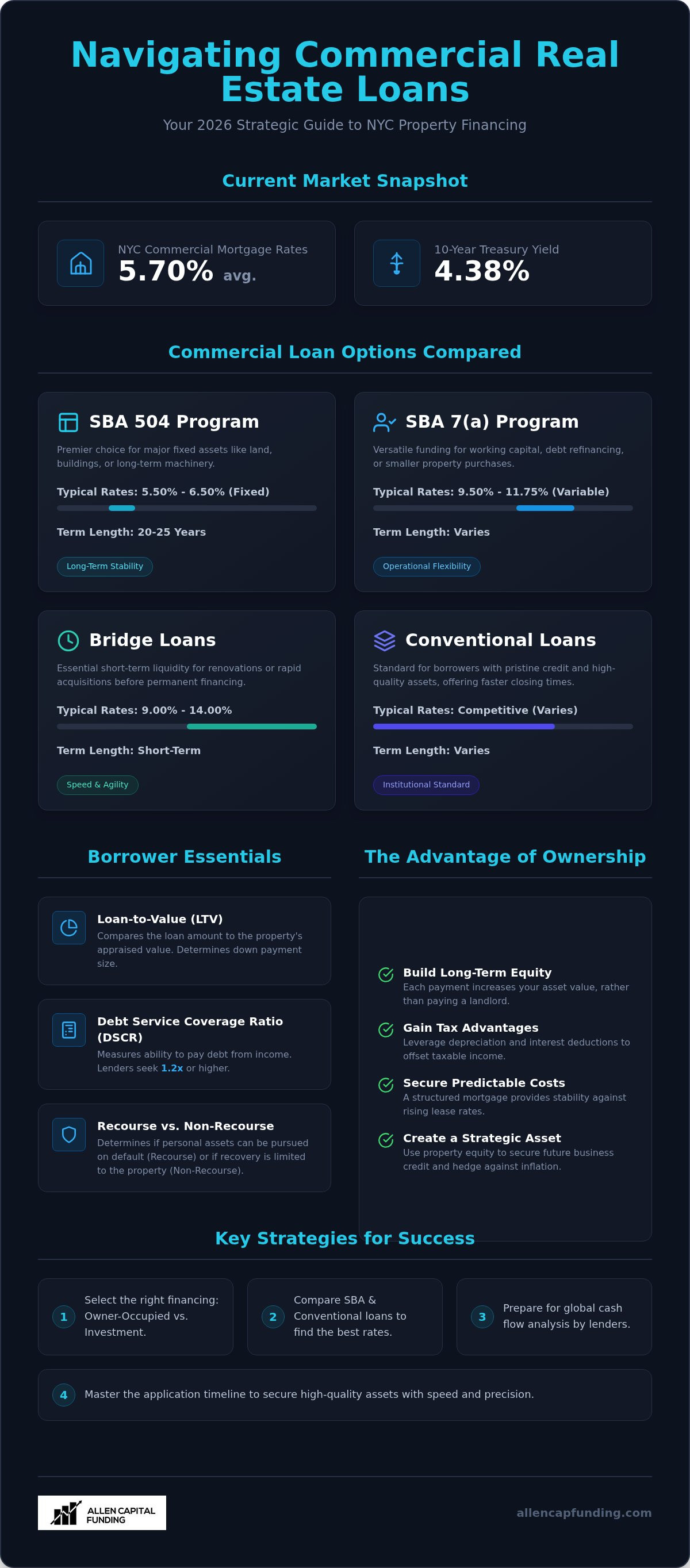
With New York City commercial mortgage rates averaging 5.70% and the 10-year Treasury yield at 4.38%, the margin for error in property financing is thinner than ever. You've likely felt the frustration of high barriers to entry at traditional banks or the anxiety of watching a prime acquisition opportunity fade while waiting for a slow approval. It's common to feel overwhelmed by technical requirements like Debt Service Coverage Ratios (DSCR) and the complexities of commercial real estate loans NY, especially when you need to move with speed and precision.
You deserve a financing partner that acts as a bridge rather than a barrier. This strategic guide promises to demystify the 2026 lending landscape, helping you understand the total cost of capital and how to qualify for competitive funding. We will explore current interest rate trends, compare SBA 504 fixed rates against conventional options, and provide a clear roadmap to streamline your application process for accelerated success.
Table of Contents
Understanding Commercial Real Estate Loans: A 2026 Overview
Commercial real estate (CRE) loans function as debt instruments secured by a lien on a property used for business or income generation. Unlike residential mortgages, a Commercial mortgage is typically evaluated based on the property's income potential or the business's operational strength. In 2026, securing commercial real estate loans NY requires a more calculated approach. Lenders have become increasingly selective, focusing on high-quality assets and robust sponsorships to mitigate risk in a bifurcated market.
Your loan is the foundation of your "capital stack," the total layers of financing used to acquire a property. For most growing businesses, this stack includes senior debt (the CRE loan) and owner equity. Choosing between owner-occupied and investment property financing is your first strategic decision. Owner-occupied loans often offer more favorable terms because the lender views the business's operations as the primary source of repayment. Investment financing, conversely, relies on rental income from third-party tenants, which requires a deeper look at market vacancy rates and tenant creditworthiness.
Why Business Owners Choose CRE Loans Over Leasing
Leasing offers flexibility, but it lacks the long-term wealth creation of ownership. When you own your facility, you build equity with every monthly payment rather than funding a landlord's portfolio. Ownership also provides significant tax advantages. Business owners can often leverage depreciation and interest deductions to offset taxable income, though you should always verify specific benefits with a tax professional. While a lease payment is a fixed expense that usually increases over time, a structured mortgage provides predictable costs and the potential for asset appreciation. It's a move from a sunk cost to a strategic asset.
Key Terminology Every Borrower Must Know
Understanding lender metrics is the best way to prepare for a successful application. These three terms define your borrowing capacity:
Loan-to-Value (LTV): This ratio compares the loan amount to the property's appraised value. Higher LTVs require smaller down payments but often come with stricter terms or higher interest rates.
Debt Service Coverage Ratio (DSCR): This is the primary metric lenders use to measure your ability to pay. It's calculated by dividing Net Operating Income by annual debt obligations. Most mid-market lenders look for a DSCR of at least 1.2x or higher.
Recourse vs. Non-Recourse: Recourse debt allows lenders to pursue your personal assets if the business defaults. Non-recourse debt limits the lender's recovery to the property itself; however, these loans often carry higher interest rates.
Types of Commercial Property Financing for Every Strategy
SBA 504 vs. SBA 7(a): Which Government-Backed Loan is Right?
The SBA 504 program is a premier choice for major fixed assets like land, buildings, or long-term machinery. It offers 20 to 25-year fixed rates, which currently range from 5.50% to 6.50%. This stability is ideal for business owners seeking long-term cost predictability. On the other hand, the SBA 7(a) offers more versatility. It can cover working capital, debt refinancing, or smaller property purchases. While flexible, its variable rates typically range from 9.50% to 11.75%. If your expansion requires both a new facility and a significant stock of goods, consider how Purchase Order Financing for Inventory: A 2026 Guide can work alongside your real estate debt to maintain operational flow.
Conventional Mortgages and Portfolio Lending
Institutional lending remains the standard for borrowers with pristine credit and high-quality assets. Conventional commercial real estate loans NY often bypass the administrative requirements of government programs, offering faster closing times for straightforward deals. As of mid-2026, conventional rates hover between 5.64% and 8.94%. For more complex scenarios, portfolio lenders or private money sources provide unmatched speed. These lenders keep loans on their own balance sheets, which allows them to ignore rigid bank formulas in favor of common-sense underwriting. Whether you choose a fixed-rate structure for security or a floating-rate SOFR-based loan for flexibility, finding the right fit is easier when you start with a Financial Check-Up to assess your current standing.
Qualification Standards: Preparing Your Financial Profile
Many entrepreneurs hesitate to apply for commercial real estate loans NY because they believe their business isn't ready for significant debt. This objection often stems from a lack of clarity regarding how modern lenders evaluate risk. In 2026, the industry has shifted toward "global cash flow" analysis. Rather than looking at the property in a vacuum, lenders assess the combined income and debt of both the business and its owners. This holistic view can often work in your favor if you have strong personal earnings alongside your business operations.
Your personal and business credit scores remain vital components of the approval process. High scores signal reliability and can significantly lower your interest rates. Before you submit a formal application, performing a strategic financial check-up is essential. This proactive step identifies potential red flags in your profile, allowing you to address them before they impact your funding timeline. It's about moving from a state of uncertainty to a position of professional confidence.
The Critical Role of the DSCR Metric
Lenders prioritize the Debt Service Coverage Ratio (DSCR) to ensure you can comfortably handle mortgage payments. You calculate this using a simple formula: Net Operating Income / Total Debt Service. For 2026, most lenders consider a DSCR between 1.2x and 1.35x to be the "safe zone" for approval. If your ratio is lower, you can often improve your standing by reducing operational expenses or increasing the property's gross income through strategic lease renewals. A higher DSCR doesn't just get you approved; it unlocks more competitive interest rates.
Documentation and Transparency Requirements
Transparency is your greatest asset during underwriting. Lenders typically require the "Big Three" financial documents: three years of federal tax returns, current year-to-date Profit and Loss (P&L) statements, and updated Balance Sheets. According to the National Association of REALTORS® and their insights on Commercial Real Estate Lending, thorough documentation is the primary driver of speed in the current market. You'll also need a Personal Financial Statement (PFS) for any owner with a 20% or greater stake. If you're pursuing a new development, a clear business plan detailing your projected timelines and market demand is mandatory.
The Application Process: From Inquiry to Closing
During due diligence, the lender verifies the asset's value and condition. You'll need to prepare for third-party reports, including property appraisals and environmental assessments. In 2026, commercial appraisal fees typically range from $3,500 to $5,000. Environmental reports, specifically Phase I assessments, ensure the land is free from contamination that could create future liability. Final underwriting follows, where the lender's committee reviews every detail before moving to the closing table. You'll want to stay proactive during this stage to ensure no last-minute documentation gaps delay your funding.
Working with a Loan Broker vs. a Direct Lender
Choosing between a direct lender and a broker depends on your internal capacity and the complexity of the deal. Direct lenders offer a single point of contact but are limited to their own specific products. Brokers act as a bridge to multiple capital sources simultaneously, which is often faster for businesses with unique needs. For a deeper analysis, read our guide on Direct Business Lenders vs. Brokers: Choosing the Right Path in 2026. A dedicated origination team saves you time by managing the back-and-forth communication that often stalls complex transactions.
Timeline Expectations for 2026 Closings
A standard closing in New York can take anywhere from 30 to over 90 days. Speed often depends on the type of funding; bridge loans move quickly, while SBA products require more administrative oversight. Common bottlenecks include delays in title searches or waiting for appraiser availability in high-demand markets like Manhattan or Brooklyn. You can keep the process moving efficiently by following this closing checklist:
Provide updated P&L statements within 48 hours of a request.
Budget for New York mortgage recording taxes, which are 1.8% for loans under $500,000 and 1.925% for larger amounts.
Ensure all major owners are available to sign personal financial statements.
Confirm total closing costs, which typically range from 2% to 6% of the purchase price.
If you're ready to secure competitive financing for your next property, connect with us to start your strategic funding plan today.
Strategic Growth: Integrating Real Estate into Your Capital Plan
Property ownership is a powerful hedge against inflation. In 2026, as lease rates in competitive New York markets continue to fluctuate, owning your facility provides a level of cost certainty that a rental agreement simply can't match. When you transition from tenant to owner, you stabilize your largest fixed expense. This move does more than just secure a location; it transforms a monthly cost into a wealth-building tool. Your property becomes a dynamic component of your broader working capital strategy. As you pay down the principal and the asset appreciates, you build a reservoir of equity that serves as a foundation for future expansion. Allen Capital Funding acts as your partner for accelerated success, helping you view commercial real estate loans NY as a strategic vehicle rather than just a liability.
Integrating real estate into your capital plan allows you to leverage your asset for other business needs. Once you've established equity, that value can be used to unlock additional liquidity. It's a proactive approach to growth. Instead of relying solely on cash flow for every new initiative, you can use your property's value to negotiate better terms for other financial products. This creates a cycle of growth where one asset fuels the acquisition of another, moving your business toward a state of permanent stability and increased market share.
Refinancing and Cashing Out Equity
Many commercial loans include balloon payments that require a tactical exit strategy. If you have a maturing note, refinancing allows you to lock in more favorable terms or pull cash out of the property to reinvest in your operations. These proceeds can fund critical needs without diluting your ownership. For example, you might use cash-out equity to secure Commercial Equipment Loans: A Strategic Guide shows how this capital can modernize your production line. Additionally, real estate equity often serves as the primary collateral for flexible business lines of credit, providing a safety net for seasonal shifts or unexpected opportunities.
Next Steps: Your Consultation with Allen Capital
Our team takes a personalized approach to every client's journey. We understand that your business goals are unique, and a one-size-fits-all loan rarely provides the best strategic advantage. We're committed to removing the barriers that often slow down property acquisition for dedicated entrepreneurs. You can book an online consultation to explore tailored funding options that match your specific vision. Let us act as the bridge between your current state and your future success by simplifying the path to capital and providing the expert guidance you need to grow with confidence.
Mastering Your Property Acquisition Strategy
Success in the 2026 market requires moving beyond simple debt to strategic capital integration. By understanding how to optimize your Debt Service Coverage Ratio and selecting between government-backed programs or institutional lending, you position your business for long-term equity growth. Owning your facility does more than stabilize costs; it creates a versatile asset that can fuel future expansion through equity leverage. This shift from leasing to ownership is a fundamental step in protecting your margins against inflation.
Navigating the nuances of commercial real estate loans NY shouldn't be a solitary hurdle for your business. Secure your property's future with a tailored capital strategy at Allen Capital Funding. Our team provides expert guidance on SBA 7(a) and 504 programs along with proactive assistance with documentation and underwriting. Through our nationwide access to diverse lending partners, we act as a dedicated guide to remove barriers and accelerate your progress. Your next acquisition is a major milestone for your company's legacy, and we're ready to help you reach it with confidence.
Frequently Asked Questions
What is the typical down payment for a commercial real estate loan in 2026?
Most lenders require a down payment ranging from 20% to 30% for conventional commercial financing. However, the SBA 504 program remains a popular alternative, allowing eligible business owners to secure property with as little as 10% down. Your specific requirement will depend on the property type, your financial profile, and whether the asset is owner-occupied or an investment.
How does a commercial mortgage differ from a residential mortgage?
Commercial mortgages are secured by business-purpose property and evaluated primarily on the asset's income potential or the business's cash flow. Unlike 30-year fixed residential loans, commercial debt often features shorter terms of five to ten years with balloon payments. Underwriting is significantly more complex, focusing on debt coverage ratios rather than just personal debt-to-income levels.
Can I get a commercial real estate loan with a lower credit score?
You can secure commercial real estate loans NY with a lower credit score by emphasizing strong property cash flow or providing additional collateral. While a lower score might result in higher interest rates or a higher down payment, many private and portfolio lenders prioritize the asset's performance. Demonstrating a solid business plan and consistent revenue can often mitigate personal credit challenges.
What is a DSCR and why do lenders care about it?
DSCR stands for Debt Service Coverage Ratio, and it measures your ability to cover annual mortgage payments using the property's net operating income. Lenders use this metric as a primary indicator of risk to ensure the property generates enough cash to pay the debt comfortably. In the 2026 lending environment, most institutional partners require a minimum ratio of 1.2x to 1.35x.
How long does it typically take to close a commercial property loan?
The closing process typically takes between 30 and 90 days from the initial application. Bridge loans and private capital can often close on the faster end of that spectrum, sometimes in less than a month. Conversely, SBA-backed loans or complex industrial acquisitions often require the full 90-day window due to extensive appraisals, environmental reports, and federal documentation requirements.
Are there prepayment penalties on SBA 504 or 7(a) loans?
SBA 504 loans carry a declining prepayment penalty that typically lasts for the first 10 years of the loan term. For SBA 7(a) loans, penalties generally only apply if the loan has a term of 15 years or longer and is paid off within the first three years. It's vital to review these terms early, as they impact your future ability to refinance or sell the asset.
What types of properties qualify for commercial financing?
Qualifying properties include office buildings, retail centers, industrial warehouses, and multifamily housing with five or more units. Specialized assets like self-storage facilities, hotels, and medical offices also qualify for specific commercial real estate loans NY. Lenders generally prefer "general purpose" buildings that are easier to re-lease, though they provide specialized products for unique business facilities.
Should I use a broker or go directly to a bank for my property loan?
Using a broker provides access to a much wider range of capital products and specialized lenders that don't deal directly with the public. While a bank is a good option for those with long-standing institutional relationships, a broker can compare multiple offers simultaneously to find the most competitive rate. This approach often saves time and ensures your capital stack is optimized for your specific growth goals.


Comments