


Business Line of Credit vs. Working Capital Loan: 2026 Guide for New Businesses
- anthonyarallen
- Jul 14
- 11 min read
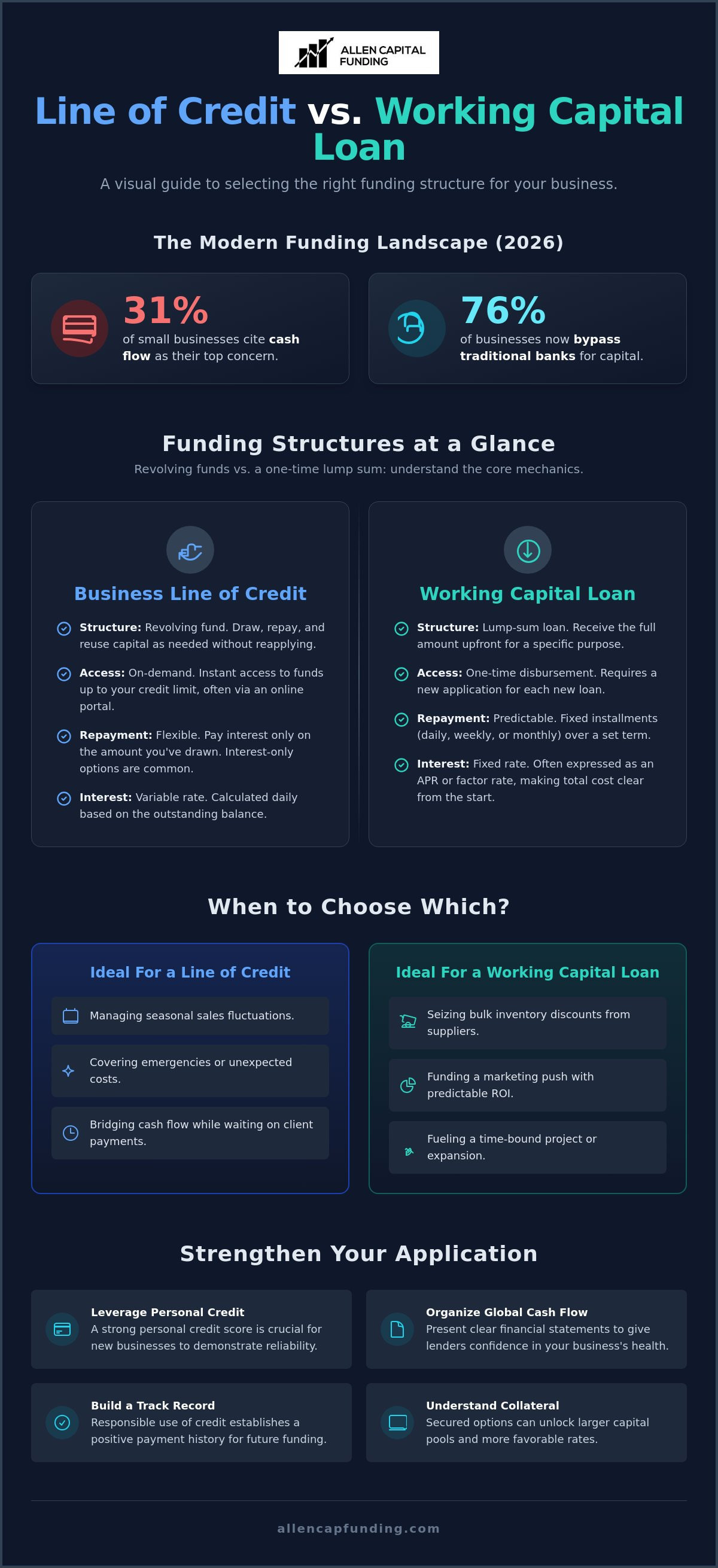
Did you know that for the first time, cash flow has surpassed inflation as the top concern for 31% of small business owners in 2026? It's a reality that makes choosing the right financing more critical than ever. When you're weighing a business line of credit vs working capital loan, the decision isn't just about finding the lowest rate. It's about selecting a structure that protects your equity and fuels your specific cash cycle. With over 76% of businesses now bypassing traditional banks for capital, you're likely looking for a partner who understands the speed of modern commerce.
We understand the frustration of high rejection rates and the confusion that comes with complex debt structures. This guide clarifies the critical differences between revolving lines and lump-sum loans to help you choose the most strategic funding for your growth. We'll preview the current 2026 interest rates, explain how to qualify with varied credit profiles, and show you how to build a lasting relationship with a funding partner. You'll gain the clarity needed to minimize interest costs and secure the flexible capital your business deserves.
Table of Contents
What is the Difference Between a Business Line of Credit and a Working Capital Loan?
Choosing the right financial instrument is a foundational step for any emerging enterprise. While both options provide the liquidity needed to keep operations running, they function in fundamentally different ways. A business line of credit acts as a revolving pool of funds. You draw what you need, pay it back, and the limit becomes available again. Conversely, a working capital loan delivers a one-time lump-sum disbursement. This is intended to bridge immediate gaps or fund specific, time-bound projects. Understanding the nuances of a business line of credit vs working capital loan helps you build corporate credit while maintaining a healthy balance sheet.
For new businesses, these tools aren't just about spending; they're about establishing a track record. Lenders look for consistency and reliability. By using these products responsibly, you demonstrate to the financial community that your business is a safe bet for larger future investments. This early stage of debt management is where you define your company's creditworthiness for years to come.
Understanding the Business Line of Credit
This option provides maximum flexibility. Think of it as a financial safety net that sits in the background until you need it. You only pay interest on the amount you actually draw, not the total credit limit. Many lenders offer interest-only payment options, which keeps your monthly obligations low during lean times. It's the ideal solution for managing seasonal fluctuations or covering expenses while waiting for late-paying clients to settle their invoices. For a deeper dive into the mechanics, you can research What is a Business Line of Credit? to see how these revolving structures operate across different industries. Because it's revolving, you don't have to reapply every time you need cash. Once you're approved, the capital is there whenever an opportunity or an emergency arises.
Defining the Working Capital Loan
Unlike revolving credit, a working capital loan provides a predictable repayment schedule. You receive the full amount upfront and repay it in fixed installments. This structure is particularly useful for purpose-driven funding. If you need to make a large bulk order of inventory at a discount or launch a specific marketing push, a term loan provides the necessary cash injection. It's a strategic tool for expansion that allows you to calculate your exact return on investment before you even sign the contract. These loans often have shorter terms than traditional equipment or real estate loans, making them a fast way to address immediate operational needs without long-term debt hanging over the company's future. By focusing on a specific outcome, you ensure that every dollar borrowed contributes directly to your bottom line.
Mechanics and Flexibility: Comparing the Two Structures
The operational reality of a business line of credit vs working capital loan often comes down to how quickly you can access cash and how that debt sits on your books. A line of credit offers instant access once the initial approval is complete. You can draw funds through an online portal or a mobile app, making it highly responsive to immediate needs. A working capital loan requires a separate application process for every new disbursement. While this might seem slower, it forces a level of financial discipline that prevents over-leveraging for non-essential costs.
Collateral requirements also vary significantly between these two structures. Many new businesses seek unsecured options to avoid tying up personal or business assets. However, unsecured funding typically carries higher interest rates and shorter repayment windows. If you have equipment or real estate to leverage, secured options can unlock larger capital pools at more favorable rates. You should carefully review the working capital loan requirements to see which structure aligns with your available assets and long-term risk tolerance.
How Interest is Calculated
Interest for a line of credit is typically calculated on a daily basis based on your outstanding balance. If you borrow $10,000 on Monday and pay it back by Friday, you only owe five days of interest. For working capital loans, the total cost of capital is usually expressed as an APR or a fixed factor rate applied to the original lump sum. This makes the total cost predictable from day one. It's also important to remember that draw fees, which often range from 1% to 3% of the amount taken, can significantly increase the effective cost of a line of credit over time. Understanding these nuances helps you manage your monthly burn rate without surprises.
Flexibility vs. Predictability
A line of credit provides the ultimate flexibility for unknown future costs. It's the "just in case" capital that stays ready for emergencies. On the other hand, many entrepreneurs prefer the psychological benefit of a fixed repayment schedule. Knowing exactly what will leave your bank account every week or month simplifies budgeting and cash flow forecasting. As you explore Qualification Strategies for Early-Stage Companies, you'll see that the choice often depends on whether your upcoming expenses are specific or speculative. If you're ready to see which structure fits your current growth trajectory, reviewing your options with a consultant can clarify the most strategic path forward.
The New Business Comparison: When to Choose Which?
Deciding between a business line of credit vs working capital loan often depends on the specific event triggering your need for cash. While both options provide liquidity, they solve different operational problems. To make the most strategic choice, you must look at the nature of the expense. Is it a recurring fluctuation or a one-time growth opportunity? Mapping your needs to the correct structure ensures you don't overpay for capital or find yourself short during a crisis.
Scenario A: Managing Payroll. If you're facing a slow month where receivables are delayed but employees still need to be paid, a line of credit is the superior tool. It bridges the gap without committing you to a long-term debt schedule.
Scenario B: Bulk Inventory Discounts. When a supplier offers a significant price break for a large one-time purchase, a working capital loan provides the necessary lump sum. The discount often offsets the cost of the loan, creating a clear profit margin.
Scenario C: High-ROI Marketing. Launching a six-month campaign with predictable customer acquisition costs is a job for a working capital loan. You receive the full budget upfront to fuel the push and repay it as the new revenue flows in.
Scenario D: Emergency Repairs. Unforeseen equipment failure requires immediate action. Having a line of credit ready allows you to pay for repairs instantly, preventing costly downtime.
Strategic Use Cases for Startups
Startups often use a business line of credit as a proactive credit cushion. By securing the facility before an emergency strikes, you ensure liquidity is available on your terms. This is particularly effective for accounts receivable financing, where you draw against the value of outstanding invoices to maintain momentum. Conversely, working capital loans are best used to scale operations during peak demand. If your data shows a massive seasonal spike, taking a lump sum to hire temporary staff or increase production capacity can help you capture every available dollar of market share.
Avoiding Common Funding Mistakes
Misaligning your debt structure with your assets is a frequent error. Never use a short-term line of credit for long-term asset purchases like real estate. The variable rates and repayment pressure can strain your daily operations. Similarly, over-borrowing on a term loan leads to unnecessary interest expenses that eat into your margins. Always ensure your funding choice aligns with your 2026 growth projections. If your revenue isn't expected to scale alongside your repayments, you may be better off with the flexibility of a revolving draw rather than a fixed installment plan.
Qualification Strategies for Early-Stage Companies
Securing capital for a new business is notoriously difficult because traditional banks often demand three years of tax returns and audited financials. This standard effectively locks out startups and companies less than two years old. When comparing a business line of credit vs working capital loan, your qualification strategy must focus on proving stability through alternative means. You can overcome a limited business history by highlighting other indicators of financial health and reliability.
Step 1: Strengthen Personal Credit. For early-stage companies, your personal FICO score acts as a proxy for the business's reliability. Aim for a score above 680 to unlock better rates and higher limits.
Step 2: Organize Global Cash Flow. Lenders often look at "global" cash flow, which combines your personal income with the business's revenue. Demonstrating that you have multiple ways to satisfy debt obligations reduces the perceived risk.
Step 3: Prepare a Use of Proceeds Statement. This is vital for working capital requests. You must clearly articulate how the funds will generate revenue, such as "purchasing $20,000 in inventory to fulfill a confirmed purchase order."
Step 4: Leverage Alternative Data. Modern lenders analyze daily bank account balances and merchant processing volumes rather than just annual tax returns. Maintaining consistent, positive daily balances can often outweigh a short time in business.
Credit Requirements in 2026
Lenders now place significant weight on real-time data and specialized business credit reports from agencies like Dun & Bradstreet or Experian Business. Even without a long history, a "clean" report free of late payments or liens is essential. Lenders will also calculate your Debt Service Coverage Ratio (DSCR). The Debt Service Coverage Ratio (DSCR) measures your available cash flow relative to your debt obligations, showing lenders you have the capacity to cover new payments without straining your operations. Understanding this number helps you determine which funding structure is actually affordable for your current stage.
Documentation Checklist
Preparation is the key to speed. You should have three to six months of recent business bank statements and your Articles of Incorporation ready for review. Having these documents organized prevents delays and shows professional competence. A professional Financial Check-Up is often the most effective first step toward a successful draw. This process identifies potential red flags in your profile before you submit an application, allowing you to fix issues and present the strongest possible case to a national network of lenders.
Navigating Capital Solutions with Allen Capital Funding
Allen Capital Funding acts as a strategic bridge in a market where direct lenders often push a single, rigid product. Many business owners feel stuck when choosing between a business line of credit vs working capital loan because they only hear one side of the story. As a brokerage, we offer a distinct advantage. One application opens doors to a national network of dozens of specialized partners. This ensures you aren't forced into a generic structure that doesn't align with your specific cash cycle or growth goals.
We focus on tailored funding because your business model is unique. A retail shop managing seasonal inventory has different capital needs than a B2B service firm awaiting client payments. Our dedicated team works to simplify the business line of credit vs working capital loan comparison by evaluating your long-term objectives. We look beyond the immediate need for cash to foster a partnership driven by expert guidance and professional confidence. This collaborative approach removes the barriers to your progress and sets the stage for accelerated success.
Beyond the 'No' of Traditional Banks
Traditional banks frequently decline applications from businesses with less than two years of history or varied credit profiles. We find solutions where others see dead ends. Our expertise includes matching new owners with SBA loans, which provide longer terms and lower rates than many alternative products. If your cash flow is still developing but your balance sheet holds value, we can explore asset-based lending to unlock liquidity. By leveraging your equipment or inventory, you can secure the capital needed to maintain momentum without the stringent requirements of a local branch.
Getting Started with Your Funding Strategy
Securing your business's future starts with a clear, methodical plan. You can book a consultation to explore capital options that are specifically tailored to your 2026 growth projections. During the initial financial review process, our consultants analyze your current state to identify the most efficient path forward. You'll receive a broad overview of available capabilities and specific categories of assistance that match your needs. This streamlined progression respects your time and delivers the clarity you need to move forward. Take the next step toward a strategic financial partnership and unlock your company's full potential.
Empower Your Growth Strategy Today
Choosing between a business line of credit vs working capital loan is a pivotal decision that defines your company's liquidity and credit trajectory. Revolving credit provides a vital safety net for operational fluctuations, while structured term loans fuel targeted expansion projects. The right choice protects your equity and ensures you don't overpay for the capital you need. By aligning your debt structure with your specific cash cycle, you position your startup for long-term stability in a competitive 2026 market.
Allen Capital Funding provides the expert guidance you need to navigate these complex financial options. Our national network of lending partners allows us to deliver tailored solutions for every growth stage. We specialize in SBA loans and credit lines, ensuring you find the most strategic fit for your unique business model. Book a Strategic Consultation with Allen Capital Funding to unlock the capital your business deserves. Your path to accelerated success starts with a dedicated financial partner by your side.
Frequently Asked Questions
Can I get a business line of credit for a new business with no revenue?
When weighing a business line of credit vs working capital loan, remember that most lenders require at least six months of revenue. It's very difficult to secure revolving credit with zero income. Startups without revenue may need to explore equipment financing or options backed by personal guarantees. Revenue serves as the primary proof that you can manage and repay a revolving debt facility safely.
Is a working capital loan easier to get than a line of credit?
Yes, working capital loans are often more accessible for early-stage companies with shorter histories. Alternative lenders frequently prioritize your daily bank account activity and merchant volume over long-term credit scores. This structure provides a lump sum that is easier to approve than a permanent revolving credit facility. It's a fast way to secure cash when your business is still scaling.
What are the typical interest rates for business credit lines in 2026?
In July 2026, interest rates for SBA lines typically range from 9.0% to 11.5% APR. Traditional bank lines often start around 8.25% for highly qualified borrowers. Online lenders offer a broader range, which can reach much higher depending on your creditworthiness. You only pay interest on the capital you actually use, which makes this a cost-effective choice for many growing enterprises.
Do I need to provide collateral for a working capital loan?
Not always. Many working capital loans are unsecured, meaning they don't require physical assets like real estate or equipment. Lenders may instead use a personal guarantee or a general lien on business assets to secure the debt. Secured options are also available and often provide lower interest rates for businesses that have tangible assets to leverage during the application process.
How long does it take to get funded for a line of credit?
Funding times vary based on the lender you choose. Online platforms can often provide approval and access to funds within 24 to 48 hours. Traditional banks typically take several weeks for the initial setup and documentation review. Once your account is established, drawing funds from your credit line is usually instantaneous through a digital portal or mobile business banking app.
Will applying for these loans hurt my personal credit score?
The application process for a business line of credit vs working capital loan typically begins with a soft credit pull. This initial check won't impact your score. A hard inquiry only happens when you move forward with a formal offer, which may cause a temporary, minor dip. Consistent, on-time repayments on your business debt can actually strengthen your overall credit profile over the long term.
Can I have both a line of credit and a working capital loan at the same time?
Yes, you can utilize both funding types simultaneously to support different areas of your business. This is a common strategy for growth-focused companies that need to balance daily costs with long-term investments. You might use a term loan for a major expansion while keeping a line of credit open for seasonal dips. Lenders will simply verify your total cash flow is sufficient to manage both payments.


Comments